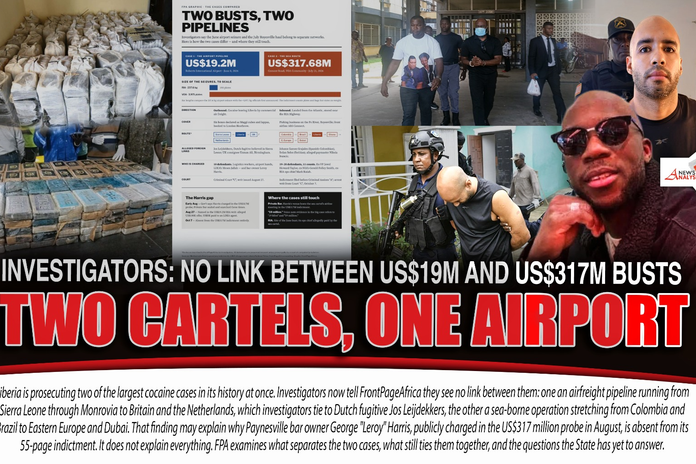
Monrovia — Moses Jallah, the former Liberia Drug Enforcement Agency (LDEA) deputy commander at Roberts International Airport, has been rearrested after allegedly attempting to leave Liberia through the same airport where 237.6 kilograms of cocaine, valued at approximately US$19.2 million, were seized.
By Gerald C. Koinyeneh
Jallah was taken back into custody and brought before the Monrovia City Court on Monday, August 10, after authorities received information that he had attempted to board an outbound flight while already facing criminal charges stemming from the cocaine investigation.
His rearrest adds a new twist to a case that has already raised questions about how a massive cocaine shipment passed through Liberia’s main international gateway and who may have been positioned to facilitate its movement.
Jallah was previously charged by the Ministry of Justice’s Special Investigation Team with obstructing law enforcement, interfering with a government function and tampering with a criminal investigation.
Those charges do not accuse him of trafficking cocaine. However, investigators have linked his alleged conduct to efforts surrounding the attempted export of the 237.6 kilograms of suspected cocaine.
Prosecutors are now weighing whether the evidence supports additional allegations involving trafficking, facilitation or conspiracy. As of Monday, no such amended charge had been filed against him.
Such a development would substantially change Jallah’s position in the case—from an official accused of interfering with an investigation to a potential participant in the broader cocaine operation.
The Shipment That Triggered the Investigation
The case began with six cargo boxes presented at Roberts International Airport as general merchandise, including lappas and Maggi cubes, and destined for England.
Airport screeners reportedly detected discrepancies between the declared weight of the shipment and what appeared on X-ray images. A physical inspection subsequently uncovered a white powdery substance that was later confirmed as cocaine.
Investigators allege Jallah became involved after the discovery, particularly in efforts to have the shipment released.
The investigation identifies businessman George Harris, also known as Leroy Harris, a Paynesville bar operator, as one of the individuals allegedly involved in efforts to secure the release of the cargo.
According to the investigative report, Harris contacted senior security and law enforcement officials, including Jallah, and allegedly offered money in exchange for the release of the shipment.
Investigators further allege that Jallah later met Harris despite knowing of his alleged connection to the cargo.
The report also claims Jallah had prior knowledge of some individuals allegedly linked to the operation but failed to act on the information.
Jallah’s Defense
Jallah disputes the investigators’ account.
In a statement contained in the investigation report, he said he was acting on intelligence from his superiors and reported the approaches made to him to the appropriate authorities.
He said he was offered money to stop the inspection and prevent arrests, but instead passed the information up his chain of command.
Jallah also maintained that he had been gathering intelligence on some of the individuals who were later implicated in the cocaine case.
The Special Investigation Team, however, concluded that his explanation did not remove his potential criminal liability and recommended that he face prosecution.
How Did He Get to the Departure Gate?
Jallah’s alleged attempt to leave Liberia now presents investigators with another question: How did an official already charged in connection with the country’s largest cocaine case make it through the departure process at Roberts International Airport?
The question is particularly significant because the airport was itself the scene of the cocaine seizure and because Jallah previously served as an LDEA commander there.
Authorities will now have to determine whether he was subject to any travel restriction, whether immigration officials were aware of his pending case, and how far he had progressed in the departure process before being intercepted.
Beyond the airport incident, prosecutors face a broader task: determining exactly what Jallah knew, when he knew it and whether his actions after the cocaine was discovered were intended to facilitate the shipment or interfere with its seizure and investigation.
For now, Jallah has not been charged with cocaine trafficking, facilitation or conspiracy.
He remains presumed innocent unless proven guilty by a court of competent jurisdiction.
Support Independent Journalism
Your support helps FrontPage Africa continue delivering independent, credible, and impactful journalism. Every contribution strengthens our ability to investigate, inform, and hold power accountable while keeping quality journalism accessible to our readers.
Support our journalism or subscribe to receive the latest FrontPage Africa stories and updates.