MONROVIA, Liberia — In late August, two pregnant women walked out of Monrovia Central Prison, the overcrowded jail on the Atlantic shore that Liberians call South Beach. Kebbeh Pewee and Annie Kollie had been held there while awaiting the outcome of their cases.
By Rodney D. Sieh
Their release drew attention only because of who was in the same prison. Former Vice President Jewel Howard-Taylor, jailed in Liberia’s largest-ever cocaine investigation, had met the women inside. Her office said she had helped pay for their freedom. The Ministry of Justice said a judge had already ordered them released.
Whichever account is right, the episode showed something that rarely makes headlines. For most Liberians caught up in the justice system, the problem is not a high-profile trial. It is waiting — for a hearing, a lawyer, a judge, a ruling — often without the money to make the wait shorter.
Now some of the people best placed to know are saying so in public: Liberia’s own judges.
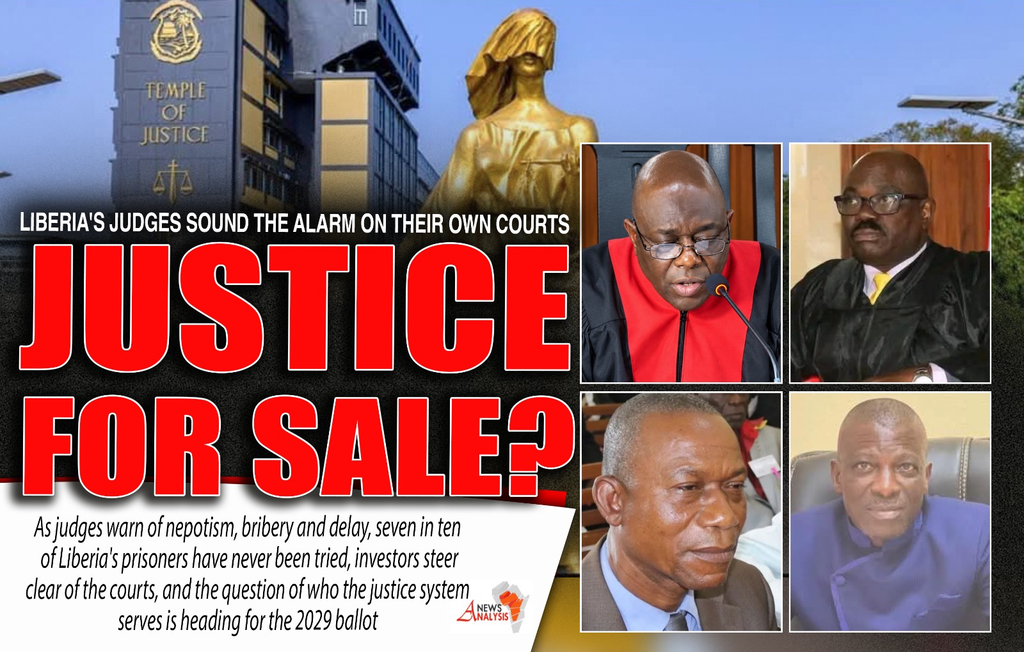
Opening the November 2026 court term in counties across the country, several circuit judges used their formal addresses to warn that corruption, favouritism, political interference and delay are eating away at public trust in the courts.
‘No Judge Is Above the Constitution’
In Liberia, each quarterly court term opens with a formal speech, known as a “charge”, in which the presiding judge reflects on the state of justice. Most are ceremonial. This month’s were not.
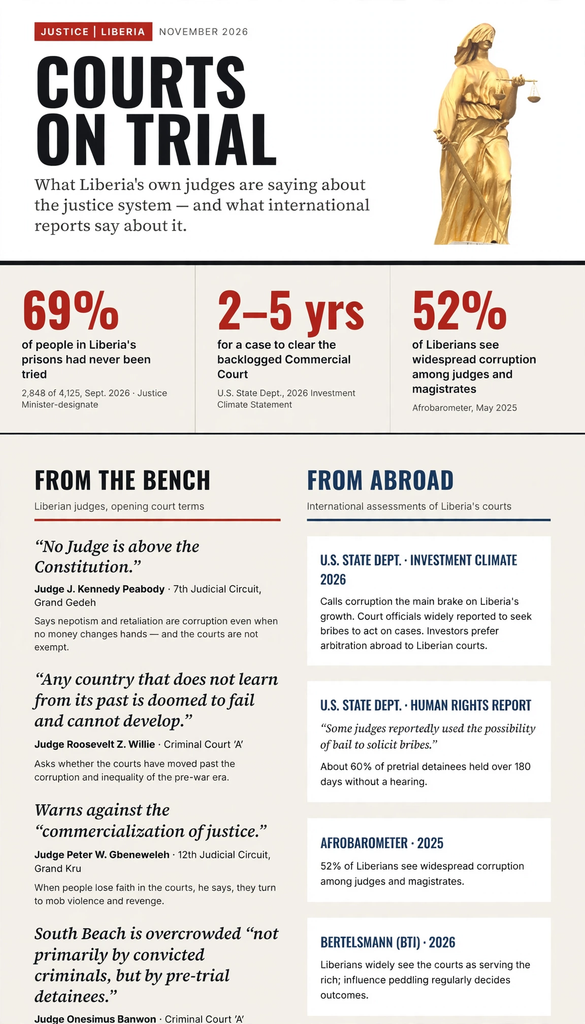
In Zwedru, the capital of Grand Gedeh County near the border with Côte d’Ivoire, Circuit Judge J. Kennedy Peabody said that filling state jobs with relatives and fellow tribesmen, and punishing staff who disagree, is corruption even when no money changes hands. Then he turned to his own branch.
“No Minister is above the Constitution. No Superintendent is above the Constitution. No Judge is above the
Constitution,” he said. “We cannot condemn retaliation in government institutions while tolerating retaliation within the justice system.”
In Monrovia, Judge Roosevelt Z. Willie of Criminal Court ‘A’ asked whether Liberia had learned anything from the failures of its justice system before the 14-year civil war. He revisited a 2006 International Crisis Group report that listed corruption, unqualified judicial staff, poor pay and a system in which money and political influence decided how citizens were treated. “Any country that does not learn from its past is doomed to fail,” he warned.
In Grand Kru County, on the south-east coast, Judge Peter W. Gbeneweleh cautioned against what he called the commercialization of justice. When people believe the courts are for sale, he said, they turn to mob violence, revenge and other forms of self-help.
They were not the first. In August, Judge Onesimus Banwon of Criminal Court ‘A’ — the same judge who ordered the two pregnant women freed — described South Beach as dangerously overcrowded, “not primarily by convicted criminals, but by pre-trial detainees.”
At the Bottom of the Pile
Liberia’s Constitution says an arrested person must be brought before a court within 48 hours and is presumed innocent. The numbers tell a different story.
As of September 2026, 2,848 of the 4,125 people held in Liberia’s prisons — about 69 per cent — had never been tried, according to Betty M. Lamin-Blamo, the nominee for Minister of Justice, who gave the figures at her Senate confirmation hearing last month. Some had not even been indicted. At South Beach alone, 1,312 of roughly 1,888 inmates were awaiting trial.
“These figures fall hardest on the poor, who cannot afford a lawyer or a bond,” she told senators.
The U.S. State Department’s most recent human rights report on Liberia, released in August 2025, found that about 60 per cent of pretrial detainees were held for more than two terms of court — roughly 180 days — without a hearing. It reported that some judges used the possibility of bail to solicit bribes, and that some magistrates asked complainants for money to transport the accused to and from detention.
For the poor, relief often comes from charity rather than the state. In October, a legal aid clinic run by the United Methodist Church secured the release of 63 pretrial detainees from South Beach through the judiciary’s Magistrate Sitting Program, which sends magistrates to hear cases of people held without trial.
The same pattern runs through everyday disputes over debts, wages and, above all, land. Less than a quarter of Liberia’s land is formally registered, according to the Liberia Land Authority, and conflicting deeds are common. A family fighting to keep a plot of land can spend years in court.
The public has noticed.
Afrobarometer, the independent pan-African survey network, found in its most recent Liberia survey, released in May 2025, that 52 per cent of Liberians see widespread corruption among judges and magistrates. The Bertelsmann Transformation Index, a German assessment of governance worldwide, says in its 2026 report that Liberians widely see their courts as serving the rich, and that influence peddling regularly decides cases.
Questions for the Top of the System
The circuit judges spoke from the lower courts. Their warnings point upward, to the five-member Supreme Court and the leadership of the judiciary.
Chief Justice Yamie Quiqui Gbeisay took office in August 2025, promising to tackle inefficiency, corruption and malpractice in the courts. More than a year later, judges in his own system are saying publicly that those problems persist.
The clearest test of the Court’s authority remains unresolved. On April 16, 2026, a Supreme Court justice ordered the House of Representatives to halt proceedings against Yekeh Kolubah, an outspoken lawmaker. The next day, the House expelled him anyway.
The Court’s own marshal had delivered the order to the offices of the Speaker and the Chief Clerk, where a receptionist and a computer operator received it. In May, the justice in chambers ruled that the House had not been properly served. The full bench heard Kolubah’s appeal on October 22 and reserved its ruling. Seven months after the expulsion, the Court has yet to say clearly whether its own order was defied.
For ordinary Liberians, the lesson is uncomfortable. If the country’s highest court cannot make its own orders stick with the Legislature, what chance does a market trader have of enforcing a judgment against a well-connected landlord?
High-profile criminal cases have raised their own concerns. In July, a court set aside a jury’s acquittal of former Finance Minister Samuel D. Tweah after finding jury misconduct. The arson trial of former House Speaker J. Fonati Koffa ended in a mistrial after the jury was disbanded. Both episodes raised questions about how juries are chosen, protected and supervised.
The U.S. State Department’s 2026 Investment Climate Statement describes a Supreme Court buckling under the volume of appeals, and notes widespread reports that court officials solicit bribes to act on cases.
The make-up of the bench adds another layer. If justices retire at 70 as the Constitution requires, every seat on the Supreme Court will have been filled by President Joseph Boakai by the time Liberians vote in October 2029, or shortly after. Two seats, including the Chief Justice’s, are due to open in the election year itself. A bench appointed entirely by the sitting president could be asked to rule on disputes over that election.
The Price in Lost Investment
The judges’ warnings landed in the same month as a blunt verdict from Washington. The State Department’s 2026 Investment Climate Statement on Liberia, published in early November, calls corruption the main brake on the country’s democratic consolidation and economic growth.
The report says Liberia’s Commercial Court, which hears disputes of US$15,000 and above, is severely backlogged, with cases taking two to five years. Judgments are hard to enforce, especially against government bodies. It notes regular media reports of executive interference in judicial matters.
The cost is not limited to foreign boardrooms. Because collateral is so hard to recover through the courts, the report says, banks demand security worth 150 to 200 per cent of a loan and charge interest of 18 to 25 per cent. That makes credit scarce and expensive for the Liberian shopkeeper or farmer who wants to grow a business.
Foreign companies have found a way around the problem: they avoid Liberian courts altogether. Investment contracts with the government often require arbitration outside the country. A Liberian citizen has no such option.
Liberia’s economy grew 5.1 per cent in 2025. But the investors who bring that growth can take their disputes abroad. Most Liberians are left with the courts their own judges are now warning about.
A Question for 2029
President Boakai came to power in January 2024 promising to fight corruption and restore the rule of law. When Liberians vote in October 2029, the courts are likely to be part of how that promise is judged.
The government points to steps under way. The Liberia Anti-Corruption Commission is pushing for a specialized criminal court for corruption cases, and a proposed amendment would remove the statute of limitations on corruption prosecutions. The Justice Minister-designate has promised to review pretrial detention files nationwide. “The State will either prosecute or release,” she told senators, urging them to pass a bill extending the terms of circuit courts to clear the backlog.
The State Department calls these efforts “nascent”. The judges who spoke this month suggest the deeper problem is not a shortage of laws or programmes, but whether those who run the system — ministers, lawmakers and judges alike — will be held to the rules they enforce on others.
That question matters most at South Beach, where more than 1,300 people presumed innocent are still waiting for their day in court.
Judge Peabody ended his address in Zwedru with a warning meant for every official, including those on the bench. “The public office you occupy is not your inheritance,” he said. “The employees you supervise are not your personal servants. The public funds you administer are not your family wealth.”
Support Independent Journalism
Your support helps FrontPage Africa continue delivering independent, credible, and impactful journalism. Every contribution strengthens our ability to investigate, inform, and hold power accountable while keeping quality journalism accessible to our readers.
Support our journalism or subscribe to receive the latest FrontPage Africa stories and updates.