“A Detailed Report Within Forty-Eight Hours”
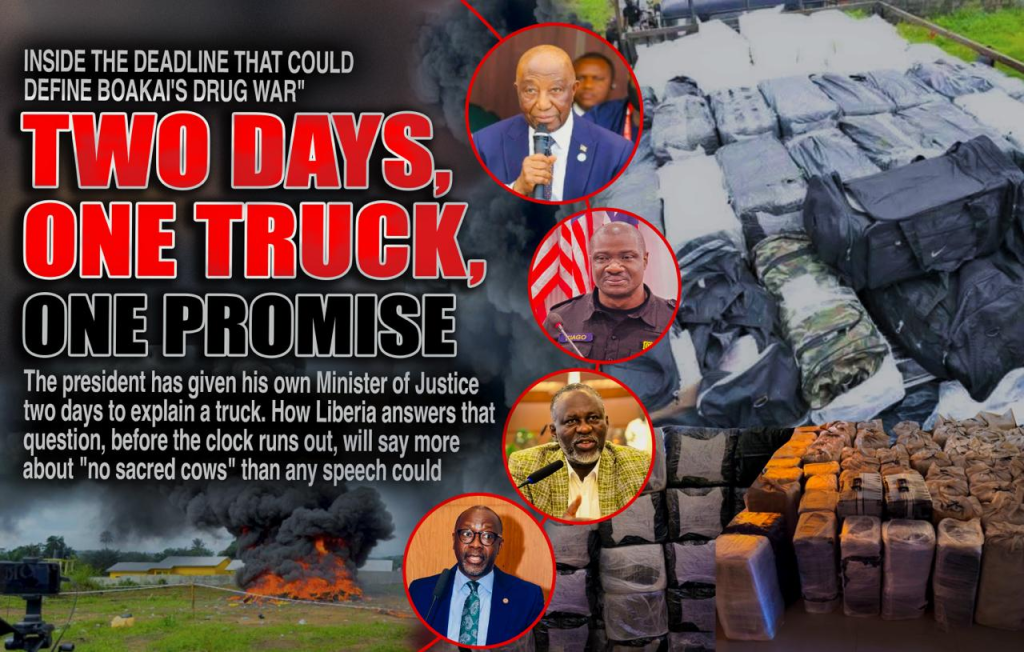
The presidency did not wait for the controversy to cool on its own. The Minister of Justice has been instructed to submit a detailed report to the President within forty-eight hours, a timeline that turns what had been an agency-level dispute into a matter the Executive Mansion is now personally supervising, on the record, with a deadline attached. President Boakai reaffirmed that his administration remains “unwavering in its fight against illegal drugs, organized crime, and corruption,” and emphasized that “no individual or institution is above the law.” He stressed that the investigation must be “thorough, objective, and guided solely by the facts,” and said that upon receiving the report, he would “carefully review its findings and determine the appropriate course of action.”
By Rodney D. Sieh, [email protected]
The move, according to the president’s own framing, comes directly in response to “emerging public allegations and social media reports linking a pickup truck — allegedly connected to a narcotics suspect or trafficker — to the LDEA OIC’s office.” That a matter first raised by an activist on social media has, within days, reached the president’s desk and produced a personal deadline is itself a measure of how seriously this allegation is being taken inside the Executive Mansion — whatever the eventual findings turn out to show.
Biago’s own letter, addressed to the Minister of Justice, frames his recusal in similar terms. He said he was stepping back from his “active duties and functions as head of the LDEA” to preserve “the utmost integrity, transparency, and public trust in the national anti-drug campaign,” and to ensure an “unhindered, credible administrative and security investigation.” Read together, the president’s 48-hour order and Biago’s own recusal letter tell a consistent story: both men, in their own words, are treating this as serious enough to require distance and speed rather than a quiet denial left to stand on its own. Whether the next 48 hours produce a report that matches that seriousness is now the only question that matters.
A Truck, a Wife, and a Bar Owner
The allegation at the center of this week’s storm is specific enough to be either easily disproven or genuinely damaging, which is exactly why it has not gone away. Activist Martin K. N. Kollie says Biago received a Toyota pickup from Leroy Harris, the private bar owner now facing prosecution over alleged cartel ties. Kollie has gone further, claiming a second vehicle was purchased for Biago’s wife, and that this purchase, too, traces back to Harris. He says he has photographs and vehicle-registration records to back the claim — the kind of documentary evidence that, if real, would move this from rumor to something considerably harder to wave away.
The allegation does not arrive in isolation. This newspaper has previously reported that Biago’s own driver maintains close personal ties to Harris — a detail that, if accurate, puts the alleged benefactor only one degree removed from the OIC’s daily orbit. This paper has also previously reported alleged ties between Biago and Michael Brown, a fugitive wanted in connection with drug trafficking. Neither claim has been independently verified by prosecutors or the courts, and Biago has not been charged with any offense connected to either one.
The Agency Pushes Back
The LDEA did not stay quiet. In a statement issued Friday, August 7, the agency called the vehicle allegation “false” and said it is “not supported by any verifiable evidence.” Biago, through the agency, said he “neither received nor accepted” the pickup described in the claim and did not authorize anyone to accept it on his behalf.
The statement struck a dual tone — categorical denial paired with an invitation to scrutiny. “Public officials must remain open to legitimate scrutiny,” it read, urging anyone with credible evidence to bring it to investigators rather than “the court of public opinion.” It closed with a pledge of “zero tolerance for corruption, misconduct, or collusion with criminal networks,” and a warning that unverified claims risk undermining ongoing operations and public confidence in the security services. Kollie was not persuaded. He has argued that the LDEA’s denial sidesteps the specific documentary evidence he says he holds, and has continued pressing the agency to explain, in his words, under what circumstances the vehicle came into Biago’s possession or use.
A Scandal with a Body Count of Its Own
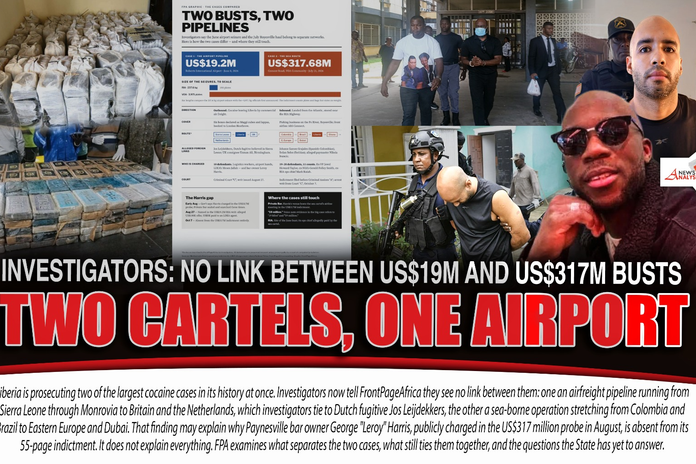
The allegations land at a combustible moment. In June, the LDEA intercepted roughly 237.6 kilograms of cocaine, valued at close to $19.2 million, hidden in cargo boxes at Roberts International Airport — a bust Biago himself hailed at the time as proof that “intelligence-driven operations” and “strengthened interagency cooperation” were paying off. A month later, in July, security forces seized nearly 3,971 kilograms of cocaine in Duazon, one of the largest hauls in the country’s history. Those seizures were meant to be the LDEA’s vindication. Instead, they have become the backdrop against which every question about the agency’s own leadership now gets asked. If the state can find nearly four tons of cocaine in Duazon, critics ask, why can it not resolve a straightforward question about a truck?
The scrutiny of Biago is also inseparable from how he got the job. Montserrado County lawmaker Thomas Fallah — writing through Representative Yekeh Kolubah’s rival, Cllr. Mulbah Morlu Koijee — alleged that the 2024 removal of former LDEA head Abe Kromah was engineered to install a more pliable leadership, and that Biago, then a deputy commissioner working under police official Coleman, was elevated as part of that arrangement. Koijee has petitioned the U.S. Embassy to back an international probe, alleging that a cartel gave vehicles not only to LDEA leadership but to figures closer to the presidency itself. None of those broader claims have been substantiated in court, and Biago has publicly rejected suggestions that he was ever on the verge of resigning over the pressure — a separate rumor the LDEA also moved quickly to knock down earlier this summer.
Konneh: “There Is No Free Lunch”
The political temperature rose further this week when Senator Amara Konneh weighed in with some of the sharpest language yet directed at the presidency over the affair. “An expensive gift, supposedly from the cartel to the chief drug enforcer — who leads the commandant-in-chief’s declared war on the cartel — represents a transaction that clearly undermines the war effort,” Konneh said. “There is no free lunch.”
Konneh called for the arrest and prosecution of “all current and former senior officials who protected the cartel,” and for an independent counsel to work alongside foreign investigators. He framed the moment in stark terms for President Joseph Nyuma Boakai: “President JNB, this Cocainegate is your LD$15 billion Containergate scandal — an issue that could define your presidency and Liberia’s future.” The comparison to Containergate — the LD$15 billion scandal that has already shadowed the administration’s fight against graft — was pointed. It signals that, fairly or not, Cocainegate is being read by some of the president’s critics less as a personnel problem and more as a test of whether the Boakai government can police its own security sector at all.
Who Is Actually Being Chased?
The Biago affair broke into public view the same weekend Senator Nathaniel McGill of Margibi County held a news conference to address what he described as circulating reports that the government was preparing to investigate or arrest him and other former officials of the Coalition for Democratic Change, the party of former President George Weah, in connection with the drug probe. Freshly back from a trip that took him through Europe and Ghana, McGill opened by rejecting the reports outright, telling reporters he had received no call, notice, or contact whatsoever from any government investigative agency. “I don’t associate with drugs,” he said, dismissing the speculation circulating on social media as “stupid” news and “foolish” talk.
McGill argued the reports made little sense set against his own standing inside the current government, pointing to his relationship with Vice President Jeremiah Koung, whom he described as a close friend, and suggesting the entire government and security apparatus around him would be implicated by the same logic if the rumors were true. He invited scrutiny rather than shying from it, telling reporters they were welcome to examine his house and his associates, and pushed back on the idea that a sitting senator should have to answer for online chatter with no formal notice behind it. He pivoted repeatedly back to his work in Margibi County — a hospital project he said he is hoping to see resourced and turned over this year, an ongoing school project in local communities, and a scholarship program supporting students in the county — framing himself as a public servant being distracted from real work by rumor rather than by any actual investigation. This newspaper cannot independently confirm or deny whether any government agency is examining McGill or other former CDC officials; no formal notice, charge, or confirmed investigation involving him has been made public.
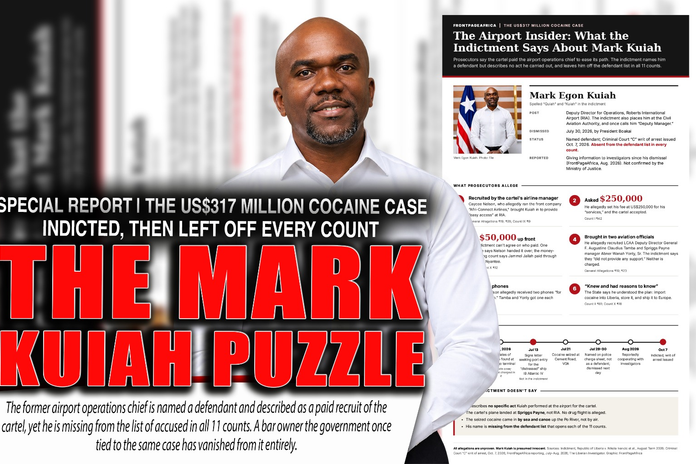
Placed next to the Biago allegations, McGill’s press conference sharpens an uncomfortable comparison. An opposition senator felt compelled to publicly deny an investigation that has not been formally confirmed, while the government’s own drug agency chief faces a specific, documented allegation — a truck, a second vehicle, a name Kollie says he can prove — that has so far been met with denial rather than an independent review of the evidence either side claims to hold. Mark Kuiah remains uncharged more than two weeks after his own dismissal. Inspector General Coleman’s claim that trafficking was “sanctioned at very, very senior level” has never been followed by a name. Now the LDEA’s own leadership is the one asking the public to simply trust its denial.
What Happens Next
For now, the facts in dispute remain exactly that — disputed. Kollie says he has documentary proof. The LDEA says none exists. Biago says he neither received nor sanctioned receipt of the vehicle. No independent body has yet examined the registration records, photographs, or other evidence either side claims to have. That is precisely the gap Konneh, and others want an independent counsel to close.
Until then, Liberia is left with competing narratives about a truck — and a straightforward test of the president’s own words. Boakai did not say there would be no sacred cows except inside his own drug agency, or that the promise applied only to the political opposition and not to the man leading his government’s own war on narcotics. He said no one would be permitted to hide behind “public office… political influence… or any other position of authority.” An opposition senator has already had to answer, publicly and at length, for rumors that have not produced a single formal charge. Liberia’s actual drug chief, facing a specific, documented allegation involving two vehicles and a name Kollie says he can prove, has so far had to answer only with a denial. Whether that gap closes — or simply becomes the latest example of a sacred cow standing exactly where the president said none would be allowed to stand — is now his to decide.
Support Independent Journalism
Your support helps FrontPage Africa continue delivering independent, credible, and impactful journalism. Every contribution strengthens our ability to investigate, inform, and hold power accountable while keeping quality journalism accessible to our readers.
Support our journalism or subscribe to receive the latest FrontPage Africa stories and updates.