Part II
His Excellency Joseph Nyuma Boakai, President of Liberia: On responsible resource management and future generations: “Our natural resources must deliver durable value for the Liberian people,”
Source: Liberia’s Executive Mansion, statement on agreements with TotalEnergies. Read the official statement.
President Boakai: “These agreements, when properly managed, will not only strengthen Liberia’s economy but also create jobs, build skills, and open opportunities that will benefit generations to come.”
By: Austin S Fallah – A True Son of the Planet Earth Soil:[email protected]
His Excellency Mamadi Doumbouya — President of Guinea: In an interview published by Guinea’s Presidency: The President stated: “La Guinée est un pays qui dispose d’importantes ressources naturelles qui suffisent à son développement.” English translation: “Guinea is a country endowed with significant natural resources that are sufficient for its development.” Relevance: Using Guinea’s natural wealth to advance development and improve people’s well-being.
Source: Presidency of the Republic of Guinea — official interview.
The quotation is from a 2022 interview, when Doumbouya headed the transitional government.
His Excellency Julius Maada Bio — President of Sierra Leone: On resource value and sustainable economic development: “Africa will not be the warehouse of the global energy transition. Our continent will be a center of value creation and industrial growth.”
Source: Office of the President of Sierra Leone, remarks at the Vienna Climate and Energy Conference, April 9, 2026.
His Excellency Alassane Ouattara — President of Côte d’Ivoire(Ivory Coast): In his address at the 2017 Africa Green Revolution Forum, President Ouattara discussed agricultural development and the need to protect forests:
“Un autre défi à relever est de maintenir, tout en développant notre agriculture, une cohabitation harmonieuse entre agriculture et forêt”
English translation: “Another challenge is to maintain, while developing our agriculture, a harmonious coexistence between agriculture and forests.” Relevance: Balancing agricultural growth with forest protection, biodiversity, and sustainable land use.Source: Presidency of Côte d’Ivoire — address at the 7th Africa Green Revolution Forum.
Former President of Liberia William V. S. Tubman: In a 1960s address to President Lyndon B. Johnson, Tubman spoke about countries possessing natural resources but lacking the capital and technical expertise to develop them: “These peoples possess the natural resources. They have the will and the desire to work and develop those resources.” Relevance: Natural resources should contribute to people’s well-being and development. Source:This is a quotation from Tubman’s published address.
Former President of Guinea Ahmed Sékou Touré: A 1979 Guinean statement to the United Nations General Assembly, delivered by the country’s delegation, emphasized the importance of protecting nature and managing natural resources rationally: “The rational management and exploitation of water, soil and vegetation resources”
Relevance: Conservation of water, soil, forests, and vegetation across the MRU region. Source:This statement is documented in Guinea’s UN General Debate record.
Former President of Sierra Leone Siaka P. Stevens:
Verified historical source: The 1973 Mano River Declaration, which Stevens signed with Liberian President William R. Tolbert Jr., states that regional progress can be achieved through: Active collaboration and mutual assistance in matters of common interest”
Relevance: Joint management of shared rivers, forests, and other natural resources. This wording comes from the declaration, not a claim that Stevens personally said those exact words.
Former President Félix Houphouët-Boigny of Côte d’Ivoire(Ivory Coast):
The Félix Houphouët-Boigny Foundation for Peace Research preserves a statement attributed to him from December 7, 1971, warning against the destruction of his country’s natural beauty: “Let us keep our dear country from irreparable errors which might in the future cause it to regret its birds and its trees.” Relevance: Protecting biodiversity, forests, wildlife, and natural heritage for future generations.
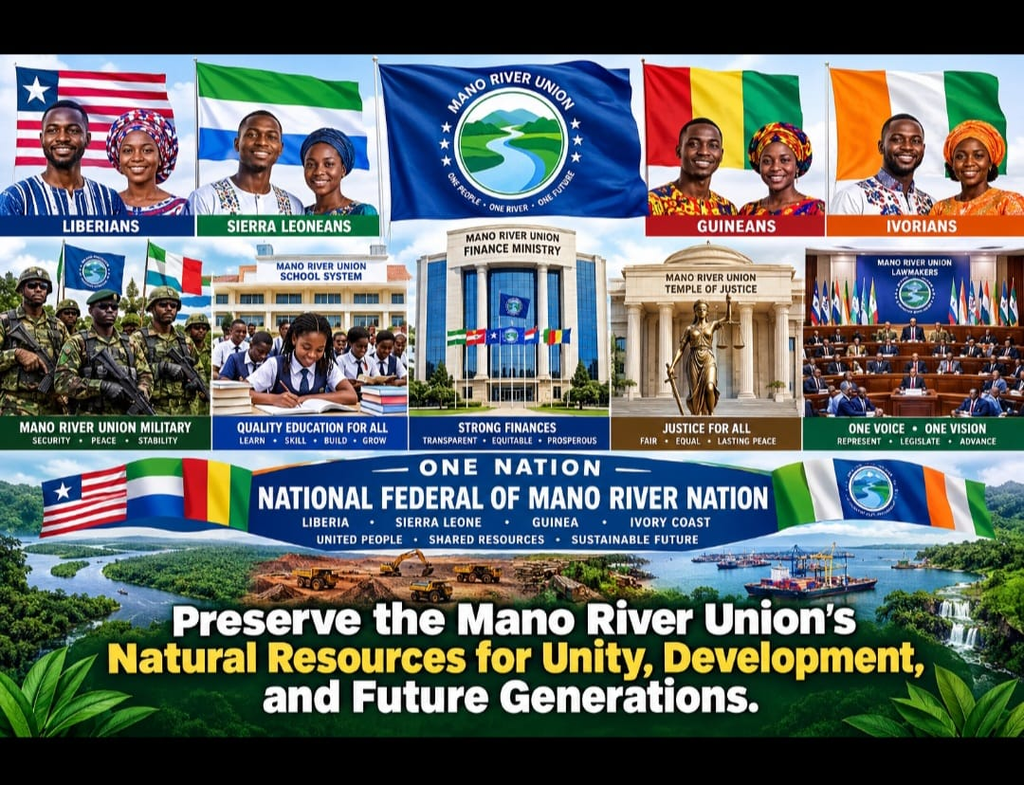
The future of the Mano River Union depends not only on what its member states possess, but also on how wisely they choose to preserve, manage, and share those possessions.
Liberia, Sierra Leone, Guinea, and Côte d’Ivoire are richly endowed with forests, rivers, minerals, fertile farmland, fisheries, and diverse cultures.
Yet natural wealth alone does not guarantee national or regional prosperity.
If resources are extracted carelessly, sold cheaply, or controlled by only a small number of people, they may leave behind damaged land, divided communities, weak institutions, and a future generation with little to inherit.
For this reason, the natural resources of the Mano River Union states must be preserved for the greater good of a united country and for the generations yet to come.
The dream of unity among the Mano River Union countries is not an unrealistic fantasy.
It is rooted in geography, history, language, culture, trade, and kinship.
The people of these four countries have interacted across borders for centuries.
Their communities are connected by common border languages and ethnic identities, including Mende, Kpelleh,Mandingo, Lorma, Kissi, Mano, Gio, Gbandi,Krahn, Grebo, Vai, and many others.
Families, markets, farms, rivers, and traditions often extend across political boundaries that were imposed during colonial times.
These connections make the Mano River Union one of the strongest possible foundations for African integration.
If Africa is to move toward greater unity as one people and eventually as one nation, the Mano River Union can serve as a practical and inspiring place to begin.
However, unity cannot be built on exhausted forests, polluted rivers, abandoned mining towns, and poor citizens.
It must be built on protected resources, accountable governments, regional planning, and a shared commitment to long-term development.
The member states must resist the temptation to deplete their resources for short-term political gain.
Instead, they should establish a common policy of conservation and responsible development that treats the region’s natural wealth as an inheritance held in trust for all people, including unborn generations.
The forests of the Mano River Union are among the region’s most valuable resources.
Liberia and Côte d’Ivoire, in particular, contain important portions of the Upper Guinean Forest, one of the world’s major biodiversity areas.
Sierra Leone and Guinea also possess valuable forests, mountains, watersheds, and wildlife habitats.
These forests provide more than timber. They protect soil, regulate rainfall, store carbon, preserve medicinal plants, support wildlife, and sustain the livelihoods of rural communities.
When forests are cut without proper planning, the results can be severe: erosion increases, rivers become polluted, farms lose fertility, animals disappear, and climate conditions become more unpredictable.
Therefore, the Mano River Union states should not allow uncontrolled logging or the sale of forest concessions that benefit foreign companies more than local people.
Timber can be harvested, but it must be harvested sustainably.
Governments should require replanting, community consultation, transparent contracts, environmental impact assessments, and strict enforcement against illegal logging.
A united Mano River Union environmental authority could monitor forests across national borders and prevent companies from escaping regulations by moving operations from one country to another.
Conservation should not be treated as an obstacle to development.
Rather, it should be understood as the foundation of lasting development.
The same principle applies to mineral resources.
The Mano River region contains iron ore, diamonds, gold, bauxite, rutile, manganese, and other valuable minerals, as researched has shown.
These resources could help finance schools, hospitals, pave roads, water systems, agricultural programs, and technological development.
Yet history has shown that mineral wealth can also create corruption, violence, and inequality when it is poorly managed.
In some parts of West Africa, diamonds and other minerals have been connected to conflict and the suffering of ordinary citizens.
Too often, communities living near mines remain poor while their land is damaged and their water is contaminated.
The solution is not to stop all mining.
The solution is to make mining serve the people.
The governments of Liberia, Sierra Leone, Guinea, and Côte d’Ivoire should develop regional standards for mining contracts, taxes, labor rights, environmental protection, and revenue sharing.
Mining companies should not be allowed to negotiate secret agreements that deprive citizens of their fair share.
Every major contract should be publicly available.
Communities affected by mining should receive direct benefits in the form of schools, clinics, roads, clean water, job training, and compensation for damaged land.
Most importantly, a portion of mineral revenues should be placed in a regional future generations fund.
Such a fund would be an investment in the United Mano River Nations of tomorrow.
Instead of spending every dollar from iron ore, gold, diamonds, or bauxite immediately, the region should save and invest part of the revenue.
The money could be used to build a national capital for a future united Mano River country, support a national army based on regional peace and security, develop educational systems, fund universities, and establish infrastructure that connects all four nations.
This approach would ensure that resources extracted today continue to benefit people fifty or one hundred years from now.
A united region needs physical connections.
One of the most important long-term goals should be the construction of a six- to eight-lane road system known as the National Mano River Union Countries Highway, or the United Mano River Nations Highway.
This highway could connect Liberia, Sierra Leone, Guinea, and Côte d’Ivoire in a roundabout belt, linking capital cities, border towns, agricultural centers, ports, universities, and industrial zones.
It would not simply be a road.
It would be a symbol of unity and a practical tool for economic transformation.
At present, many communities near borders remain isolated.
Farmers may produce rice, cassava, cocoa, coffee, palm oil, fruits, vegetables, fish, or livestock, but they often cannot reach major markets because roads are poor or border procedures are difficult.
Traders lose money through delays, high transportation costs, insecurity, and informal charges.
Students may find it difficult to attend schools or universities in neighboring countries.
Patients may struggle to reach hospitals.
A well-designed regional highway would reduce these barriers and create opportunities for millions of people.
Still, the construction of such a highway must not become an excuse to destroy forests, displace communities, or waste public funds.
It should be planned carefully, using environmental studies and public consultation.
Roads must include drainage systems, bridges, safety measures, rest areas, market centers, and protections for wildlife corridors.
Communities along the route should be involved in the planning process and should benefit through jobs, local contracts, and improved access to services.
Infrastructure should unite people, not harm them.
The idea of a national capital for the future United Mano River Nations also deserves serious consideration.
A shared capital could become a center of government, diplomacy, education, culture, and innovation.
Rather than being designed as a city for political elites, it should be planned as a modern African capital that serves ordinary citizens.
It should include universities, technical institutes, libraries, hospitals, museums, government offices, transportation networks, affordable housing, public parks, and cultural centers.
It should celebrate the history and languages of all the peoples of the Mano River region.
The location of such a capital would need to be determined fairly and peacefully.
It should not be imposed by one country over the others.
A neutral or jointly developed location may be more acceptable than placing the capital in an existing national capital.
The process itself would be a test of regional maturity.
If the four nations can negotiate fairly over a shared capital, they can demonstrate that unity is based on cooperation rather than domination.
Education must also be at the center of this vision.
Natural resources may provide money, but education determines whether that money will be used wisely.
The Mano River Union needs engineers to build roads and bridges, doctors and nurses to strengthen health care, teachers to educate children, scientists to protect forests and rivers, economists to manage public revenue, lawyers to enforce fair contracts, and historians to preserve the region’s heritage.
A united educational system could allow students to move freely among institutions in all four countries.
Universities could specialize in areas that benefit the entire region, such as mining engineering, agriculture, forestry, climate science, public health, peace studies, transportation, and African languages.
The region should also protect and promote its languages and cultures. Unity does not mean that everyone must abandon their identity.
True unity respects diversity while creating a shared political and economic purpose.
Mende, Kpelleh, Lorma, Kissi, Mano, Gio,Gbandi,Mandingo, Krahn, Grebo, Vai, and other languages should be recognized as treasures of the Mano River Union.
They represent centuries of knowledge, oral history, music, trade, family ties, and cultural strength. Schools and media should preserve local languages while also teaching common regional and international languages that allow citizens to communicate across borders.
A united country built on respect for cultural diversity would be stronger than one built on forced uniformity.
Critics may argue that the four Mano River countries have different political systems, economic interests, and national identities.
They may say that regional unity is too difficult or that each country should focus only on its own development.
These concerns should not be dismissed.
Political union requires trust, strong institutions, democratic participation, and careful planning.
It cannot be achieved overnight.
Yet the existence of difficulties does not mean that unity is impossible.
In fact, the very challenges faced by the countries, poverty, unemployment, insecurity, environmental damage, weak infrastructure, and dependence on raw material exports are reasons to cooperate more closely.
The path toward a United Mano River Nations should be gradual.
It may begin with stronger environmental agreements, easier movement for citizens, regional trade policies, shared infrastructure projects, joint educational programs, and coordinated security efforts.
Over time, the member states could build common institutions, such as a regional parliament, development bank, natural-resource commission, and court of justice.
The final goal of political unity should emerge from the consent of the people, not from force.
Citizens must be allowed to participate through dialogue, elections, community meetings, and constitutional processes.
A regional national army, for example, should not be created merely as a military force.
It should be a disciplined institution dedicated to protecting citizens, defending borders, responding to disasters, fighting illegal resource exploitation, and preserving peace.
The painful history of conflict in parts of the Mano River region proves that security must be based on human rights, professional training, civilian oversight, and regional cooperation.
A united security system could help prevent armed groups, smugglers, and illegal mining networks from taking advantage of weak borders.
Ultimately, the preservation of natural resources is not only an environmental issue.
It is a question of justice, sovereignty, unity, and survival.
The forests, rivers, minerals, and fertile lands of the Mano River Union do not belong only to the present generation or to a few powerful officials and corporations.
They belong to the children who will be born tomorrow, to farmers who depend on healthy soil, to students who need schools, to workers who need roads, and to communities that want peace and dignity.
The Mano River Union has the opportunity to become a model for Africa.
Its people are connected by history, common border languages, shared cultures, and economic needs.
By preserving natural resources, investing in education, building the United Mano River Nations Highway, creating transparent institutions, and gradually deepening regional unity, Liberia, Sierra Leone, Guinea, and Côte d’Ivoire can lay the groundwork for one strong and prosperous country.
From the unity of the Mano River Union may come a larger lesson for the entire continent: Africa’s strength is greatest when its people protect their shared wealth and work together for a common future.
Support Independent Journalism
Your support helps FrontPage Africa continue delivering independent, credible, and impactful journalism. Every contribution strengthens our ability to investigate, inform, and hold power accountable while keeping quality journalism accessible to our readers.
Support our journalism or subscribe to receive the latest FrontPage Africa stories and updates.