Part II
His ExecellcyJoseph Nyuma Boakai President of Liberia:
“We must equip our youth with STEM education, digital literacy, and technical training so they become co-creators in the global digital economy, not just consumers.” Relevance: This directly supports your argument that digital literacy is essential to youth empowerment and responsible participation in the digital age.
Source: Embassy of Liberia — President Boakai’s address to the 81st UN General Assembly.
By: Austin S Fallah – A True Son of the Planet Earth Soil: [email protected]
Madam Ellen Johnson Sirleaf, former President of Liberia: “They believe in a democracy of policies, not personality; merit, not money; action, not words.”Relevance: This offers a strong ethical standard for examining online political propaganda, personality-driven politics, and the manipulation of young voters.
Source: Embassy of Liberia — President Sirleaf’s inaugural address following her reelection.
Former President of the Republic of Liberia George Manneh Weah: “Blood should never be the price tag for democracy.”Relevance: This memorable statement reinforces the importance of peaceful political participation, tolerance, and rejecting incitement and political violence, including when amplified through social media.
Source: United Nations Mission in Liberia — Excerpts from President Weah’s inaugural address, January 22, 2018.
The father of true national reconciliation-former President Nelson Mandela of South Africa: “Education is the most powerful weapon which you can use to change the world.” Relevance: Education, critical thinking, and equipping young people to resist manipulation.Source: United Nations — Building on the Legacy of Nelson Mandela. The UN attributes this statement to Mandela’s remarks at the launch of Mindset Network in Johannesburg, July 16, 2003.
Hon.ANTÓNIO GUTERRES · UNITED NATIONS SECRETARY-GENERAL: “A democracy that excludes is no democracy at all.” Relevance: Youth exclusion, unequal participation, and the moral obligation to ensure that young people’s voices matter.
Source: UN Web TV — International Day of Democracy 2025.
Hon. KOFI ANNAN · FORMER UN SECRETARY-GENERAL: “Politics is too important to be left only to politicians. Democracy depends on the lively participation of organized civil society in political life.” Relevance: Civic education, youth engagement, and holding political leaders accountable both online and offline. Source: Kofi Annan Foundation — Elections and Democracy.
Hon. Edward Wesee: “The danger of Liberia’s future is the failure of today to prepare the young people for a better tomorrow.”
Hon. Alexander Torbor Kun: “Why youths of other nations are preparing for a better tomorrow, some Liberian youths, with information at their fingertips, are ill-preparing for tomorrow, but preparing to blame today’s generation, something(information technology age)that we never had.”
Democracy is often described as government by the people, but that definition is incomplete if it refers only to elections, political parties, and constitutional procedures.
A meaningful democracy must also be measured by the quality of life available to ordinary people, especially those with the least power to protect themselves.
It must be judged by whether children can attend school safely, whether families can find food and shelter, whether women and girls can move through society without fear of exploitation, and whether public institutions respond to suffering with compassion rather than indifference.
When governments and societies fail these basic tests, democracy may retain its name while losing its moral substance.
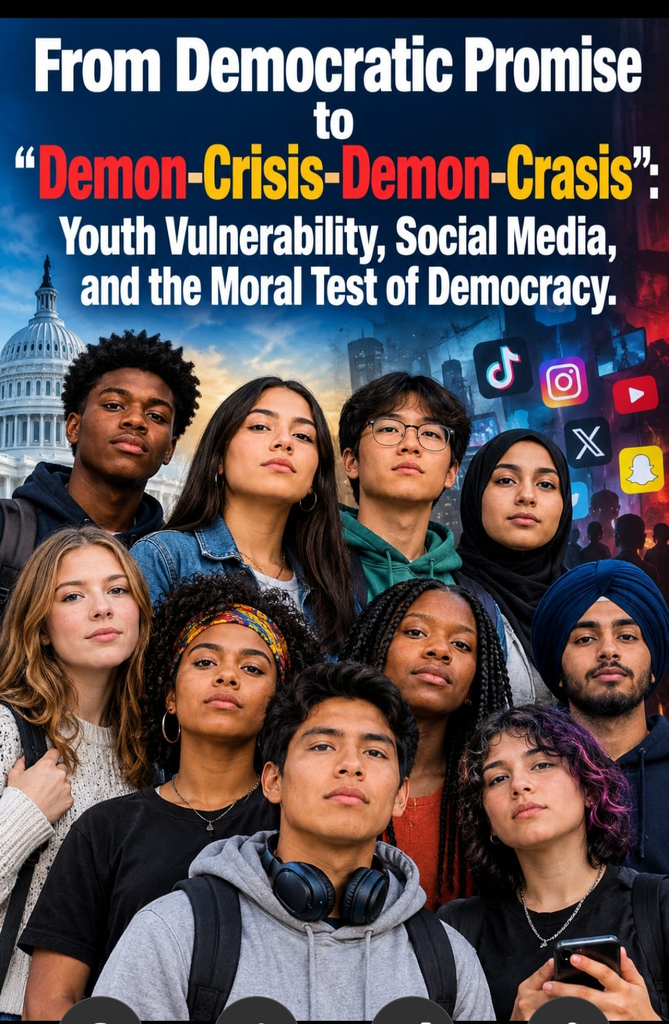
The phrase “demon-crisis-demon-crasis” can be understood as a warning about this degeneration.
It suggests a destructive cycle in which social evils create crises, crises deepen public fear and desperation, and desperate populations become vulnerable to harmful leaders, violent movements, exploitative markets, and dehumanizing ideologies.
In such a cycle, democratic government stops protecting dignity and becomes a system overwhelmed by neglect, division, propaganda, and social decay.
The danger is not merely that democracy may collapse through a military coup or authoritarian takeover.
It may also collapse gradually when citizens lose confidence that democratic institutions can meet their most basic needs.
One of the clearest examples of this danger is the exploitation of girls and young women who enter prostitution or other forms of commercial sexual exploitation as a means of survival.
Across many parts of the world, girls under eighteen face poverty, empty-spewing propaganda, displacement, lack of education, and limited employment opportunities.
Some are coerced or trafficked; others make constrained choices in situations where hunger, homelessness, debt, or the need to support relatives leaves them with few alternatives.
It is important to speak precisely: children cannot meaningfully consent to commercial sexual exploitation, and blaming them for their circumstances compounds the injustice they already experience.
The real responsibility lies with the systems that fail to protect them and with those who profit from their vulnerability.
When a girl must exchange her safety, privacy, or future for food, rent, school fees, or medical care for her family, society has failed long before she reaches that point.
Her situation reveals more than individual misfortune.
It reveals structural weakness: inadequate schools, limited health care, unemployment, corruption, gender discrimination, domestic violence, weak child-protection systems, and the absence of reliable social support.
A nation may proudly conduct itself, but its protections are hollow if children are pushed into conditions of exploitation.
Democracy cannot be separated from social responsibility.
The relationship between poverty and exploitation is especially significant because poverty does not simply limit material choices; it also weakens political voice.
Families living in extreme hardship are often too occupied with daily survival to participate fully in civic life.
They may not have time to attend community meetings, contact elected representatives, follow policy debates, or organize for reform.
Their children may leave school early and therefore enter adulthood without the educational tools needed to advocate for themselves.
This creates a political imbalance: the wealthy and secure can make their voices heard, while those who suffer most from public failures are often least able to influence public decisions.
A democracy that intends to prevent this imbalance must do more than condemn exploitation after it happens.
It must create conditions for young people to develop into capable, respected, and independent citizens.
That requires investment in universal education, particularly for girls; affordable health care; housing support; nutrition programs; employment training; mental-health services; and strong protections against trafficking and abuse.
It also requires institutions that families can trust. Police officers, teachers, social workers, and judges must be trained to protect children, not punish or stigmatize them.
A girl who seeks help should encounter safety and opportunity, not humiliation.
Education deserves particular emphasis because it is both a right and a form of democratic infrastructure.
Schools do not merely teach reading, mathematics, and science.
At their best, they teach young people to reason, cooperate, question authority responsibly, and imagine futures beyond the limits poverty imposes.
When girls stay in school, they are more likely to access information about health, work, and legal rights.
They are better positioned to partheir participate in their communities and to resist those who seek to exploit them.
Yet education alone cannot solve the problem if families cannot afford transportation, uniforms, meals, or basic living expenses.
Public policy must therefore address the full economic reality that drives children out of school.
The second half of the first century should give democracy a fuller and more humane meaning.
The world has made extraordinary technological progress, but technological advancement is not the same as moral progress.
A society may have artificial intelligence, instant communication, space exploration, and global efforts while still tolerating child exploitation and widespread deprivation.
The central question is whether humanity will use its resources to expand human dignity or to concentrate wealth, manipulate public opinion, and deepen inequality.
Democracy must become not only a way to select leaders but also a commitment to ensuring every person has a realistic chance to live safely and contribute meaningfully.
Social media will play a crucial role in determining which direction democracy takes.
Digital platforms have transformed the way people communicate, organize, learn, and participate in public life.
A young person in a remote community can now access educational resources, share experiences, connect with advocates, and call attention to injustice in ways that were possible only a few decades ago.
Social media can expose corruption, document abuses, raise awareness when poverty becomes a crisis, build solidarity across national borders, and give survivors of exploitation a platform to speak when traditional institutions have ignored them.
However, the same platforms can also intensify the “demon-crisis-demon-crasis” cycle. Social media can reward outrage over understanding, and popularity over truth.
Misinformation spreads rapidly because it often appeals to fear and anger.
Empty-spewing propaganda can drive citizens to distrust one another and view political opponents as enemies rather than fellow members of a democratic community.
Online harassment can silence women, journalists, activists, and young people.
Criminal networks can use digital platforms to recruit, deceive, threaten, or exploit vulnerable individuals.
Political actors can use coordinated disinformation campaigns to weaken confidence in elections, courts, public health systems, and the press.
For these reasons, social media must become a space where new ideas flow responsibly and where respect for one another flourishes.
Freedom of expression is indispensable, but freedom does not mean irresponsibility.
Speech that deliberately dehumanizes others, incites violence, spreads dangerous falsehoods, or encourages exploitation shapes democracy’s direction.
It damages the public sphere on which democracy depends.
The goal should not be to silence disagreement or impose a single opinion. Rather, the goal should be to create an environment in which disagreement is informed, respectful, evidence-based, and directed toward solving common problems.
Accountability must therefore become a central principle of digital life.
Technology companies cannot continue to present themselves as neutral tools while profiting from systems designed to maximize attention regardless of the human consequences.
Their algorithms shape what billions of people see, believe, and share; they consistently amplify hateful content, sensational falsehoods, or material that endangers children. Companies have a moral and social obligation to respond.
Transparency about how platforms recommend content, protect personal data, remove abusive material, and prevent exploitation is essential.
Independent researchers, civil society organizations, journalists, and governments all have roles to play in ensuring that digital platforms serve the public interest.
At the same time, governments must be held accountable as well.
Calls for regulating social media can be misused by authoritarian leaders who wish to censor critics, suppress protest, or control information.
Democratic regulation must therefore be transparent, limited by law, subject to independent oversight, and consistent with human rights.
Governments should target criminal exploitation, coordinated disinformation, harassment, and incitement to violence without turning legitimate criticism into a crime.
Citizens must be able to challenge leaders, expose misconduct, and organize peacefully.
The balance is difficult, but difficulty is not an excuse for avoiding responsibility.
Digital literacy is another necessary part of the solution.
Citizens of all ages should learn how to evaluate sources, recognize manipulated content, protect themselves, and engage constructively online.
This education should not be reserved for young people.
Parents, grandparents, teachers, public officials, and community leaders also need support in navigating the rapidly changing digital world.
The aspiration should be for social media to become a place where generations meet rather than a place where generations distrust one another.
It should be a place that parents and grandparents can enter with confidence and pride, knowing that it reflects values they hope to pass on: honesty, kindness, courage, curiosity, and respect for human life.
A healthy democracy also depends on rejecting the temptation to treat vulnerable people as symbols rather than human beings.
Discussions about prostitution, trafficking, poverty, and exploitation become political arguments in which the lived experiences of girls and women also disappear.
Policies should be shaped by listening to survivors, frontline social workers, educators, local communities, and youth themselves.
People who have endured exploitation possess knowledge that policymakers may lack.
The illegality limits prevention programs, shelter services, legal reforms, and recovery efforts.
Respecting survivors means recognizing their agency while also acknowledging the coercive conditions that constrained their choices.
The alternative to “demon-crisis-demon-crasis” is not naïve optimism.
It is deliberate, ethical renewal.
It means building institutions that intervene before desperation becomes exploitation.
It means treating every child’s education, safety, and health as a public responsibility.
It means requiring technology platforms to protect dignity instead of monetizing harm.
It means teaching citizens to disagree without hatred and to demand accountability without embracing violence.
Above all, it means recognizing that democracy survives only when people believe that their society sees them, values them, and offers them a future.
The coming decades will test whether democracy can meet this challenge.
If governments continue to neglect young people, tolerate inequality, and allow digital spaces to be dominated by propaganda and cruelty, the destructive cycle will deepen.
But if societies choose investment over abandonment, truth over manipulation, and human dignity over profit, democracy can become more than a political label.
It can become a lived reality.
A democratic world worthy of the future must be one in which no girl is forced to sacrifice her childhood for survival, no citizen is reduced to a target of hatred, and no digital platform is permitted to undermine the peace and liberty it should help protect.
Support Independent Journalism
Your support helps FrontPage Africa continue delivering independent, credible, and impactful journalism. Every contribution strengthens our ability to investigate, inform, and hold power accountable while keeping quality journalism accessible to our readers.
Support our journalism or subscribe to receive the latest FrontPage Africa stories and updates.