Part II:
https://www.facebook.com/share/r/1B3YUszQTm/
https://www.facebook.com/share/r/19cMCL5p4w/
https://www.facebook.com/share/r/19cMCL5p4w/
https://www.facebook.com/share/r/1D31VWEcDz/
https://www.facebook.com/share/r/19kcGhkH2K
https://www.facebook.com/share/r/1b2BF6Ydk5/
The administration of President Joseph Nyuma Boakai and Vice President Jeremiah Kpan Koung did not create this situation, nor did the Unity Party’s second coming.
Rather, it reflects deep-rooted systemic issues that have persisted over time.
By: Austin S. Fallah – A True Son of the Planet Earth Soil: [email protected]
However, these are precisely the kinds of challenges that President Boakai and Vice President Koung have the opportunity and responsibility to confront, dismantle, and permanently eliminate under the ARREST Political Platform presented during the Unity Party’s return to power.
President Joseph Nyuma Boakai: Public service and abuse of state resources:
Source: Executive Mansion, March 29, 2024: Government as a public trust: “A place of service and accountability.” Context: The Executive Mansion’s report on President Boakai’s BBC interview described his opposition to the perception of government as a place for self-elevation and personal enrichment—source: Executive Mansion — President Boakai on governance and corruption.
President Boakai: Recovering public assets: “retrieve, recover, restore, and reinstate” public assets. Context: In the March 6, 2024 announcement establishing an asset-recovery task force, the Executive Mansion described the President’s stated objective of recovering assets allegedly converted to private use by government officials and employees. The excerpt above is from the government’s account of the order, not necessarily a verbatim standalone sentence spoken by President Boakai—source: Executive Mansion — Executive Order #126.
Salaries and benefits at state-owned enterprises: In September 2024, the Executive Mansion reported that President Boakai reiterated his commitment to “regulating and capping the salaries and benefits” of state-owned enterprise executives and board members.
Context: This directly concerns public-sector compensation, responsible resource use, and aligning remuneration with Liberia’s economic circumstances. The wording is reported by the Executive Mansion—source: Executive Mansion — Regulation and oversight of state-owned enterprises.
President Pro Tempore Nyonblee Karnga-Lawrence: Public-sector resource allocation. Source: Liberia News Agency report carried by the Ministry of Information, June 26, 2024: Public institutions and limited resources: “Our public institutions frequently operate under financial constraints that restrict their capacity to deliver essential services.” Context: President Protempore Karnga-Lawrence made this statement during Liberia’s Public Service Day observance. It provides a useful perspective on the pressure public institutions face when allocating scarce resources to healthcare, education, security, and other essential services. It does not criticize officials’ salaries.
Senator Abraham Darius Dillon: Reducing legislative salaries. Source: The Liberian Post, December 5, 2025: A legislative salary cap: “Let’s pass the law where we set our salary. I am proposing US$5,000 maximum, especially for lawmakers.” Context: Senator Dillon advocated legislation to cap lawmakers’ monthly pay at US$5,000. The report describes his proposal to extend compensation reforms to other branches of government.
Senator Dillon: “I can not justify my high salary because people can come to my office and beg me for assistance.” Context: Dillon challenged the argument that lawmakers need high salaries to meet constituents’ requests for personal assistance. This is particularly relevant to whether public compensation should be determined by the duties of office rather than informal expectations of private generosity—source: The Liberian Post — Dillon’s proposed salary cap.
Hon. Musa Hassan Bility: Equal standards for public compensation. Source: Analyst Liberia, approximately December 2025: Compensation reform across government: “They are questioning the entire architecture of excessive remuneration for top public officials.” Context: Bility supported Dillon’s legislative salary-reduction proposal and argued that compensation reform should also cover the Executive Branch, including senior officials in ministries, agencies, commissions, and state-owned enterprises. Source: Analyst Liberia — Bility supports Dillon’s salary-cut bill
Hon. Bility: Leadership and sacrifice: “History will remember whether we used our time in office to protect our personal allowances or to reset Liberia on a path of fairness and discipline.” Context: The report attributes this statement to Bility during his argument for compensation reform and accountability across government. Source: Analyst Liberia — Bility supports Dillon’s salary-cut bill
Hon. Bility: Accountability for legislative spending
“There’s no account for that money.” Context: In a September 2026 report, Hon.Bility was quoted alleging that the Legislature received US$272 million from public coffers between 2018 and 2023 without adequately accounting for it.
Cllr. Tiawan Saye Gongloe: Salaries in a country facing widespread poverty:
Source: Africa-Press, April 30, 2023: Legislative compensation and poverty: “In four years, the President Pro Tempore earns more than a million dollars, even business people are not making money like that in Liberia,” Context: Cllr. Gongloe criticized the compensation of senior legislative officials relative to the economic conditions of ordinary Liberians.
Source: Africa-Press — Cllr. Gongloe criticizes legislative leaders’ salaries.
Cllr. Gongloe: The Speaker’s compensation: “The Speaker probably makes US$1million in five to six years while the people are suffering. This is scandalous.”
Context: Gongloe argued that legislative leadership compensation was excessive in relation to public hardship—source: Africa-Press — Cllr. Gongloe criticizes legislative leaders’ salaries.
Hon.Simeon Freeman: Government expenditure and public needs
Source: The New Dawn, republished by allAfrica, June 30, 2025:Lawmakers’ compensation and services for citizens: “Where is the accountability? Where is the development?” Context: Hon. Freeman criticized what he considered excessive legislative salaries and allowances while communities lacked adequate healthcare, electricity, and paved roads.
Hon. Edward Wesee: Public service versus public privilege: Are government positions being treated as a public trust or as a means of personal enrichment?
Hon. Alhaji V. Kromah: Government salaries and benefits: Are the salaries, allowances, benefits, and other forms of compensation received by public officials justified by their responsibilities and Liberia’s economic circumstances?
Hon. Alexander Torbor Kun: Misuse of state resources and accountability: What have Liberian leaders said about public expenditure, corruption, the use of government vehicles and facilities, and the responsibility of officials to account for public funds?
Austin S Fallah: A call to every Liberian Public Servant: If you have enriched yourselves or are enriching yourselves through state resources while leaving the people in abject poverty, that is not leadership. True leadership requires integrity, sacrifice, and a commitment to improving Liberians’ lives. Change your lifestyle, prioritize public service, and invest in the welfare of the people—not in your salaries.”
The Liberian National Legislature has a constitutional and moral obligation to protect the Liberian people’s resources.
Those resources include the taxes paid by market women, motorcycle riders, teachers, civil servants, small business owners, farmers, and other citizens who struggle every day to survive.
In a country where many citizens live on less than one United States dollar per day, public spending must be guided by fairness, transparency, necessity, and national priorities.
It is therefore reasonable for Liberians to question whether public officials should receive salaries above US$7,000 per month, per diem allowances above US$3,000 per month, housing or rent expenses of US$25,000, luxury vehicles, drivers, fuel, generator gasoline, scratch cards, and other benefits funded by the public treasury.
The issue is not whether public servants deserve to be paid. They do.
Government officials, legislators, judges, ministers, doctors, teachers, police officers, and civil servants all contribute to national development in different ways.
A public servant should earn enough to live with dignity, perform effectively, and resist undue financial pressure.
However, fair compensation differs clearly from excessive privilege.
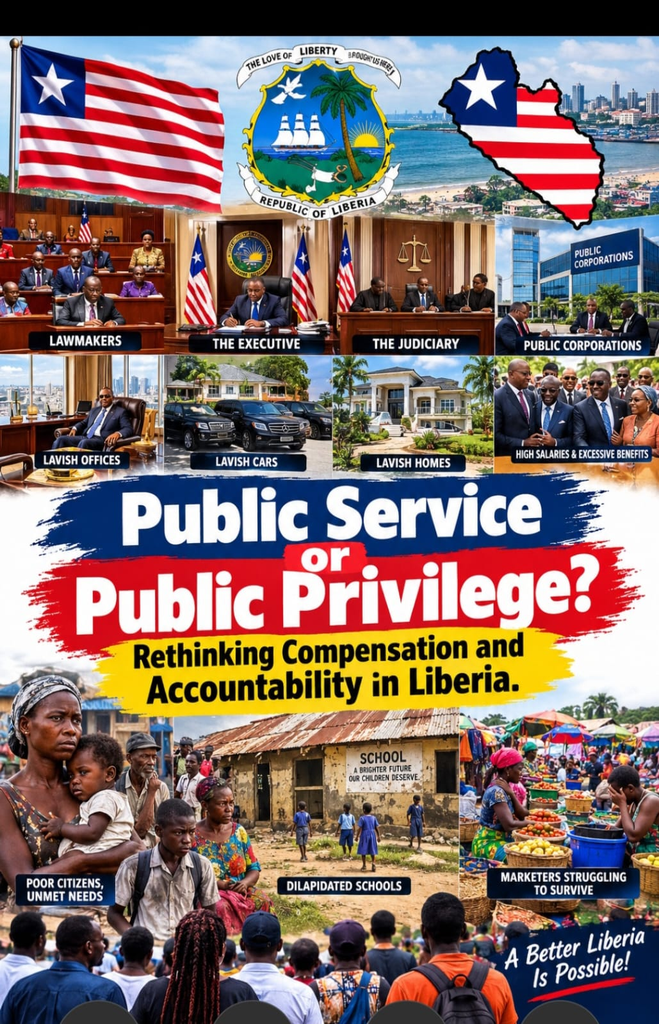
When a small group of political leaders benefits far more than the ordinary citizens they represent, government begins to look less like public service and more like a system designed to reward those in power.
Liberia’s lawmakers should carefully examine whether the compensation packages approved for high-ranking public officials are justified by education, experience, performance, and the country’s actual economic condition.
The fundamental question is simple: What extraordinary qualifications, expertise, or sacrifice makes one public servant deserving of thousands of United States dollars each month while millions of citizens lack reliable electricity, clean water, quality schools, hospitals, roads, and jobs?
If a government employee receives a salary over US$7,000 per month, more than US$3,000 in per diem, US$25,000 for housing, a new vehicle, a driver, free fuel, generator support, and additional allowances, citizens deserve a clear and convincing explanation.
In any democracy, public officials are not masters of the people.
They are servants of the people. Their salaries and benefits are not gifts from private companies; they are paid from national revenue.
Every dollar spent on unnecessary privileges is a dollar that may not be available for a rural clinic, a school roof, medicine for a public hospital, a road connecting farmers to markets, or salaries for teachers and health workers.
Therefore, compensation for public officials must always be viewed as a public interest issue rather than a private entitlement.
Liberia’s situation makes this debate especially urgent.
The country has endured civil conflict, economic instability, unemployment, inadequate infrastructure, and persistent poverty.
Many families struggle to provide meals each day. Young people graduate from schools and universities but cannot find decent jobs.
Rural communities often travel long distances to access health care. Public school teachers and nurses may work under difficult conditions for salaries that do not reflect the importance of their service.
Meanwhile, citizens regularly hear reports and public discussions about large allowances, foreign travel budgets, fuel allocations, vehicle purchases, housing benefits, and other costly privileges attached to political offices.
Such disparities create understandable frustration.
A teacher educating hundreds of children may earn only a fraction of what a senior official receives in a month.
A nurse working long hours in an understaffed hospital may lack basic medical supplies while government officials have access to vehicles, drivers, fuel, and generous travel packages.
Police officers responsible for public safety may work without adequate equipment, while powerful officeholders enjoy benefits that seem disconnected from the country’s hardships.
This is not merely an economic problem. It is also a moral and governance problem.
Excessive official compensation can be a form of indirect corruption when it is designed, approved, or protected through legal procedures but has no reasonable relationship to actual work, qualifications, or national capacity.
Traditional corruption often involves stealing money, demanding bribes, or diverting public funds into private accounts.
Indirect corruption can be more difficult to identify because it may be hidden behind payrolls, allowances, travel claims, per diem, consulting fees, fuel allocations, and other official benefits.
Transactions may appear legal on paper, yet still violate the spirit of public service.
A benefit does not become morally acceptable simply because it has been approved by an agency, included in a budget, or placed on a payroll.
If public officials use their authority to create unusually generous packages for themselves while ordinary Liberians suffer, the public has a right to question whether the process serves the nation or serves those in power.
Laws and budget lines should not become tools for legalized waste. Government must not use technical language to disguise unjustifiable privilege.
Supporters of high compensation may argue that Liberia must pay senior officials well to attract qualified professionals.
This argument deserves consideration. Government needs competent economists, lawyers, engineers, administrators, health specialists, diplomats, auditors, and policy experts.
Highly skilled individuals may have opportunities in the private sector or abroad.
If government salaries are extremely low, the public sector may struggle to recruit and retain capable people.
Adequate compensation can also reduce officials’ temptation to engage in bribery or misuse public funds.
However, this argument has limits.
First, a high salary does not automatically produce honesty, competence, or patriotism.
Some of the most effective public servants in history worked not for extravagant compensation but out of commitment to their country and confidence in the importance of public duty.
Second, Liberia should not assume that only people who demand excessive benefits are qualified to serve.
Many educated, experienced, hardworking Liberians at home and in the diaspora would be willing to contribute to national development at a reasonable cost if the system were transparent, merit-based, and respectful.
Third, public compensation should reflect economic reality.
A country with widespread poverty cannot responsibly maintain a governing class whose lifestyle resembles that of wealthy nations while basic public services remain weak.
The question is not whether officials should be paid enough to work effectively.
The question is whether their total packages are proportionate to Liberia’s revenue, economic conditions, and national priorities.
A public official may have a master’s degree, a law degree, a doctorate (all holders of Ph.Ds are called doctors; not all doctors hold Ph.Ds), or decades of experience, but those credentials alone do not justify unlimited access to public resources.
Education and experience should lead to better service, better policy, and better results for citizens, not automatic entitlement to luxury.
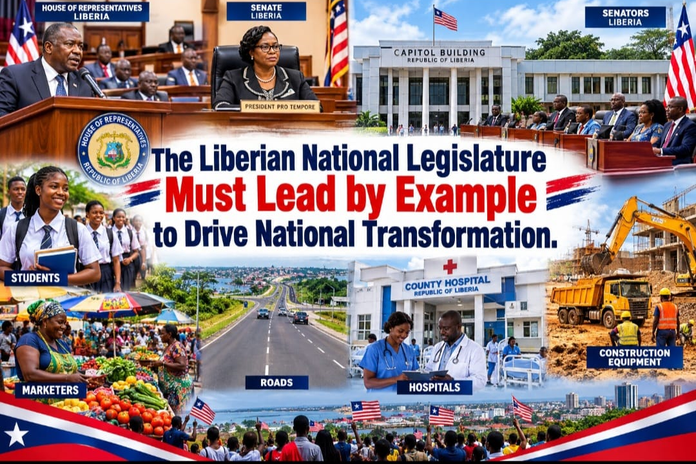
The National Legislature must therefore lead the review and reform of public sector compensation.
Lawmakers approve national budgets, oversee executive agencies, and represent citizens.
They should establish clear national standards for salaries, allowances, housing, travel, vehicles, fuel, and per diem.
These standards should apply not only to lower-level employees but also to legislators, ministers, agency heads, and other senior officials.
No group should be exempt from accountability simply because it can approve its own benefits.
A first reform should be full public disclosure.
The government should publish the salaries and benefits of all elected officials, ministers, agency heads, commissioners, and other high-ranking public servants.
This information should be easy to access and presented in a form that ordinary citizens can understand.
The public should know an official’s base salary, housing allowance, travel allowance, fuel allocation, vehicle cost, per diem rate, health coverage, communication allowance, and any other taxpayer-funded benefit.
Transparency does not create conflict; secrecy creates suspicion.
When citizens have accurate information, they can judge whether public money is being used responsibly.
Second, Liberia should establish an independent public compensation commission.
This body should include economists, auditors, civil society representatives, labor experts, public policy experts, legal professionals, and respected citizens.
Its duty should be to recommend fair salary scales based on national revenue, inflation, job responsibilities, qualifications, performance, and comparisons with other public servants.
The commission should not be controlled by the same officials who benefit from high compensation.
Its recommendations should be published, debated openly, and reviewed periodically.
Third, allowances must be strictly regulated.
Pay per diem only for legitimate official travel, and cover actual, reasonable expenses with required receipts.
It should not become a hidden second salary.
Travel claims should require receipts, travel reports, and evidence that the trip produced a public benefit.
If an official receives accommodation, meals, or transportation directly from a host organization, the per diem should be reduced accordingly.
The government should also establish limits on foreign travel and require public officials to explain the purpose and outcome of expensive trips.
Fourth, housing benefits should be reasonable and standardized.
It is difficult to justify extremely high monthly rent payments in a nation where many citizens lack decent housing.
If the government provides housing support to officials, it should set a reasonable cap based on market conditions and the demands of their duties.
Public servants should not live in “castles” funded by taxpayers while families sleep in unsafe structures or overcrowded communities.
Housing allowances should support practical accommodation, not luxury lifestyles.
Fifth, government vehicles and fuel must be controlled.
Some public offices may need vehicles, especially those involving fieldwork, security, emergency response, or official travel.
Yet vehicles should not become personal property or permanent status symbols.
Rules should govern who qualifies for official vehicles, how they are used, how fuel is recorded, and when cars must be returned to the government.
Drivers and fuel allocations should also be justified by the actual demands of the position.
No official should treat public gasoline as a private benefit for family errands, personal business, or home generators without clear legal authorization and public reporting.
Most importantly, compensation should be tied to performance and public outcomes.
If an official receives a substantial salary, citizens should be able to see measurable results.
Has the official improved service delivery? Has an agency reduced waste?
Have schools, clinics, roads, agriculture programs, or public safety systems improved under that person’s leadership?
Has the official attended legislative sessions, conducted oversight, responded to constituents, and complied with asset-declaration requirements?
Public office should not be a route to wealth; it should be a contract with the people.
Liberia must also strengthen institutions that investigate waste, conflict of interest, and misuse of public funds.
The General Auditing Commission, the Liberia Anti-Corruption Commission, civil society organizations, investigative journalists, and the courts all have important roles to play.
Audits should not be ignored.
Audit findings should lead to corrective action, repayment where necessary, disciplinary measures, or prosecution when laws have been violated.
Accountability can not exist only in speeches.
It must be practiced through institutions that have the independence and courage to challenge powerful individuals.
Citizens also have a responsibility in this process.
Liberians should demand answers from those they elect.
During elections, voters should ask candidates whether they support public disclosure of salaries and benefits, limits on unnecessary allowances, and stronger audits.
Communities should organize public forums and encourage representatives to explain how public resources are being spent.
Young people, women’s groups, professional organizations, religious leaders, and the media should continue to speak against waste and inequality.
Silence allows abuse to grow.
The purpose of public service is not to create a privileged political class.
It is to improve the lives of the people.
A country cannot develop when its leaders enjoy excessive benefits while citizens endure hunger, unemployment, poor health care, and weak education.
Liberia needs leaders who understand that public money is sacred.
It belongs to the people, especially to the poor citizens whose taxes, labor, and sacrifices sustain the nation.
The Liberian National Legislature must therefore act with urgency and integrity.
It should review excessive salaries, per diem, housing allowances, fuel allocations, vehicles, and other benefits that cannot be reasonably justified.
It should create transparent standards, publish compensation records, strengthen audits, and ensure that every dollar spent serves the national interest.
Education, experience, and expertise are valuable, but they must be matched by humility, accountability, and service.
Liberia does not need public officials who become wealthy because they hold office.
Liberia needs public servants who recognize that leadership is a responsibility, not a reward.
Until the country addresses the inequality built into its public compensation system, citizens will continue to see government not as a partner in development, but as a distant institution that benefits the few at the expense of the many.
Support Independent Journalism
Your support helps FrontPage Africa continue delivering independent, credible, and impactful journalism. Every contribution strengthens our ability to investigate, inform, and hold power accountable while keeping quality journalism accessible to our readers.
Support our journalism or subscribe to receive the latest FrontPage Africa stories and updates.