MONROVIA — For the better part of three weeks, the IB Atlantic IV existed mostly as a rumor with coordinates attached. It was a ship the government said it was watching, a ship whose engine trouble nobody could quite verify, a ship that drifted at 0.3 knots toward a port it wasn’t supposed to be near, flying a flag that asks almost nothing of the vessels that fly it. Liberians read about it in fragments — an anonymous government source here, a rejected letter there, a pursuit off Rivercess that didn’t end so much as move somewhere else.
By Rodney D. Sieh, [email protected]
That fragment collecting is over. The IB Atlantic IV has been arrested in Ivory Coast, and for the first time since this saga began, the ship everyone was chasing is not the one deciding where it goes next.
It is Ivorian security forces who now decide that. Liberia is left to ask for it back.
A quieter ending than the chase deserved
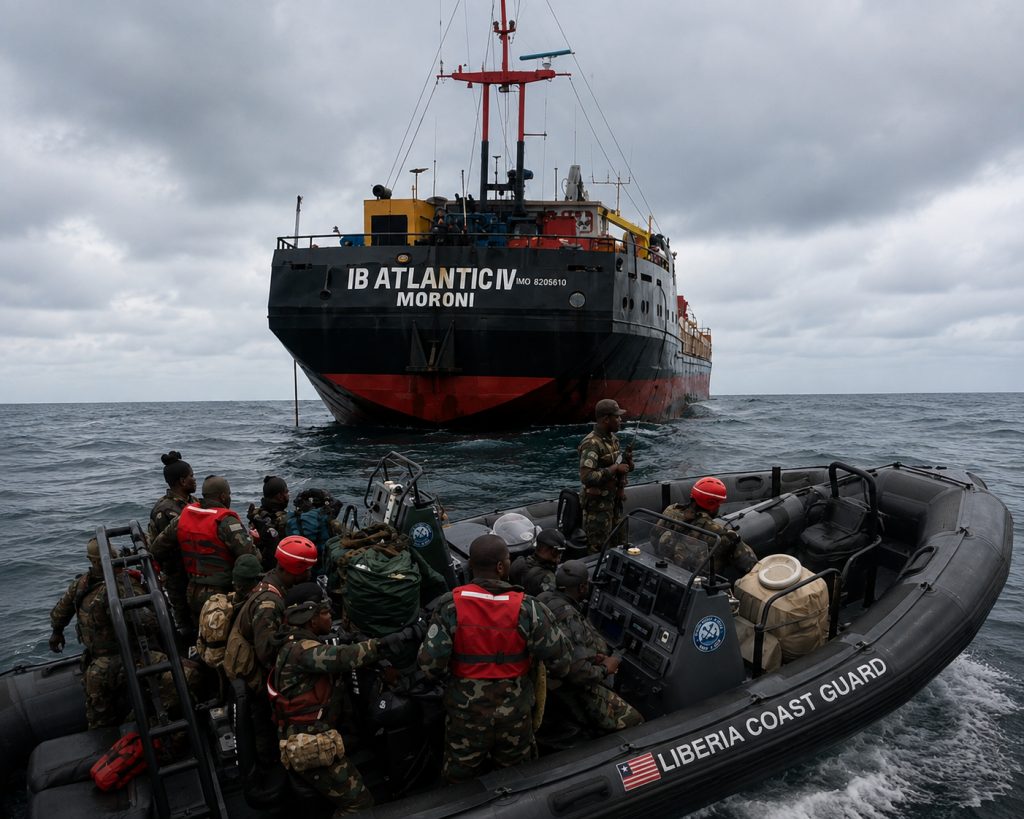
There is something almost anticlimactic about how it ended. After Armed Forces troops pursued the vessel off Rivercess, after the Coast Guard admitted its boats simply weren’t built for a chase that went this far, after Nigerian partners were brought in to help track a ship Liberia couldn’t catch on its own — the capture came not from a Liberian deck but from a neighboring country’s port authority, acting on a warning Liberia itself had sent to Abidjan and Conakry.
That is not nothing. Liberia’s outreach to Ivory Coast and Guinea worked exactly as regional cooperation is supposed to work. But it also means the country’s own maritime enforcement — the Coast Guard, the National Security Agency, the Armed Forces chief of staff who was, by his own agency’s account, “personally monitoring” the situation for a week — never once had the ship in hand. Now the Liberia Maritime Authority is scrambling to arrange a Sea Shepherd Global escort just to bring the vessel home, the same partnership that has helped Liberian authorities make roughly twenty fishing-vessel arrests since 2017. It is a solution built for a different problem, repurposed now because Liberia has no faster one.
Whether narcotics were aboard the ship remains, as of this writing, unconfirmed. That single unanswered question is the hinge the entire story turns on — and Monrovia will not rest easy until it is answered.
The paper trail that came before the pursuit
To understand why this ship earned three weeks of national anxiety, it helps to go back to July 13, to a letter that, read today, sounds like a rehearsal for everything that followed.
That was the day Mark Egon Kuiah — then a deputy at Roberts International Airport, a man with no formal role in maritime affairs — wrote to the Liberia Maritime Authority not as a government official but as “registered agent” for a company called Madris Group of Companies Incorporated. The vessel he was writing about, he said, was in distress at sea, its engine performance compromised by “external obstruction affecting the vessel’s propeller.” It needed a berth. It needed a dive team.
LiMA said no. The agency’s reasoning, delivered plainly to this newspaper, was that the story didn’t add up: the ship hadn’t docked anywhere, was still sitting in Sierra Leonean waters, and yet was already being arranged for a Liberian welcome, as if the paperwork had gotten ahead of the emergency.
Weeks later, Kuiah was swept up in the same dismissal wave that has since widened into Liberia’s broader cocaine purge — a purge that has also ensnared the former commander of the Liberia Immigration Service post at Bo-Waterside and his deputy, both allegedly caught in March carrying suspected narcotics while trying to cross back from Sierra Leone.
The ship in Kuiah’s letter was the IB Atlantic IV.
A ship that told two different stories about itself
What makes the IB Atlantic IV genuinely strange is not that it was suspicious — plenty of vessels off West Africa’s coast are. It’s that the ship told two irreconcilable stories about itself at the same time, and neither matched what its own transponder was broadcasting.
One account, from an anonymous government source, placed it in distress off Sierra Leone, drifting toward Guinea-Bissau. Kuiah’s letter, filed a week earlier, told a third version entirely. And the ship’s Automatic Identification System — the transponder every large vessel must broadcast, showing position, speed, and declared destination — placed it in open West African waters, moving at a crawl, declaring a destination of Lomé, Togo. Not Sierra Leone. Not Guinea-Bissau.
A 41-year-old cargo ship, flagged in Comoros — a registry international shipping analysts describe as asking few questions of anyone — moving at less than a third of a knot is not a ship in transit. It is a ship waiting. And in the days after it first appeared, intelligence sources told FrontPageAfrica that a smaller, unidentified vessel approached it and appeared to attempt passing something aboard. Officials have never said what, or whether the attempt succeeded. But the detail reframes everything that came before it: not a disabled ship asking for mercy, but a ship parked at a fixed position, waiting for a delivery that Liberia’s institutions were too slow, or too divided, to intercept.
The week nobody was in charge
Ask three Liberian security institutions who was responsible for the IB Atlantic IV in its first days in Liberian waters, and — as this newspaper found when it tried — you get three different answers that all point somewhere else. LiMA said it had “information relative to the vessel” and had passed it along to the National Security Agency. The NSA said the Coast Guard was aware. The Coast Guard’s own chief of staff was, according to the NSA, personally monitoring the situation.
Everyone was watching. No one was catching.
That is the sentence this episode leaves behind, and it is the sentence Liberia’s Legislature should sit with before it advances a bill to break the National Port Authority into four separate regional operators. A government that could not coordinate a single response to one suspicious ship, watched by three agencies for the better part of a week, is being asked to prove it can coordinate four ports instead of one. Nothing about the events of the last three weeks makes that case. If anything, the IB Atlantic IV has made the opposite case for free.
What comes next
The ship is now sitting in an Ivorian port, in Ivorian hands, waiting on a Liberian government trying to arrange its own passage home. Whether the coming search finally answers the question that has hung over this entire saga — was there ever anything aboard — will determine whether this story ends as a costly false alarm or the confirmation of exactly what critics of Liberia’s port security have warned about for months.
Either way, the country got lucky this time only in the sense that a neighbor caught what it could not. That is not luck built to last, and it is not oversight built to repeat.
Support Independent Journalism
Your support helps FrontPage Africa continue delivering independent, credible, and impactful journalism. Every contribution strengthens our ability to investigate, inform, and hold power accountable while keeping quality journalism accessible to our readers.
Support our journalism or subscribe to receive the latest FrontPage Africa stories and updates.