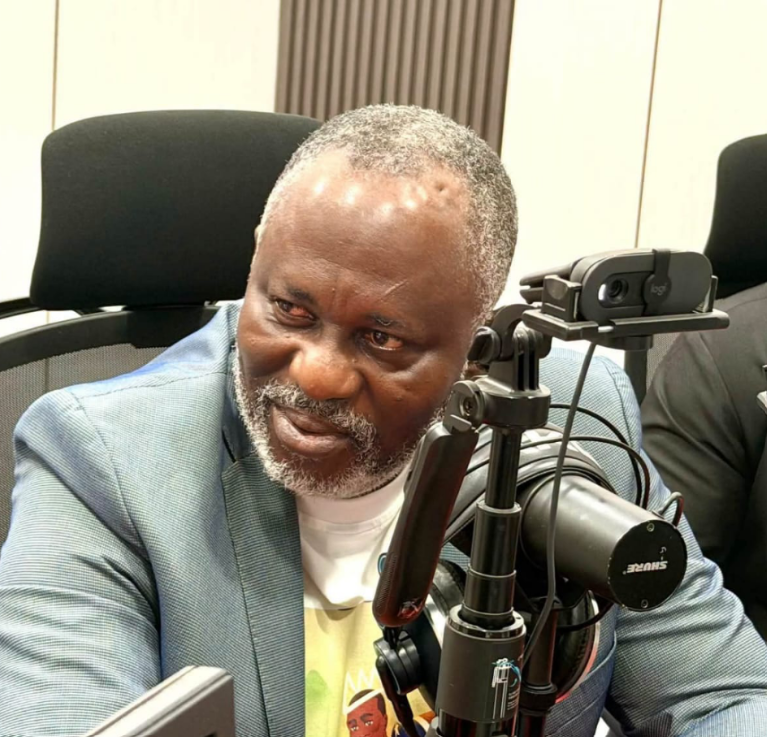
MONROVIA – When a political veteran sets his sights on a party’s top office, the usual questions concern votes, delegates and alliances. In the case of Senator Nathaniel F. McGill and the opposition Congress for Democratic Change (CDC), another question looms larger: how will the world react if the party’s next chairman is a man the United States government has sanctioned?
By Selma Lomax, [email protected]
McGill, now the senator for Margibi County, was recently reported pledging support for the completion of a party headquarters. His chairmanship ambition therefore remains a prospective contest, but it has already prompted debate about the CDC’s direction as it prepares for the 2029 elections.
McGill is far from a newcomer. He climbed through the party’s senior ranks and served as National Chairman during the period that ended in the CDC’s historic 2017 victory. He then became one of the most powerful officials in the Weah administration, serving as Minister of State for Presidential Affairs. In 2023, he won the Margibi senatorial seat with 52,934 votes, about 39.89 per cent of the valid votes cast.
Supporters see a seasoned organiser who understands both the party and the machinery of government. Critics see a leader whose record carries costs the party may struggle to absorb. Both views deserve a fair hearing, but one issue stands apart because its consequences reach beyond Liberia’s borders.
The Treasury Designation
On 15 August 2022, the Office of Foreign Assets Control (OFAC) of the US Treasury Department designated McGill under Executive Order 13818, which carries the Global Magnitsky framework targeting serious human rights abuse and corruption. According to the Treasury’s announcement, the action followed allegations involving unjustified government stipends and the distribution of undocumented cash to other officials for governmental and non-governmental activities. The Treasury also alleged that he used his official position to prevent the discovery of misappropriation.
Precision matters here. A sanctions designation is an administrative action by a government. It is not a criminal conviction by a court in Liberia or the United States, and the allegations have not been tested before a judge. McGill remains free to contest them and to seek reconsideration through the appropriate channels.
Even so, the designation is no footnote. It is a formal act by one of the world’s most influential governments, and it carries concrete legal effects. Treating it as routine political noise would be a serious misjudgement for any party hoping to return to power.
What the Sanctions Do and Do Not Mean
McGill’s name now appears on the Specially Designated Nationals and Blocked Persons List. As a result, property and financial interests under US jurisdiction must generally be blocked, and US persons are broadly prohibited from transactions involving him unless authorised.
The legal picture requires nuance. Electing a sanctioned chairman would not automatically sanction the CDC as an institution. OFAC’s 50 per cent rule applies to entities owned, directly or indirectly, 50 per cent or more by blocked persons, and it does not extend to a party merely because a designated individual holds office within it. Nor would his election automatically bar every activity undertaken by non-US persons inside Liberia.
The practical risks lie elsewhere, particularly among the party’s overseas supporters. The CDC maintains networks among Liberians in the United States, including CDC-USA, and these supporters contribute to fundraising, organising and political engagement. Any transaction involving McGill that touches American citizens, banks or property could raise compliance questions. Banks, donors and event organisers often avoid risk rather than study the fine print, so a party led by a sanctioned chairman should expect added scrutiny and greater hesitation from partners abroad.
Why the Sanctions Could Be a Bad Omen
The deeper problem is reputational. Politics runs on perception, and perception travels across borders. Liberia’s relationship with the United States remains strategically important, touching development assistance, security cooperation, governance reform and investor confidence. Washington’s stance on corruption shapes how many partners view Liberian institutions and the people who lead them.
A party seeking power in 2029 must look like a credible government-in-waiting. It must persuade diplomats, donors and investors that it has learned from its time in office. If its chairman, the public face of the organization, appears on an American sanctions list over alleged corruption, the CDC begins that effort with a visible handicap. Several consequences could follow.
Loyalty to a leader does not erase international concern, and the party cannot simply campaign around the problem. Until the designation is lifted or amended, the CDC must treat it as a daily reality.
The Weah-Era Shadow
The sanctions do not stand alone. They sit within a broader record from McGill’s years in government. As Minister of State for Presidential Affairs, he stood at the center of presidential decision-making and party-government coordination. When an administration loses public favor, its chief political managers share the scrutiny. Critics, including some CDC partisans, complained that power had gathered among a small circle, that party stakeholders were sidelined and that internal criticism was poorly received.
Two episodes shaped public perception in particular. In January 2021, Representative Acarous Moses Gray criticized senior officials, including McGill, over alleged nepotism. The appointment of McGill’s sister, Rebecca McGill, as Deputy Minister of Finance for Administration became part of that debate. A family connection does not prove an unlawful appointment or an unqualified appointee. Still, the appearance of family advantage damaged a movement that had promised change.
Then came the elaborate tomb built for McGill’s late mother in 2021, which FrontPage Africa described in a July report. McGill reportedly said a friend built it. Available reporting does not show that state funds were used, and the difference between poor optics and proven misuse matters. Even so, the spectacle stirred public anger during a period of widespread hardship.
None of this is a permanent bar to leadership. Combined with the Treasury allegations, however, it forms a pattern that opponents are likely to exploit.
Reading the Margibi Numbers
Supporters often cite the Margibi victory as proof of McGill’s strength. The achievement is real, but the figures tell a more layered story. In the first round of the 2023 presidential election, George Weah received 56,272 votes in Margibi, or 41.76 per cent. Joseph Boakai won the county with 63,431 votes, or 47.08 per cent. McGill’s 52,934 votes fell about 3,338 short of Weah’s total. In other words, McGill won his Senate seat while the CDC’s presidential candidate lost the county.
That outcome points to personal appeal, local relationships and candidate-specific loyalty, which are common features of Liberian elections. It does not show that McGill betrayed his party, and no credible evidence has been offered to support such a claim. Indeed, he publicly reaffirmed his support for Weah after the first-round results.
The lesson is that winning a county is different from building a national machine. The CDC lost the 2023 runoff by only 20,567 votes, with Boakai and Jeremiah Koung of the Unity Party taking 50.64 per cent against 49.36 per cent for Weah and Jewel Howard-Taylor. The party remains a major force, and what it needs now is organization, discipline and renewed public trust. A chairman must be able to mobilize the entire country without carrying liabilities that push allies away.
Questioning the “Winning Chairman” Label
McGill’s allies often describe him as the winning chairman of 2017. That year, Weah took the runoff with about 61.5 per cent of the vote, ending twelve years of Unity Party rule and producing the first peaceful handover between living elected presidents in more than seven decades.
His role in that period is part of the record, but the victory had many authors. Weah’s personal popularity mattered, as did the party’s grassroots structures and the alliance with the National Patriotic Party and the Liberty Party. Crediting one man for the entire result is inaccurate. A good chairman is judged on unity, institution-building and lasting public confidence, and a single winning cycle does not prove those qualities.
One historical claim also needs correction. Published results for the December 2014 Margibi special senatorial election list Ansu Dao Sonii as the CDC candidate, and McGill does not appear among the candidates. Claims that he contested and lost that race cannot be supported by the record.
Leadership Style and Party Democracy
Beyond the sanctions, the party must ask whether McGill can reunite a divided house. Some critics accuse him of intolerance toward dissent and of favouring a close circle of allies. These remain allegations, not established findings, but delegates are entitled to ask hard questions:
Some accounts of his rise claim that positions were created to accommodate him, and others say he held two offices at once. These stories require proof from constitutional documents and convention records, and until that proof appears, they should not be treated as settled fact. The principle behind them still stands: a party must show that its procedures are stronger than any single personality.
The Boakai administration will be judged on corruption, economic management, jobs and public services. If it stumbles, the opposition will gain an opening. Public frustration, however, will not hand votes to the CDC automatically, because voters will compare both political establishments.
That is why the choice of chairman carries such weight. The CDC needs a face of renewal who can challenge the government with credibility. A leader whose record already raises questions about governance, and who sits under a foreign corruption designation, may struggle to carry that message at home or abroad.
The case for McGill rests on experience, relationships, institutional memory and his link to the 2017 triumph. The case against rests on the sanctions, the baggage of the Weah years, doubts about his leadership style and the risk of reopening old wounds.
Both sides raise fair points. Supporters can argue that he is capable and battle-tested, while critics can argue that the party cannot afford a leader who complicates its dealings with Washington and the wider international community while it rebuilds trust.
The sanctions are the sharpest edge of that debate. They are an allegation, not a conviction, and McGill may contest them. As long as they stand, however, they send a signal to donors, diplomats, diaspora supporters and voters. For a party that wants to project accountability, that signal could prove a bad omen.
The delegates will make the final call. If McGill shows real change, answers the reputational questions directly and commits to inclusive leadership, he can make a serious case. If his bid looks mainly like an effort to regain personal influence, the CDC may spend the road to 2029 explaining its past instead of offering a future.
Support Independent Journalism
Your support helps FrontPage Africa continue delivering independent, credible, and impactful journalism. Every contribution strengthens our ability to investigate, inform, and hold power accountable while keeping quality journalism accessible to our readers.
Support our journalism or subscribe to receive the latest FrontPage Africa stories and updates.