“Liberia’s debt of gratitude to its national security apparatus must be repaid not with political promises, but with every institution that protects the nation’s dignity, opportunities that give everyone within the borders of the nation a life purpose, and a police service that everyone must trust and respect. And Liberia’s youth, in turn, owe their country a commitment to peace, discipline, citizenship, and the rejection of violence. The restoration of sanity is therefore not the responsibility of the police alone; it is a national covenant between the people and the institutions created to serve them.”
By: Austin S Fallah – A True Son of the Planet Earth Soil: [email protected]
President Joseph Nyuma Boakai — National Unity and Rule of Law: “Partisanship must give way to nationalism.” — President Joseph Nyuma Boakai Sr., Inaugural Address, January 22, 2024.AP News.
Application: Liberia’s young people should be encouraged to see the police not merely through political lenses, but as an institution whose legitimate role is to protect life, maintain public order, and uphold the rule of law. The restoration of sanity begins when patriotism becomes more important than partisan confrontation.
Former President George Weah — The Youth as Liberia’s Future: “The youth are the future of Liberia.” — George Manneh Weah, reflecting on his efforts to support Liberian youth through football. FourFourTwo.
Application: If Liberia’s youth are the nation’s future, society shares a responsibility to guide, educate, protect, and empower them. The Liberia National Police can help build that future by earning young people’s trust and treating them as partners in peace and national development, not simply as subjects of law enforcement.
Former President Ellen Johnson Sirleaf — Leadership and Responsibility: “Leadership is never given on a silver platter; one has to earn it.” — Ellen Johnson Sirleaf, former President of Liberia. Wikiquote.
Application: This principle applies not only to elected officials but also to police officers, community leaders, parents, educators, and young Liberians themselves. Authority earns legitimacy through integrity, fairness, discipline, and service. A police institution earns citizens’ confidence when its conduct shows that public power exists to protect the public.
African Proverb — Collective Responsibility: “If you want to go fast, go alone. If you want to go far, go together.” — African proverb.
Application: Liberia can not restore social sanity through government or the police alone. The police, youth organizations, families, religious institutions, schools, civil society, political leaders, and communities must work together. Liberia’s youth and the Liberia National Police should therefore build a partnership based on dialogue, accountability, respect, and shared responsibility.
Chinua Achebe — The Responsibility to Rebuild:
“One of the truest tests of integrity is its blunt refusal to be compromised.”
— Chinua Achebe, Nigerian novelist and intellectual.
Application: Restoring sanity requires integrity on every side. Young people must reject violence, drugs, criminality, and destructive political manipulation; police officers must reject corruption, excessive force, discrimination, and abuse of authority. When both citizens and institutions refuse to compromise justice and human dignity, Liberia can turn its security challenges into an opportunity for national renewal.
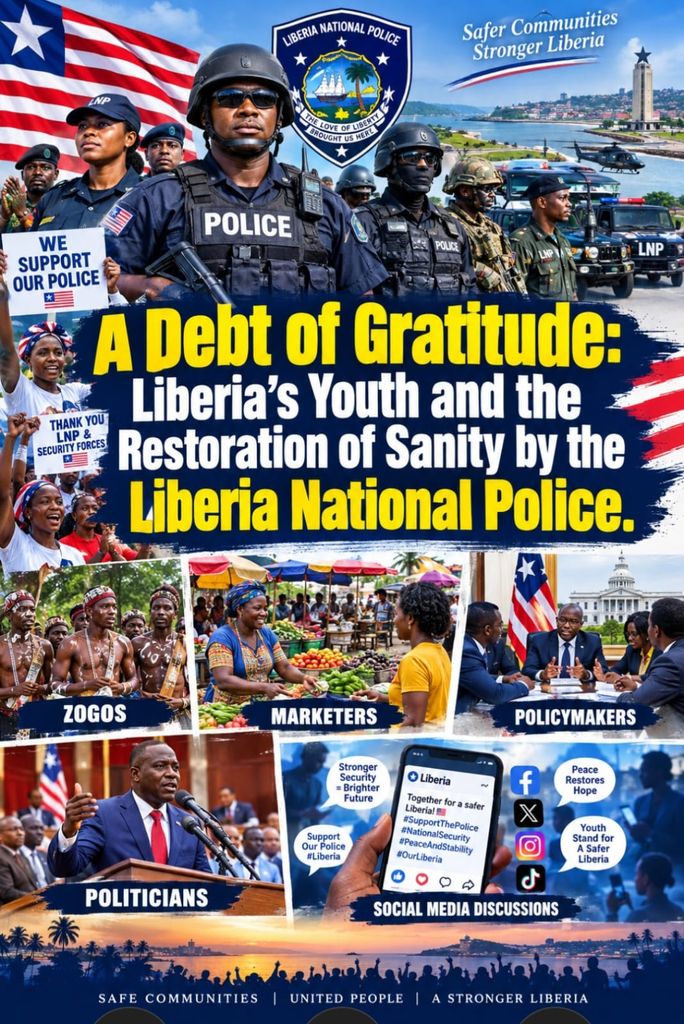
For years, the streets of Monrovia and other Liberian cities bore witness to a harrowing sight: young people, disoriented and emaciated, moving through public spaces like the living dead.
These were the “Zogos,” a generation of Liberian youths whose lives had been hollowed out by drugs.
They were not born that way. They were made that way, victims of a ruthless drug economy operated by Liberian and foreign traffickers who saw young people not as human beings, but as profit margins.
For too long, the crisis seemed unstoppable. Families buried their children. Communities lived in fear.
The nation’s future appeared to be disappearing one overdose at a time.
Yet under the leadership of President Joseph Nyuma Boakai, Vice President Jeremiah Kpan Koung, and the Alliance government, the Liberia National Police has mounted a serious and effective campaign against drug cartelism and trafficking.
Because of these efforts, the population of young people once called Zogos is dwindling, and a measure of sanity has been restored to the lives of Liberian youths.
For this, Liberian youths and young people must be grateful.
At the same time, every well-meaning Liberian must continue to condemn the drug cartels and traffickers who still seek to undermine national security and destroy the future of the nation’s young people, particularly its young girls and boys.
To understand why gratitude is owed, one must first understand the scale of the devastation that drug cartels inflicted on Liberia’s youth.
The term “Zogos” entered the national vocabulary as a grim descriptor for young people whose addiction to heroin, cocaine, marijuana, and other dangerous substances had stripped them of their dignity, their health, and their will to live.
They wandered the streets barefoot, their eyes vacant, their bodies ravaged by disease and malnutrition.
They were often seen begging, stealing, or lying in gutters and graveyards, oblivious to the world around them.
The image of a young person who should have been in school or at work, instead shuffling through traffic like a zombie, became a national trauma.
Daily deaths were reported. Young men and women were dying from overdoses, from violence connected to the drug trade, or from illnesses left untreated because addiction had consumed every resource they had.
Families were torn apart. Parents mourned children who were still alive but already lost.
Communities became unsafe, as the desperation of addiction fueled petty crime and instability.
This was not a natural disaster. It was a man-made catastrophe, engineered by drug cartels and traffickers who deliberately targeted Liberia’s youth because they were vulnerable, numerous, and, in the traffickers’ eyes, expendable.
Against this backdrop, the actions of the Liberia National Police under the current government take on profound significance.
President Joseph Nyuma Boakai, Vice President Jeremiah Kpan Koung, and the Alliance government have made the fight against drug trafficking a central priority of national security.
The Liberia National Police, working alongside other national security agencies, has arrested and brought to courts and some have been found guilty, while others awaiting trials, numerous Liberian and foreign nationals involved in drug cartelism and trafficking.
These operations have disrupted supply chains, dismantled distribution networks, and removed dangerous criminals from the streets.
The result is not merely a set of statistics; it is a visible change in the nation’s daily life. Liberians can proudly say that the population of youths and young people once called Zogos is dwindling.
This means fewer young people are dying. Fewer families are being destroyed.
Fewer communities are living under the shadow of drug-fueled violence.
It means that young people who might have been lured into addiction now have a better chance to stay in school, find work, and build a future.
It means that the phrase “restoring sanity” is not an empty spewing slogan but a lived reality for thousands of Liberian youths.
Gratitude, in this context, is not a matter of blind political loyalty or empty praise.
It is a rational and moral response to tangible results.
The Liberia National Police has placed its officers in harm’s way to confront heavily armed drug cartels.
Police officers have risked their lives, worked long hours, and faced threats from powerful criminal networks whose resources often exceed those of the state.
They have done so not for personal gain but for the protection of the public, and especially for the protection of young people who were the primary targets of the drug trade.
When a young person is saved from addiction, when a family is spared the grief of burying a child, when a neighborhood is freed from the terror of drug-related violence, that is a gift.
It is a gift that deserves acknowledgment. Liberian youths and young people, in particular, should be grateful because they are the direct beneficiaries of this work.
The decline in the Zogo population means that their peers, their siblings, their friends, and their future spouses are more likely to live.
It means that the path to education and employment is less obstructed by the lure of drugs.
It means that the dream of a peaceful and prosperous Liberia is no longer a fantasy but a realistic possibility.
Gratitude is the proper response to such a profound change.
Of course, some might argue that gratitude is premature or that the government has not done enough.
They might point out that drug use still exists, that some young people remain addicted, and that the root causes of drug abuse, poverty, unemployment, trauma, and lack of opportunity, have not been fully addressed.
These are valid concerns. However, they do not negate the progress that has been made.
Acknowledging the success of the Liberia National Police does not mean claiming that the problem is solved.
It does not mean ignoring the need for rehabilitation programs, mental health services, economic development, and educational reform.
On the contrary, gratitude can coexist with constructive criticism.
One can say, “Thank you for what you have done, and we still need more.”
But to withhold gratitude entirely because the fight is not yet over would be both unfair and demoralizing.
It would ignore the courage of police officers who have risked their lives.
It would dismiss the real decline in the Zogo populationtion as if it were nothing.
It would send a message that no amount of effort is ever enough, which is a recipe for cynicism and inaction.
Liberian youths should be mature enough to recognize progress while still demanding more.
Gratitude is not weakness; it is a sign of civic maturity.
At the same time, every well-meaning Liberian must continue to condemn those drug cartels and drug traffickers who persist in undermining national security and the future of the Liberian people.
These criminals are not merely breaking the law; they are committing a form of generational warfare against the nation.
They target young people because young people are the future leaders of Liberia.
By flooding communities with dangerous drugs, they rob the nation of its doctors, teachers, engineers, entrepreneurs, and public servants before those young people even have a chance to realize their potential.
The impact on young girls is especially devastating. Young girls who fall into drug addiction are at heightened risk of sexual exploitation, trafficking, unwanted pregnancy, and death.
They are often forced into prostitution to support their habits, which exposes them to violence and disease.
The drug cartels do not care about these girls; they see them only as another market to exploit.
Therefore, to condemn drug traffickers is not merely to express disapproval; it is to take a stand for the dignity and safety of Liberia’s daughters.
It is to say that the future mothers of the nation will not be sacrificed on the altar of criminal profit.
Every well-meaning Liberian, whether a parent, a teacher, a pastor, a business owner, or a public official, has a moral duty to speak out against these cartels and to support the police in their efforts to bring them to justice.
This condemnation must be active, not passive. It is not enough to shake one’s head and say that drugs are bad.
Liberians must cooperate with the Liberia National Police by reporting suspicious activity, refusing to be bribed or intimidated by drug traffickers, and rejecting any social acceptance of drug money.
Communities must organize neighborhood watches, support anti-drug education in schools, and create opportunities for young people to avoid the trap of addiction.
The government, for its part, should continue to fund the police and national security agencies, strengthen the judicial system so that arrested traffickers face swift and fair trials, and invest in rehabilitation programs for former Zogos who need help rebuilding their lives.
Gratitude for the current success should translate into a determination to finish the job.
The fight against drug cartels is not a battle that the police can win alone. It requires a national movement.
Liberian youths and young people have every reason to be grateful to the Liberia National Police under the leadership of President Joseph Nyuma Boakai, Vice President Jeremiah Kpan Koung, and the Alliance government.
The police have arrested and brought to justice Liberian and foreign nationals who once created daily Zogos, caused young people to look like zombies, and led to daily deaths.
Because of their work, the population of young people once called Zogos is dwindling, and sanity is being restored to the lives of the nation’s youth.
This is a real achievement, and it deserves recognition. But gratitude must not become complacency.
The drug cartels and traffickers who remain active are enemies of the state and enemies of the future.
Every well-meaning Liberian must condemn them, especially for the harm they do to young girls and future leaders.
The road ahead is still long, but the direction is now clear.
With continued police action, community supportt, and national resolve, Liberia can ensure that the Zogo phenomenon becomes a tragic chapter in its history rather than a permanent feature of its present.
The youth of Liberia have been given a second chance.
They should seize it with gratitude, vigilance, and a fierce commitment to building a nation that no drug cartel can ever destroy.
Support Independent Journalism
Your support helps FrontPage Africa continue delivering independent, credible, and impactful journalism. Every contribution strengthens our ability to investigate, inform, and hold power accountable while keeping quality journalism accessible to our readers.
Support our journalism or subscribe to receive the latest FrontPage Africa stories and updates.