Hon. Augustine Kpehe Ngafuan — Finance and Development Planning Minister, in a May 20, 2026 interview on the Liberia Broadcasting System’s Super Morning Show, Minister Ngafuan stated: “Liberia’s current debt stock stands at US$2.8 billion; the external debt is US$ 1.4 billion; domestic debt stands at US$1.2 billion.” Local Voices Liberia.
By: Austin S Fallah – A True Son of the Planet Earth Soil: [email protected]
A fact-check by Local Voices Liberia subsequently reviewed the FY2026 National Budget and the Central Bank of Liberia’s 2025 Annual Report and concluded that the figures were substantially correct.
For the civic-literacy argument, this is particularly useful: Economic claims should be tested against primary fiscal data rather than accepted merely because they come from a politician, government critic, commentator, or social-media post
Hon. Ngafuan Ngafuan also said in his August 24, 2026 National Flag Day oration:
“But a bigger budget is not an end in itself.” THE LIBERIAN INVESTIGATOR.
That short quotation can anchor a discussion about the difference between the size of Liberia’s budget and the actual economic welfare of Liberian citizens.
Finance Minister Ngafuan emphasized revenue administration and warned:
“We shall push all revenue-generating agencies to their full potential, but we must be careful not to milk the willing cow to death.” Micat.
That quotation provides an excellent entry point into the relationship between taxation, economic incentives, public revenue, and citizens’ understanding of government finance.
Hon. Samuel D. Tweah Jr. — Former Minister of Finance: In a 2021 World Bank interview, Hon. Tweah described the government’s economic priorities following the COVID-19 shock. He said:
“Our goal is to increase growth that is sustainable and inclusive.” World Bank.
He then connected that goal to agriculture, infrastructure, electricity, digitization, domestic revenue mobilization, public expenditure management, and social protection.
Another particularly relevant statement was:
“All Liberians must prosper in this transition.” World Bank.
And regarding public financial management, Hon. Tweah said: “We are strengthening domestic revenue mobilization and public expenditure management to increase transparency and efficiency.”
Hon. Amara Konneh — Former Minister of Finance:
During an IMF African Finance Ministers press briefing following the Ebola crisis, Hon. Konneh explained Liberia’s economic deterioration:
“The disease ravaged our economy beyond imagination.” IMF.
He also explained that Liberia’s projected growth had fallen dramatically because of Ebola and declining commodity prices:
“For Liberia, we were projected to grow at six percent, but with the decline in commodity prices and the Ebola disease, our economy sort of got into a freefall to around one percent in 2014.” IMF.
In a 2014 Guardian article, Hon. Konneh described the broader consequences of the Ebola crisis: “This is why we are not just fighting a disease, but for the economic survival of a nation.”
These statements demonstrate an important principle or narrative: Economic outcomes can not always be attributed to domestic government decisions alone. Commodity prices, epidemics, international trade, investment conditions, and other external shocks can substantially affect Liberia’s economy.
Hon. Antoinette M. Sayeh — Former Minister of Finance: Hon. Sayeh’s 2006 statement to the IMF provides some of the strongest primary-source material on Liberia’s socio-economic development.
She described Liberia as emerging from: “two decades of economic mismanagement and 15 years of brutal civil war which devastated our economy and human assets”
She also emphasized the importance of institutional confidence: “Reestablishment of confidence in these institutions is crucial to maintaining stability, securing sustained external support, and encouraging private investment.” IMF eLibrary.
Hon.Sayeh further stated: “We remain resolutely committed to tackling the endemic corruption, which is a major obstacle to Liberia’s development.”
And, importantly, for civic literacy: “Our people’s expectations are high, and showing concrete improvements in their lives- limited electricity, some jobs, improved roads- is essential to our ability to maintain support for the difficult reforms ahead.” IMF eLibrary.
This last quote is especially powerful because it connects economic reform, measurable results, public expectations, and citizen confidence.
Daron Acemoglu — Nobel Prize Economist: In his 2024 Nobel banquet speech, Acemoglu stated: “Our research shows that inclusive institutions – including democratic participation, the rule of law, and broad access to economic opportunities – are a major contributor to shared prosperity in all parts of the world.”
Simon Johnson — Nobel Prize Economist: ” Economic development is not simply a question of money; it is also a question of the institutions through which economic decisions are made and enforced.”
IMF: Discussion of fiscal transparency states: “Without good fiscal information, governments can’t understand the fiscal risks they face or make good budget decisions.”
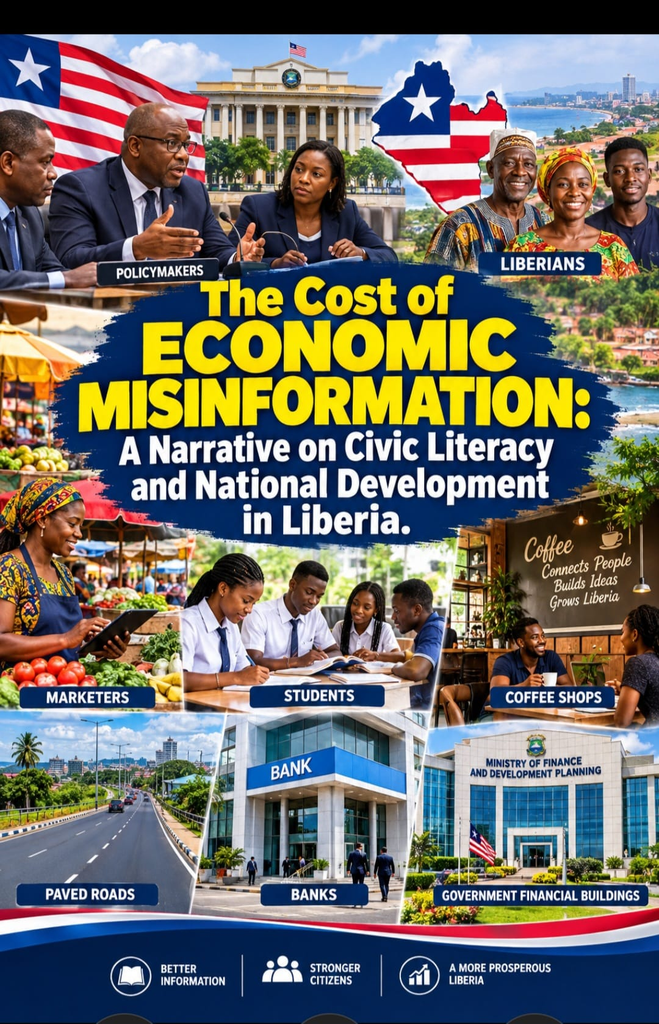
Liberia’s struggle for sustained economic development cannot be understood only through the actions of elected officials, international donors, foreign investors, or public institutions.
It must also be understood through the quality of public debate.
A nation’s economic future is shaped not only by the policies that governments adopt but also by whether citizens can distinguish between evidence and rumor, long-term planning and short-term political slogans, productive criticism and destructive misinformation.
When public discussions about the economy are dominated by speculation, personal insults, conspiracy theories, and simplistic explanations, it becomes difficult for responsible leaders, trained professionals, and informed citizens to communicate the complex realities of national development.
This does not mean that ordinary citizens should be excluded from economic debates.
On the contrary, democracy requires broad participation.
Market women, motorcycle riders, farmers, students, civil servants, laborers, business owners, and unemployed youth all have legitimate experiences that should inform public policy.
However, participation must be accompanied by a willingness to learn, verify facts, and understand basic economic principles.
A person does not need a doctorate in economics to ask important questions about inflation, unemployment, public debt, corruption, exchange rates, taxation, or infrastructure.
Yet citizens, small, small-dry-feet, unschooled political foot soldiers on social media, nd some so-called commentators have a responsibility not to confuse personal frustration with economic analysis.
Liberia will not move forward if its political and economic discussions are reduced to roadside arguments, liquor shop, social-media rumors, and emotionally charged accusations unsupported by facts.
The central challenge is not that some Liberians lack formal education.
Many people without advanced degrees possess wisdom, practical business experience, and valuable knowledge of their communities.
The more serious problem is the spread of confident ignorance: the belief that complex national issues can be explained through shallow assumptions, partisan propaganda, or misinformation.
When individuals reject evidence simply because it comes from economists, accountants, policy experts, civil servants, or researchers, they weaken the nation’s ability to make sound decisions.
Economic development requires discipline, patience, planning, and a basic understanding of how governments raise revenue, spend public funds, manage debt, regulate markets, and encourage investment.
For example, one common misunderstanding in public debate by some so-called self-proclaimed plenty good-for-nothing spewing propaganda on social media, ill-informed tabata economists, is the belief that government can solve poverty simply by printing or distributing more money.
This idea may sound attractive, especially in a country where many families struggle to afford food, transportation, school fees, and health care.
However, printing money without corresponding growth in production can lead to inflation.
In our economics classes at the University of Liberia and intellectual academic institutions in the United States, we learned that inflation occurs when too much money chases too few goods.
If the government increases the money supply while rice, fuel, medicine, housing, and other necessities remain scarce, prices may rise.
As a result, ordinary people’s purchasing power declines.
A family may have more Liberian dollars in hand but still be unable to buy as much food as before.
Liberia has experienced the consequences of currency instability and rising prices.
When the Liberian dollar loses value against the United States dollar, imported goods cost more
Because Liberia imports many essential commodities, including rice, petroleum products, machinery, medicine, and construction materials, the exchange rate directly affects daily life.
A rise in imported fuel costs increases transportation costs.
Higher transportation costs can then raise food prices in markets across Monrovia and rural counties.
Therefore, when citizens demand that government “just lower prices” without considering exchange rates, supply chains, global oil prices, import dependence, and domestic production, they may be asking for a solution that government can deliver overnight.
This is why economic literacy matters.
Citizens should understand that national prosperity is not created by speeches alone.
It is created through productive agriculture, reliable electricity, quality education, functioning paved roads, transparent institutions, investment, public health, peace, and responsible financial management.
Liberia can not achieve food security merely by criticizing rice prices after they rise.
It must invest in farmers before shortages occur. Thanks to Hala-Na-Meleka-God-Almighty agriculture tools, machines, etc, are being brought into the country by the government.
That means improving rural roads so farmers can take cassava, vegetables, cocoa, coffee, rubber, and rice to market.
It means providing access to seeds, storage facilities, credit, farm equipment, extension services, and land security.
It also means reducing post-harvest losses, which occur when food spoils because farmers lack proper storage, transportation, or access to buyers.
The importance of agriculture provides a clear example of the difference between superficial criticism and informed public engagement.
If the government spends money on feeder roads in Lofa, Bong, Nimba, Grand Bassa, Bomi, Gbapolu, Sinoe, or other counties, some people may complain that the money should have been used for immediate cash handouts.
But road construction, when properly planned and honestly implemented, can create long-term benefits, as Liberians are seen.
Better roads reduce transportation costs, connect farms to markets, increase trade, improve access to clinics and schools, and encourage private investment.
The economic value of a road is not always visible on the day it is completed; its value emerges over years as businesses expand, farmers sell more produce, and communities become connected to commercial opportunities.
Similarly, public criticism of taxes often reflects a lack of understanding about how governments function.
Citizens have every right to demand that taxes be fair and that public funds be used honestly.
However, it is unreasonable to demand better hospitals, better schools, electricity, clean water, roads, security, and public, sector salaries while also insisting that no one should pay taxes.
Government services require revenue. The issue is not whether a country should collect taxes, but whether it collects them efficiently, fairly, and transparently.
Liberia needs a tax system that does not punish small businesses and poor households while allowing wealthy individuals, politically connected actors, or large corporations to avoid their obligations.
A well-informed public should therefore focus on questions such as: Are tax revenues being collected properly?
Are public contracts awarded transparently?
Are mining, forestry, and agricultural concessions benefiting local communities?
Are budget allocations reaching schools, clinics, and roads?
Are government agencies being audited?
Are public officials declaring assets and being held accountable for conflicts of interest?
These are serious questions that promote democratic accountability.
In contrast, shouting that “all government spending is theft” without examining budgets, audit reports, procurement records, or policy outcomes may create anger but does not improve governance.
Liberia’s history demonstrates why institutions and informed civic participation matter.
The country endured civil conflict that destroyed infrastructure, weakened public trust, disrupted education, and damaged the capacity of government institutions.
The consequences of war did not disappear simply because elections returned.
Rebuilding a nation after conflict requires more than changing political leaders.
It requires rebuilding courts, schools, health systems, roads, financial institutions, and public confidence.
It requires teaching citizens how democratic systems work and why national development takes time.
The Ebola crisis of 2014–2016 is another important example. Ebola was not merely a health emergency; it was an economic disaster.
Businesses closed, workers lost income, trade slowed, schools were disrupted, and fear affected transportation and investment.
The crisis showed that public health is deeply connected to economic growth.
A country can not attract investment or maintain productivity when its health system is unable to respond to major disease outbreaks.
Therefore, spending on clinics, trained nurses, disease surveillance, sanitation, and public health education should not be seen as wasteful expenditure.
It is an investment in national economic security.
The COVID-19 pandemic reinforced the same lesson.
Around the world, economies suffered because workers, businesses, schools, and supply chains were disrupted.
In Liberia, as elsewhere, policymakers had to balance public health, employment, trade, and social protection.
Such decisions were difficult, and reasonable people could disagree about particular policies.
But disagreement should be based on evidence and serious analysis, not on the assumption that every difficult decision is proof of incompetence or malicious intent.
An informed society must also recognize that governments do not control every factor affecting the economy.
Liberia’s economy is influenced by global commodity prices, international demand for rubber and iron ore, regional trade conditions, foreign exchange markets, climate events, global fuel prices, and international financial institutions.
If the global price of iron ore declines, government revenue and export earnings may fall.
If fuel prices rise internationally, transportation and food costs may increase domestically.
If major trading partners experience recession, demand for exports can decline.
These realities do not excuse poor governance, corruption, or bad policy.
Rather, they explain why responsible economic analysis must consider both domestic decisions and international conditions.
At the same time, Liberia should never use global conditions as an excuse for avoidable domestic failures.
Mismanagement, corruption, weak procurement practices, poor project monitoring, and political favoritism can undermine even the best economic plans.
A government that means well for its people must prove its intentions through transparent action.
It must publish budgets in accessible language, explain major policy decisions, strengthen anti-corruption institutions, protect whistleblowers, and make public officials accountable.
Economic experts, accountants, financial experts, auditors, journalists, civil-society organizations, universities, and community leaders all have essential roles to play in monitoring government performance.
The answer to misinformation, therefore, is not elitism.
Experts should not speak as though ordinary citizens are incapable of understanding their own country’s challenges.
Instead, trained professionals should communicate in clear, respectful language.
Economists should explain why inflation happens.
Budget officials should show citizens where public money goes.
Journalists should investigate claims before publishing them.
Schools and universities should include practical civic and financial education.
Radio programs, especially important in communities with limited internet access, should host fact-based discussions about taxes, farming, business development, public debt, and government budgets.
For instance, instead of merely announcing a national budget figure in millions or billions of dollars, government officials could explain how much is allocated to education, health, roads, security, agriculture, and debt payments.
They could explain why some projects take years to complete, why donor funds may be restricted for particular purposes, and why public revenue is limited.
Such communication would reduce suspicion and empower citizens to ask more intelligent questions.
A population that understands the budget is better able to detect waste, challenge corruption, and demand results.
Liberia needs citizens who are critical but responsible, passionate but informed, and politically active but not easily manipulated.
The country does not need blind supporters of government, nor does it need reckless critics who oppose every policy simply because of party loyalty.
It needs a culture in which public arguments are based on facts, data, constitutional principles, and concern for future generations.
Ultimately, Liberia’s development will depend on a partnership between government and citizens.
Government must govern transparently, competently, and honestly.
Citizens must participate thoughtfully, reject misinformation, and develop the economic knowledge necessary to evaluate public policies.
No nation becomes prosperous when public debate is driven by ignorance, hostility, and rumor.
Conversely, nations become stronger when citizens understand that economic progress requires productive work, institutional integrity, education, investment, accountability, and patience.
The people of Liberia deserve better than political noise and uninformed economic arguments.
They deserve a public culture in which the farmer, student, market seller, professional, journalist, and public official can debate national issues with respect and seriousness.
Liberia’s future should not be shaped by careless talk or unsupported accusations.
It should be shaped by informed citizenship, responsible leadership, and a collective commitment to building an economy that serves all Liberians.
Untuk informasi lebih lanjut tentang toto slot online, Anda dapat merujuk pada Slot Toto Online
Support Independent Journalism
Your support helps FrontPage Africa continue delivering independent, credible, and impactful journalism. Every contribution strengthens our ability to investigate, inform, and hold power accountable while keeping quality journalism accessible to our readers.
Support our journalism or subscribe to receive the latest FrontPage Africa stories and updates.