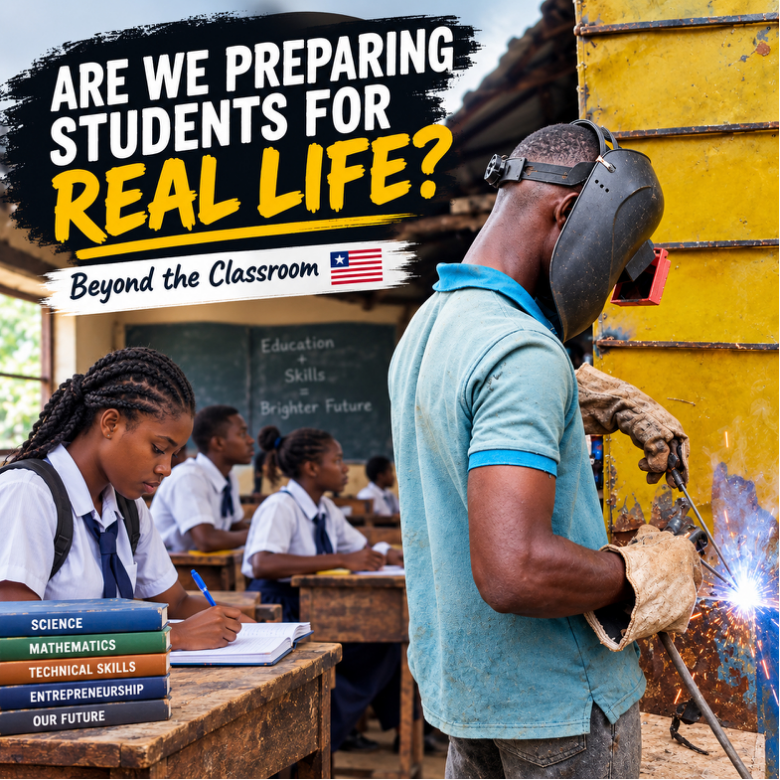
Each year, thousands of young Liberians leave high school carrying certificates, ambitions, and hopes for the future. These young people are expected to become part of the workforce and contribute to the transformation of Liberia in areas such as health, security, agriculture, technology, business, and other sectors.
By Kalifa M. Sackor Jr., contributing writer
But an important question remains: Are we giving them enough practical skills to navigate the world beyond the classroom?
The world is changing rapidly. Technology is changing how people work, businesses are changing how they operate, and countries are continuously looking for ways to improve the skills of their citizens. Liberia cannot afford to ignore these changes. At the same time, however, Liberia must recognize its own socioeconomic realities. Our approach to education should therefore not simply copy what works in other countries. It should respond to the conditions and opportunities that exist within Liberia.
Education should certainly provide academic knowledge. Mathematics, science, language, history, and other subjects are essential. Academic education develops knowledge and prepares students for further studies and professional careers. However, education can also do something more: it can help young people understand how to apply what they learn to real-life problems.
This is where technical and entrepreneurial education deserves greater attention in Liberia.
The idea of practical education is not new. Booker T. Washington, for example, strongly advocated industrial and vocational education, emphasizing practical skills, work, economic independence, and the dignity of labor. Liberia’s situation today is not directly comparable to that of the United States during Washington’s time, but the broader principle remains relevant: education should not only give people knowledge; it should also help them develop the ability to use that knowledge productively.
My own experience has influenced how I view this issue. My educational background in electronics gave me technical knowledge, but my involvement in welding, fabrication, and entrepreneurship has exposed me to lessons that cannot be fully learned from textbooks alone. Working with my hands, solving practical problems, dealing with customers, managing costs, and trying to turn technical skills into economic opportunities have shown me the value of combining education with practical experience.
This experience has also made me think about what could happen if more young Liberians were given opportunities to discover and develop practical abilities while they are still in high school. Not every student will become a technician, tradesperson, or entrepreneur, but students should have the opportunity to discover what they are capable of doing before they leave the education system.
The goal is not to turn every high school student into a business owner, nor should vocational training replace academic education. Rather, students should have opportunities to discover their practical abilities, learn how things work, understand basic financial principles, solve problems, and develop skills that can prepare them for different paths after high school.
Those paths may include university education, professional careers, employment, skilled trades, entrepreneurship, or further technical training.
The question, therefore, is not whether academic education is important. The question is whether academic education alone is enough for our Liberian youths.
This question becomes more important when we consider the situation facing young Liberians.
According to Liberia’s 2024 Labor Force Survey, conducted by the Liberia Institute of Statistics and Geo-Information Services (LISGIS) and the Ministry of Labor (MOL), 44.2 percent of young people aged 15–24 were not in education, employment, or training (NEET).
This statistic does not mean that a lack of technical education is the cause of this situation. There are many factors that influence whether young people find employment, remain in education, or receive further training. However, it does highlight a serious challenge in the transition from youth to productive economic activity.
It should therefore make us ask: What happens to a young Liberian after leaving school if they have an academic certificate but no practical skill, work experience, or understanding of how to create economic opportunities?
For some students, university will be the next step. But not every student will attend university, and not every student will follow the same career path. Some will enter the workforce. Some may want to establish businesses. Others may have abilities that are better developed through practical training.
This is where technical and entrepreneurial education can play an important role.
Imagine a high school student being introduced to basic electrical work, welding, electronics repair, air-conditioning and refrigeration, agriculture, construction, information and communication technology, tailoring, mechanics, or other practical areas. Alongside these skills, the student could learn basic entrepreneurship, financial literacy, marketing, customer service, and problem-solving.
Such education would not guarantee employment or business success. But it could give young people additional tools with which to respond to the realities they will face after school.
For example, a student who learns electronics repair may eventually become an electronics technician, work for a company, establish a repair business, or continue into higher education in electronics or electrical engineering. A student exposed to agriculture may develop an interest in commercial farming or agricultural technology. A student introduced to welding may discover a career in fabrication, construction, manufacturing, or engineering.
The important point is that students would have an opportunity to discover these possibilities before leaving the education system.
Liberia does not necessarily need to turn every high school into a fully equipped vocational institution. That would require significant financial resources, infrastructure, equipment, instructors, and maintenance. A more realistic approach could involve partnerships between schools, technical institutions, local businesses, workshops, and professionals.
Schools could establish practical-skills clubs, entrepreneurship programs, career-exposure activities, short technical courses, or partnerships with local businesses where students can receive supervised practical experience.
This approach could also benefit local businesses. A welding workshop, electrical business, electronics repair shop, farm, construction company, or technology business could become part of the learning environment by exposing students to real-world work.
Entrepreneurial education is equally important. Teaching entrepreneurship should not simply mean telling every student to “start a business.” It should teach students how to identify problems, understand customers, calculate costs, manage money, evaluate risks, develop solutions, and recognize opportunities. These skills can be useful even for someone who eventually becomes an employee rather than a business owner.
Ultimately, the purpose of education should be broader than preparing students to pass examinations.
A certificate is valuable, but a certificate should not be the only thing a young person leaves high school with. Students should leave with knowledge, but where possible, they should also leave with practical abilities, problem-solving skills, financial awareness, and a better understanding of how their knowledge can be applied in the real world.
Liberia’s future depends heavily on its young people. If we expect them to contribute to the development of the country, we must also consider whether our education system is giving them the tools to do so.
The answer may not be to choose between academic education and technical education. Perhaps the better approach is to give young Liberians both.
Because the real question is not simply whether our students are learning.
It is whether we are preparing them for life after learning.
Source: Liberia Institute of Statistics and Geo-Information Services (LISGIS) & Ministry of Labor (MOL), Liberia Labor Force Survey Results, 2024. Reported in: International Monetary Fund, Liberia: Poverty Reduction Strategy Paper, IMF Country Report No. 25/292, 2025.
Author Bio
Kalifa M. Sackor Jr. is a Liberian entrepreneur and electronics-trained technical practitioner with experience in welding, fabrication, and small-business development. His interests include practical education, entrepreneurship, youth development, and creating opportunities for young Liberians to acquire skills that can be applied beyond the classroom.
Support Independent Journalism
Your support helps FrontPage Africa continue delivering independent, credible, and impactful journalism. Every contribution strengthens our ability to investigate, inform, and hold power accountable while keeping quality journalism accessible to our readers.
Support our journalism or subscribe to receive the latest FrontPage Africa stories and updates.