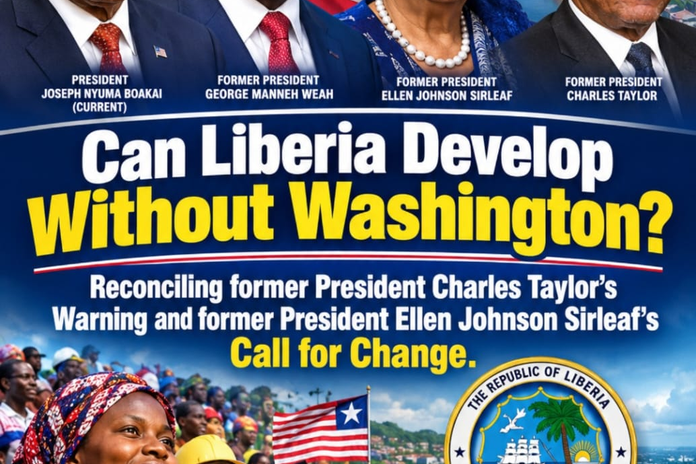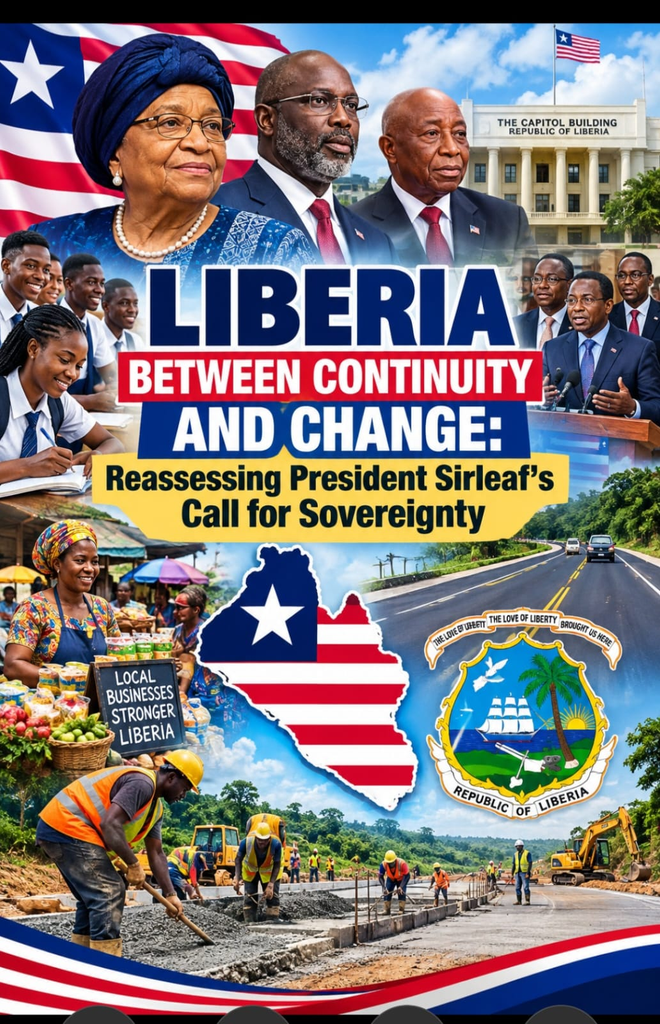
Former President Sirleaf: Liberia has been doing the same thing over and over, same structures, same type of policies, same type of attitudes, and mindset. It is time for change; Africa is changing, the world is changing, and Liberia can not be left behind. It will not happen until we agree to change our country. We have to stop following the United States of America. Let’s join the new area of sovereignty and respectability that Africa is pushing.” Source: Facebook, Voice of Liberia. https://www.facebook.com/share/v/18DEF7UL35/
By: Austin S Fallah – A True Son of the Planet Earth Soil: [email protected]
Former President Ellen Johnson Sirleaf: China’s Economic Agenda: In discussions regarding China’s role in Africa, such as in interviews with the Council on Foreign Relations, former President Sirleaf noted that China’s primary motivation was gaining rapid access to raw materials to sustain its domestic growth.
- Former President Sirleaf: Credited Chinese investors and government programs with moving quickly and flexibly to address critical infrastructure needs, such as roads and public buildings, when traditional Western partners were more cautious.
- Relations with the United States: Former President Sirleaf consistently maintained that Liberia’s partnership with Beijing did not conflict with its historic and strategic relationship with Washington.
The Inquirer Monrovia: February 26, 2008. By: Patrick K. Wrokpoh: www.allafrica.com/Liberia:
“America Has No Problem With China-Liberia’s Relations”
“The office of President Ellen Johnson Sirleaf says Liberia’s traditional friend, the United States of America, has no problem with the existing ties between Liberia and the People’s Republic of China.
President Sirleaf’s Press Secretary, Cyrus Wleh Badio, who briefed Executive Mansion reporters yesterday on details of President Sirleaf’s meeting with George W. Bush last Thursday, quoted President Bush as making it clear that his country has no problem with Liberia’s relations with China.”
“Liberia is a country with a rich history, but it has been slow to progress.” — President Joseph Nyuma Boakai, Independence Day Address, 2024.
“Reversal of multilateralism is not an option for a just and peaceful world.” — President Joseph Nyuma Boakai, UN General Assembly Address, 2025.
“We call for greater inclusion, effectiveness, and respect for international law.” — President Boakai, UN General Assembly, 2025.
“Liberia remains positively engaged with its partners and friends at the bilateral and multilateral levels…with keen focus on national interest.” —Former President George Weah, 2021 State of the Nation.
Former President Weah: Identified Liberia’s foreign-policy objectives as including: “The preservation of the territorial integrity and sovereignty of the country “
Former President Ellen Johnson Sirleaf’s 2006 Inaugural Address: “Good neighborliness, non-interference, peaceful co-existence, regional cooperation and integration.”
Hon. Alexander B. Cummings, ANC Political Opposition Leader: In his 2020 address, Cummings recalled Liberia’s founding declaration in these terms: “We were free, equal to all nations, and not the subject of any nation.”
Hon. Benoni Urey — Opposition Political Leader: Discussing investment, he argued, “Foreign investment must also be prioritized.”
Former President Julius Nyerere — Tanzania, 1968: “No nation has the right to make decisions for another nation; no people for another people.”
“Mutually beneficial co-operation among the nations of the world.” — Former President Nelson Mandela, Non-Aligned Movement Address, 1998.
Ngũgĩ wa Thiong’o — Kenyan Novelist: “Africa actually enriches Europe.”
Ngũgĩ argued that:
“Economic and political control of a people can never be complete without cultural control.”
Former Liberian President Ellen Johnson Sirleaf’s statement that Liberia must stop repeating “the same thing over and over”, the same structures, policies, attitudes, and mindsets, raises an important question about the country’s political and economic direction.
Her argument that Liberia should not merely follow the United States but should instead join Africa’s emerging “era of sovereignty and respectability” reflects a powerful appeal for national self-determination.
At the same time, this appeal must be compared with the position expressed by her office in 2008, when it stated that the United States had no problem with Liberia’s relationship with the People’s Republic of China.
The two statements are not necessarily contradictory.
Both recognize that Liberia can maintain relations with multiple global powers.
However, they differ significantly in tone, political urgency, and implied criticism of Liberia’s historical dependence on the United States.
The central issue is whether Liberians should now heed Sirleaf’s call for change, even though she served as president from 2006 to 2018 and had considerable opportunity to advance the reforms she later described as necessary.
The answer should be neither an unquestioning yes nor a dismissive no.
Liberians should take the substance of her message seriously because Liberia still faces structural challenges that require a new national mindset.
Yet they should also evaluate her words critically, because leadership is measured not only by speeches after office but also by decisions made while holding power.
Former President Sirleaf’s legacy demonstrates both the possibilities and limitations of reform within a deeply dependent political and economic system.
Former President Sirleaf’s later statement is fundamentally a critique of repetition.
She argues that Liberia has continued with the same structures, policies, attitudes, and mentality despite changes occurring across Africa and the wider world.
This observation has strong historical relevance.
Liberia’s political history has often followed recurring patterns: centralized authority, elite control over resources, weak public institutions, dependence on foreign capital, inadequate investment in rural communities, and a tendency to expect external partners to solve domestic problems.
The country’s civil wars, public health crises, youth unemployment, poor infrastructure, and persistent corruption have all exposed the consequences of weak institutions and uneven development.
When former President Sirleaf says that Liberia must change, she is therefore not merely speaking about foreign policy.
She is speaking about national political culture.
A country can not become sovereign simply by announcing independence from foreign influence.
Sovereignty requires functioning institutions, accountable leadership, economic productivity, social cohesion, and citizens who believe that public office exists to serve the nation rather than private interests.
Liberia’s problem has never been only its relationships with powerful countries.
Every small country needs external partnerships.
The deeper problem is whether those relationships are managed from a position of national strategy or from a position of dependency and political vulnerability.
This distinction matters especially when comparing former President Sirleaf’s call to move away from “following the United States” with the 2008 statement on China-Liberia relations.
According to a report in The Inquirer Newspaper, published on www.allafrica.com/Liberia, former President Sirleaf’s office said the United States had no problem with Liberia’s existing ties to China.
The 2008 statement was diplomatic and reassuring.
It suggested that Liberia did not need to treat relations with Washington and Beijing as mutually exclusive.
Rather than framing China as a threat to Liberia’s traditional friendship with the United States, the statement presented the two relationships as compatible.
In practical terms, that position made sense. Liberia emerged from years of conflict with enormous reconstruction needs.
Roads, electricity, schools, hospitals, water systems, ports, and public institutions required major investment.
The United States remained an important historic partner, especially in areas such as governance, education, security, humanitarian assistance, and public health.
China, meanwhile, was becoming an increasingly significant actor across Africa through infrastructure projects, trade, loans, technical assistance, and diplomatic engagement.
For Liberia, cultivating relationships with both countries was not necessarily ideological inconsistency; it was a matter of national necessity.
The major difference between the 2008 position and the later statement lies in emphasis.
In 2008, former President Sirleaf’s administration appeared focused on assuring both the United States and China that Liberia’s diplomacy would remain balanced.
This cautious approach suited a postwar government seeking international legitimacy and investment.
Liberia could not afford to alienate the United States, which had played a major role in supporting the country’s recovery. Nor could it ignore China’s growing economic influence.
The message was essentially one of diplomatic inclusion: Liberia could work with China without abandoning its historic relationship with the United States of America.
By contrast, the latter statement has a more forceful and transformational tone.
It suggests that Liberia’s long habit of looking to the United States for direction may have become an obstacle to independent national development.
The phrase “We have to stop following the United States of America” should not necessarily be interpreted as a demand to end diplomatic relations with America.
Such an interpretation would be unrealistic and potentially harmful.
Instead, the statement can be read as a warning against psychological, political, and economic dependence.
Former President Sirleaf appears to be challenging Liberians to stop treating U.S. approval as the primary measure of national success.
This is an important distinction. A sovereign Liberia can maintain strong relations with the United States while refusing to be defined by those relations.
It can cooperate with China while demanding transparency, fair contracts, local employment, environmental protections, and long-term benefits for Liberian citizens.
It can partner with the European Union, ECOWAS, the African Union, India, Brazil, the Gulf states, and multilateral institutions without surrendering its national priorities.
Genuine sovereignty is not isolation. It is the capacity to choose partnerships based on the interests of the Liberian people.
Nevertheless, former President Sirleaf’s critics have reason to ask why this call for a new mindset was not more fully implemented during her presidency.
She inherited a country devastated by civil war, and it would be unfair to ignore the difficult conditions under which she governed.
Her administration helped restore international confidence in Liberia, secured debt relief, attracted donor support, rebuilt elements of state administration, and guided the country through major crises, including the Ebola epidemic.
Her election itself was historically significant, both for Liberia and Africa, as she became Africa’s first elected female head of state.
These accomplishments should not be minimized.
Yet her administration also faced serious criticism for failing to transform the very structures she later condemned.
Corruption remained a persistent concern. Economic growth did not sufficiently improve the lives of many ordinary Liberians.
Youth unemployment and underemployment remained widespread. Public services, especially outside Monrovia, continued to be weak.
The management of natural resources and concession agreements often raised questions about transparency, community benefits, and the distribution of national wealth.
Many citizens believed that political and economic power remained concentrated among a relatively small group of elites.
These criticisms do not mean that Sirleaf did nothing. Rather, they illustrate how difficult it is to reform a state where institutions are fragile and expectations of government are high.
They also show that political will alone is not enough.
A president may introduce reforms, but lasting change requires a civil service capable of enforcing laws, a legislature willing to exercise oversight, courts able to act independently, journalists free to investigate wrongdoing, and citizens prepared to demand accountability.
In Liberia, the problem of “same structures” cannot be blamed on one leader alone, even though every president bears responsibility for the choices made during his or her administration.
The question, then, is whether Sirleaf’s statement should be rejected because she did not fully achieve the change she now advocates.
That would be too simplistic. Political leaders can recognize unfinished work, and former leaders can still make valid observations about national problems.
A message should be judged by its truth as well as by the messenger’s record.
Liberia does need institutional reform, a stronger national identity, economic diversification, and a foreign policy based on self-respect.
If Sirleaf’s statement encourages citizens to think more critically about dependency, it has value.
However, Liberians should not simply “heed” the message in a passive sense.
They should convert it into concrete demands.
Calls for sovereignty must be matched by specific policies. For example, Liberia should develop a long-term national development strategy that is not rewritten every time a new administration takes office.
Such a strategy should prioritize education, agriculture, energy, health care, technology, transportation, and industrial development.
Liberia can not claim economic independence while importing basic food products that could be grown locally, exporting raw materials without processing them, and relying heavily on foreign aid to fund essential public services.
Liberia also needs greater transparency in its international agreements.
Whether a contract involves an American, Chinese, European, African, or Liberian company, citizens should be able to know the terms.
How much revenue will the government receive? How many Liberians will be employed? What protections exist for communities affected by mining, logging, agriculture, or infrastructure projects?
What environmental standards will be enforced? How will the agreement contribute to local capacity rather than merely extract resources?
Sovereignty is weakened when foreign agreements are negotiated in secrecy or when national leaders cannot explain how those agreements benefit the public.
The United States-China dimension should therefore not become a distracting ideological contest.
Liberia should avoid being pressured into choosing one global power over another.
The country’s leaders must reject the false choice that partnership with China automatically means hostility toward the United States, or that cooperation with the United States requires suspicion of China.
The 2008 statement from Sirleaf’s office correctly recognized this point. Liberia has the right to maintain constructive relations with both countries.
What matters is whether these relationships are balanced, transparent, and aligned with Liberian interests.
At the same time, Sirleaf’s later warning about “following” the United States deserves attention because historical relationships can create habits of dependence.
Liberia and the United States share unusually deep ties rooted in Liberia’s founding and in generations of political, cultural, religious, and economic interaction.
These ties can be beneficial, but they can also encourage the belief that Liberia’s future must always be validated from outside.
A mature relationship with the United States should be based on mutual respect, not paternalism.
Liberia should welcome American investment, educational exchange, trade, and support for democratic institutions, while retaining the confidence to disagree when national interests require it.
Similarly, Liberia must engage China with clear-eyed realism.
Chinese investment and infrastructure support can contribute to development, but such engagement should not be romanticized.
Liberia must guard against unsustainable debt, opaque contracts, weak labor protections, environmental damage, and projects that do not build domestic capacity.
The same standard should apply to every foreign partner. The issue is not whether a partner is American, Chinese, European, or African; the issue is whether Liberia’s leaders negotiate responsibly and whether Liberians receive durable benefits.
Ultimately, former President Sirleaf’s two statements can be understood as parts of a larger argument for diplomatic flexibility.
The 2008 statement defended Liberia’s right to cooperate with China without fear of U.S. opposition.
Her later statement calls for Liberia to become more independent in its thinking and more committed to African sovereignty.
Together, they suggest that Liberia should not be trapped by old alliances or new rivalries.
Instead, it should build relationships that serve a national development agenda.
Liberians should therefore listen to Sirleaf’s call for change, but they should also insist on accountability from all leaders, including former leaders who now speak about reform.
The country can not afford another cycle in which politicians condemn failed structures after benefiting from them while in office.
Change must become more than rhetoric. It must mean stronger institutions, transparent governance, productive investment, civic participation, and a foreign policy guided by Liberia’s own priorities.
Liberia does not need to abandon the United States in order to be sovereign, nor does it need to embrace China uncritically in order to be modern.
What it needs is the confidence to engage every nation on equal terms. That is the “respectability” former President Sirleaf invokes: not dependence on one power, not submission to another, but a Liberia capable of deciding its future for itself.
Support Independent Journalism
Your support helps FrontPage Africa continue delivering independent, credible, and impactful journalism. Every contribution strengthens our ability to investigate, inform, and hold power accountable while keeping quality journalism accessible to our readers.
Support our journalism or subscribe to receive the latest FrontPage Africa stories and updates.