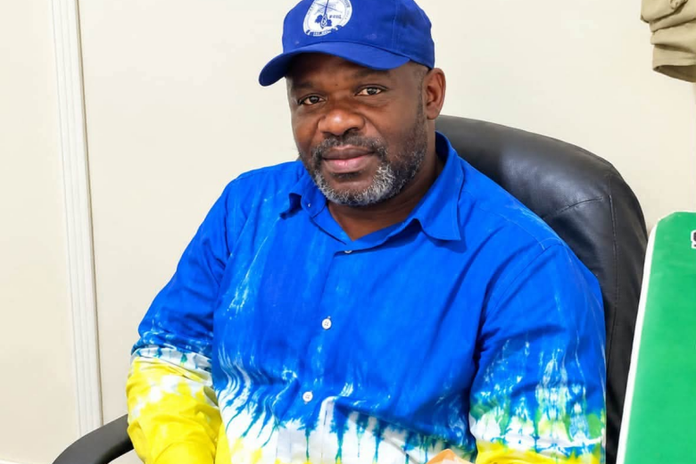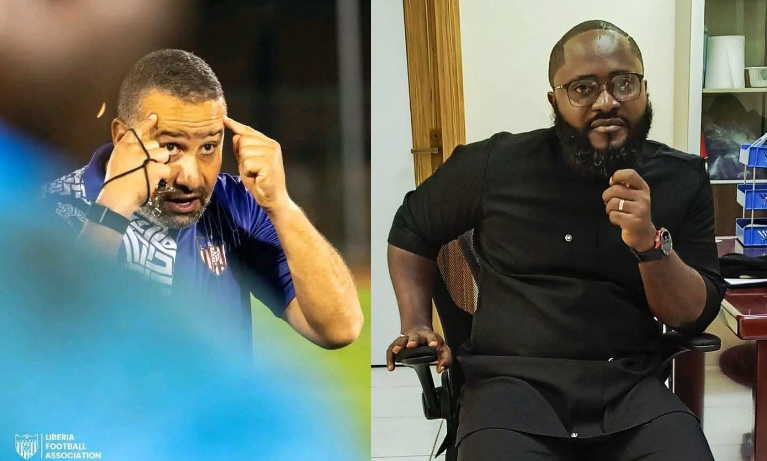
MONROVIA — Veteran Liberian sports journalist Webster Cassell has called for patience with Lone Star head coach Mohammed Adil Erradi, urging Liberians to resist judging the Moroccan-Belgian tactician solely on the back of a single setback.
By: Christopher C. Walker | [email protected]
In a detailed post on his social media page titled “DON’T CONDEMN A COACH AFTER ONE DEFEAT Give Coach Erradi A Chance,” Cassell argued that Erradi’s extensive pedigree and success across African football merit fair consideration before final conclusions are drawn regarding his ability to lead the national team.
The appeal follows Liberia’s 3–1 defeat to Rwanda in Kigali during their opening 2027 Africa Cup of Nations (AFCON) qualifying fixture a result that sparked intense public debate over the technical direction of the Lone Star.
While acknowledging the high expectations surrounding national team football, Cassell stressed that constructive criticism must be grounded in long-term performance trends rather than knee-jerk reactions.
Erradi’s African Footprint
Cassell’s primary argument rests on Erradi’s established track record across the continent, where the coach has managed competitive setups in Morocco, Ghana, and Rwanda.
Notably, Erradi served as assistant coach to Juan Carlos Garrido at Moroccan powerhouse Raja Casablanca in 2017 before moving to Rwanda’s APR FC, where he oversaw one of the most dominant periods in the club’s history.
During his tenure with APR FC, Erradi guided the side to three consecutive Rwanda Premier League titles, anchored by a 50-match unbeaten streak.
He also led APR into the second round of the CAF Champions League in 2022, earning the Rwanda Championship Coach of the Year award.
“These are not insignificant accomplishments, nor are they the credentials of a coach who is unfamiliar with the African football landscape,” Cassell wrote.
Transition from Club Success to National Team Duty
Following his success in Rwanda, Erradi coached Kawkab Athletic Club of Marrakech in Morocco before taking the helm of the Liberian national team.
However, Cassell conceded that domestic dominance does not automatically yield international success. Managing a national team presents distinct challenges, requiring quick adaptation to limited preparation time, diverse player pools, and tactical execution under intense international pressure.
“Ultimately, Erradi’s tenure should be assessed on the strength of his work with Lone Star the team’s tactical development, the competitiveness of its performances, and the results it delivers in qualifiers and other international fixtures,” Cassell noted.
Tactical Philosophy Under Scrutiny
The 3–1 loss in Kigali exposed early defensive vulnerabilities, with the hosts taking a 2–0 lead before Sylvanus Nimely pulled one back for Liberia. A late first-half penalty restored Rwanda’s two-goal cushion, leaving the Lone Star unable to mount a second-half comeback.
Despite the setback, Cassell cautioned against dismantling the technical setup over a single match.
He highlighted Erradi’s structured philosophy—which prioritizes defensive compactness, collective discipline, and organization as a necessary foundation for Liberia’s long-term growth.
Patience Without Abandoning Accountability
Cassell emphasized that supporting the technical team does not mean shielding them from scrutiny, but rather ensuring that evaluations are fair, objective, and given time to mature.
“We cannot demand progress while simultaneously denying the technical team the patience and collective support required to build a competitive side,” Cassell argued, adding that responsibility for national team success is shared across players, the Liberia Football Association (LFA), government stakeholders, and supporters.
“Let us support the process without abandoning accountability. Let us demand results without rushing to condemn,” Cassell concluded. “And let us judge the technical team by what it delivers on the pitch over time, not by premature assumptions.”
Support Independent Journalism
Your support helps FrontPage Africa continue delivering independent, credible, and impactful journalism. Every contribution strengthens our ability to investigate, inform, and hold power accountable while keeping quality journalism accessible to our readers.
Support our journalism or subscribe to receive the latest FrontPage Africa stories and updates.