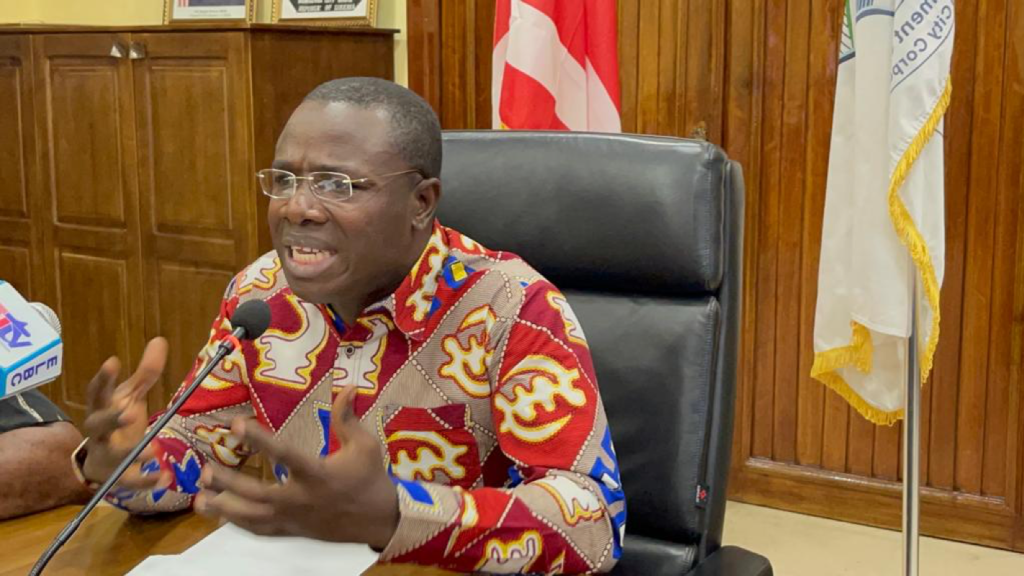
Former Monrovia City Mayor Jefferson T. Koijee says handing over the 19th Street premises does not amount to surrender or an admission of guilt, accusing the Boakai-Koung administration of political persecution while declaring 2029 as his political destination.
Former Monrovia City Mayor Jefferson T. Koijee says he has officially handed over a disputed property on 19th Street, Coleman Avenue, in Sinkor, to Vice President Jeremiah Kpan Koung following an intervention by his spiritual adviser, Pastor Philemon A. Tarpeh.
In a public statement, Koijee said the decision was driven by his faith and commitment to peace, insisting that relinquishing the premises should not be interpreted as an admission of wrongdoing or a retreat from his political struggle.
“I have chosen peace. My faith remains unshaken. 2029 is our destination,” Koijee declared, signaling his intention to remain politically active ahead of the next presidential election.
The former mayor, who served under the administration of ex-President George Manneh Weah, used the statement to renew allegations of political persecution against the administration of President Joseph Nyuma Boakai and Vice President Koung.
At the center of his argument is the ownership dispute surrounding the Sinkor property.
Koijee recalled that on September 18, 2018, then Managing Director of the Liberia Water and Sewer Corporation, Mo Ali, publicly alleged that he had acquired a house valued at US$250,000 in less than nine months.
According to Koijee, the allegation followed him for years and was repeatedly used to portray him as corrupt.
However, he said a writ of summons issued by the Monrovia City Magisterial Court on October 13, 2026, identifies Vice President Koung as claiming the same property.
He questioned how the property could have been attributed to him in 2018 but is now being claimed by the Vice President.
“So which lie were they telling then, and which lie are they telling now?” Koijee asked, challenging the government to explain the circumstances surrounding the competing claims.
He said the Boakai-Koung administration owes the Liberian public an explanation, although the competing ownership claims and the legal status of the property remain matters requiring clarification through the appropriate legal process.
Koijee also revisited the international sanctions announced against him on December 8, 2023, saying his political opponents celebrated the development as the end of his political career.
He claimed that the sanctions resulted in repeated visa denials and other restrictions but credited Pastor Tarpeh’s prayers and spiritual support for helping him overcome the difficulties.
“The man they buried is still standing,” he said, invoking biblical passages to reinforce his message of resilience and faith.
The former mayor further rejected allegations linking him to criminal activities, including murder, accusing the current administration of using state institutions and public platforms to tarnish his reputation.
Koijee argued that despite nearly three years of accusations, authorities had failed to prove the allegations against him in court.
“They called me a criminal. They called me a murderer,” he said. “For almost three years the Boakai-Koung regime has controlled the police, the prosecutors, and the microphones, and not one case has been proven against me.”
He challenged the government to produce evidence supporting the allegations, including financial records and properties allegedly linked to him.
However, his claims about the absence of proven cases do not, on their own, establish that all allegations against him are unfounded. The specific status of any investigations or proceedings would need to be established through official records.
In defending his public service record, Koijee cited his tenure as Monrovia City Mayor, arguing that he prioritized public service over personal comfort.
He said he continued using an official vehicle purchased by his predecessor rather than requesting a new one, adding that he nearly lost his life in an accident involving the same vehicle on June 16, 2018.
Koijee maintained that throughout his six years as mayor, he never purchased a new official vehicle for himself and challenged critics to verify the claim through records at City Hall.
He also directed questions at Chairman George Sylvester Mulbah, demanding clarification over his alleged relationship with the Office of the Vice President.
“Seven statements, and still no answer. Are you employed in the Office of Vice President Jeremiah Kpan Koung? Yes or no?” Koijee asked.
He did not provide further details about the seven statements referenced in his challenge.
Despite handing over the disputed premises, Koijee said he would continue advocating for what he described as constitutional governance, independent courts and equal justice.
He framed the property handover as a decision to avoid confrontation rather than a withdrawal from the political arena.
“They can take a property, but they cannot take my voice, my faith, or the people’s hunger for change,” he declared.
Koijee concluded by reaffirming his political ambition ahead of the 2029 elections, describing the next presidential contest as the destination of his ongoing political struggle.
“I have handed over the premises. I have not handed over the truth,” he said.
The property dispute, the circumstances surrounding its handover and the competing claims of ownership are likely to remain subjects of public interest as the political exchanges between the former mayor and the current administration continue.
Support Independent Journalism
Your support helps FrontPage Africa continue delivering independent, credible, and impactful journalism. Every contribution strengthens our ability to investigate, inform, and hold power accountable while keeping quality journalism accessible to our readers.
Support our journalism or subscribe to receive the latest FrontPage Africa stories and updates.