“Stop the online gossip-innuendos, hooliganism, and complaining, and respectfully engage your Senators and Representatives on this important National Economic Endeavor. Don’t let this be another one week, or only 7-days Wahala oooooo. Call them, intelligently engage them on the importance of such undertaking.” -Austin S Fallah.
By: Austin S Fallah – A True Son of the Planet Earth Soil:[email protected]
“Liberians should heed Senator Abraham Darius Dillon’s call to demand that lawmakers finally pass the bill for their salary reductions that has remained before the Legislature for years.
The 2027 national budget must not be approved without meaningful cuts to lawmakers’ salaries, allowances, and other benefits.
Liberia cannot continue with a system where public officials enjoy excessive compensation while the majority of citizens face severe economic hardship and poverty.
It is time to establish greater social and economic balance, accountability, and fairness in the management of public resources.
This situation has gone on far too long, and the people must insist on real reform.”
In every democracy, public office is supposed to be a call to service, not a pathway to excessive personal enrichment.
Elected officials are entrusted with public resources because citizens believe that those officials will use state power and public money to promote the welfare of the nation.
When the salaries, benefits, and privileges of public officials appear dramatically disconnected from the daily suffering of ordinary people, however, that trust begins to collapse.
Liberia is confronting this concern precisely.
As many citizens struggle with unemployment, rising living costs, inadequate health care, poor roads, limited electricity, and the burden of educating their children, reports and public discussions about high compensation for lawmakers and senior government officials have generated understandable outrage.
Montserrado County Senator Abraham Darius Dillon has brought this issue into sharper national focus by urging Liberians to do more than criticize public officials from a distance.
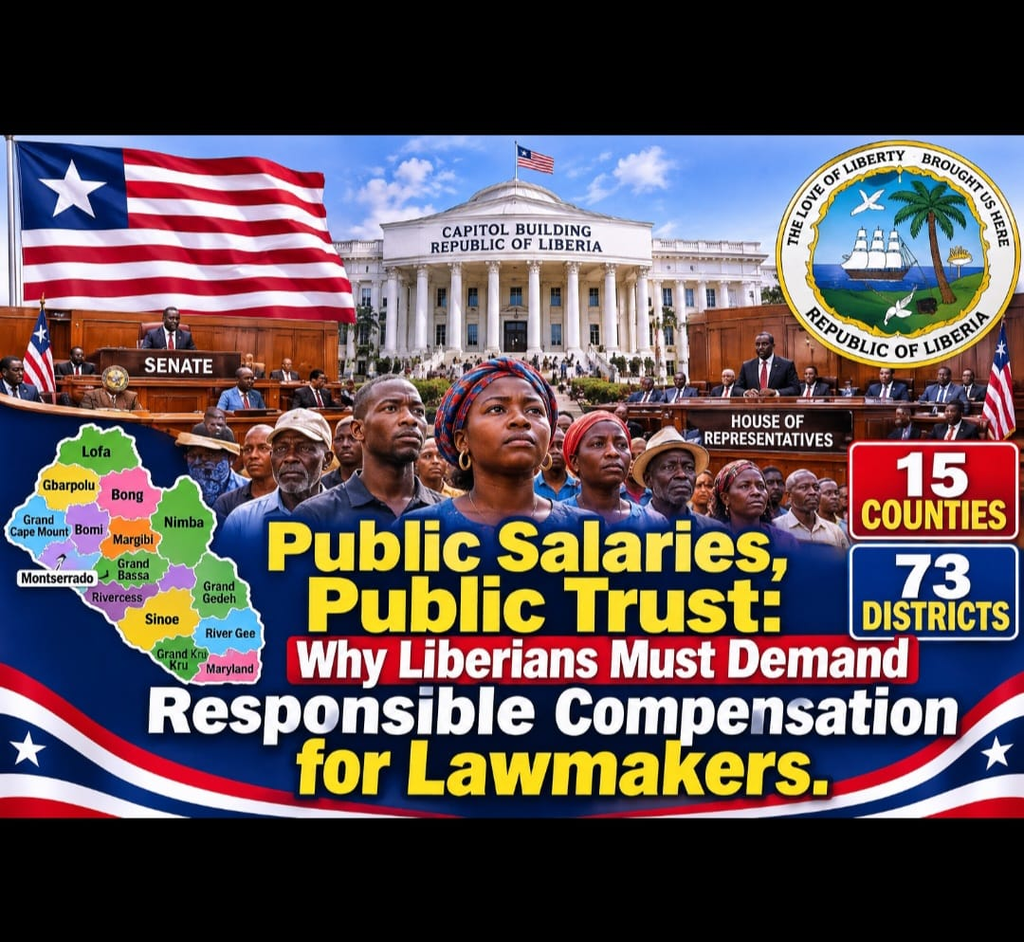
He has called on citizens to pressure their Senators and Representatives to support a bill that would reduce lawmakers’ monthly salaries to US$5,000.
His message is important because it shifts the debate from frustration to action.
Rather than merely complaining about extravagant public compensation, Liberians must engage the democratic process and demand accountability from those they elected.
This is not an attack on government; it is a demand for government to operate in accordance with the values of fairness, sacrifice, transparency, and public service.
The central argument is simple: when the majority of citizens live under severe economic hardship, lawmakers and high-ranking officials cannot reasonably justify compensation packages that seem excessive given the country’s economic realities.
Liberia needs a serious, respectful, and legally grounded review of public sector salaries and benefits, beginning with the Legislature itself.
Reducing lawmakers’ salaries to a more reasonable level would not solve every national problem.
Still, it would send a powerful message that public leadership is about service to the people, not privilege for the few.
First, legislative salaries are fundamentally a moral question.
Liberia remains a country in which many families struggle to meet their most basic needs.
Across communities, parents are unable to afford school fees, young people graduate without finding jobs, patients face medical emergencies without sufficient public health services, and households contend with food insecurity.
In such an environment, citizens naturally question why elected officials should receive compensation that many regard as disproportionately high.
The issue is not whether lawmakers deserve to be paid. They do. Legislators have important responsibilities: making laws, approving national budgets, representing constituencies, overseeing the executive branch, and debating policies that affect the entire country.
Those responsibilities require time, competence, independence, and fair compensation.
However, fair compensation is not the same as unlimited or excessive compensation.
A public official’s salary must be judged against the economic condition of the nation and the standard of living of the people being represented.
If citizens who pay taxes and depend on public services cannot afford necessities, then a political class enjoying unusually generous salaries and benefits creates an obvious contradiction.
Government cannot repeatedly ask citizens to make sacrifices while leaders remain unwilling to sacrifice themselves. A country cannot credibly promote austerity, fiscal discipline, and budget restraint if those who approve the national budget protect generous packages for their own offices.
This concern becomes even more significant when one considers the National Legislature’s role in approving government budgets.
Senators and Representatives are not passive observers of public spending.
They are among the very individuals responsible for reviewing, amending, and passing budgets into law.
Therefore, when Liberians discuss or ask about the salaries and benefits of the Deputy Governor of the Central Bank of Liberia and other high-ranking officials, they are discussing or asking a broader question about the entire budgetary system.
If certain public officials receive compensation that citizens consider too high, those figures did not appear by accident.
They emerged through official budget proposals, legislative reviews, negotiations, and legal approvals.
For this reason, lawmakers must be willing to account for their own salaries and benefits before focusing solely on the compensation of other public officials.
It is easy for political actors to criticize salaries in the executive branch, autonomous agencies, or public corporations.
Yet the Legislature must also examine itself.
Those who pass budgets should not place themselves beyond the scrutiny they demand of others.
The principle of accountability must apply equally to every branch of government.
No institution should be treated as too powerful, too important, or too politically sensitive to answer legitimate public questions.
A reduction of lawmakers’ salaries to $5,000 per month, as proposed in the public debate, should therefore be considered seriously.
Such a proposal may be controversial, and reasonable people may disagree about the exact figure.
Some may argue that legislators need sufficient pay to avoid corruption or to meet the obligations associated with public office.
Others may say the proposed amount should be adjusted for inflation, professional expectations, constituency responsibilities, and the need to attract qualified individuals into public service.
These concerns deserve consideration.
Still, they should not become excuses for preserving a compensation system that citizens view as unjust.
The most important principle is that legislative pay must be reasonable, transparent, and defensible.
If US$5,000 per month is the proposed ceiling, lawmakers should openly explain whether that amount is workable and, if not, clearly justify an alternative amount.
They should not dismiss the public’s concerns or hide behind technical language.
The debate should be based on facts: the national budget, the cost of living, civil servants’ salaries, the average income of Liberian households, and the amount allocated to essential services.
Citizens deserve to know not only the official salaries of their representatives but also the full value of allowances, fuel benefits, travel expenses, housing support, vehicles, medical coverage, staff budgets, and other privileges connected to public office.
Transparency is essential because salary debates can be misleading when only basic pay is discussed.
A government official may have a stated monthly salary that appears moderate but receive additional benefits that dramatically increase the total cost to taxpayers.
Conversely, public discussion can also become unfair when citizens hear exaggerated numbers without access to accurate documents.
The solution is not rumor, anger, or personal attacks. The solution is full disclosure.
Liberia should require a publicly accessible compensation report for all senior public officials, including members of the Legislature, cabinet officials, leaders of state-owned enterprises, autonomous agencies, and other highly paid public servants.
Such a report should clearly distinguish salary from allowances and explain the legal authority under which each payment is made.
The controversy surrounding the Central Bank of Liberia and its Deputy Governor illustrates why transparency is necessary, as Senator Dillon asked during the Deputy Governor’s confirmation hearing.
The question should not be whether citizens have the right to inquire about the compensation of public officials.
They absolutely do. Public funds are involved, and citizens have a legitimate interest in how those funds are allocated.
At the same time, the discussion should be fair and informed.
If compensation packages were approved through budgets submitted to the Legislature and passed into law, then responsibility belongs to the wider system of government, not merely to one individual or institution.
It would be unfair to single out a particular official while ignoring the lawmakers and budget authorities who approved the legal framework for such compensation.
This broader perspective matters because it prevents the country from turning a structural problem into a personal quarrel.
Liberia’s challenge is not simply that one officeholder, one agency, or one branch of government may have a high salary.
The larger issue is whether the national compensation system reflects the country’s values and priorities.
Does the budget place the needs of ordinary citizens first?
Does it invest adequately in hospitals, schools, sanitation, agriculture, roads, job creation, and social protection?
Are civil servants, teachers, nurses, police officers, and other frontline workers compensated fairly?
Are elected officials prepared to live by the same principles of restraint they encourage others to accept?
These questions should guide the national conversation.
Reducing lawmakers’ salaries could also produce practical benefits.
The money saved may not transform the entire national budget, but it could be directed toward programs that visibly improve the lives of ordinary people.
Even modest savings could support scholarships for disadvantaged students, medical supplies for clinics, equipment for public schools, assistance for vulnerable communities, or basic infrastructure projects.
More importantly, the reform would establish a precedent.
If lawmakers voluntarily accept reduced compensation, other senior government officials may be more willing to review their own packages.
It could encourage a culture in which public resources are treated with greater care.
Critics may argue that lower salaries could discourage talented individuals from entering politics.
But this argument assumes that the main motivation for public office should be financial reward.
While government must attract competent people, public leadership should not become a competition for the highest paycheck.
Liberia needs leaders motivated by patriotism, responsibility, and a genuine desire to improve the country.
A reasonable salary can support dignified public service without turning elected office into a privileged economic status unavailable to ordinary citizens.
Furthermore, excessive official pay can create a damaging political culture.
When citizens believe that politics is the quickest route to wealth, elections become more expensive, more divisive, and more vulnerable to corruption.
Candidates may spend enormous sums seeking office because they expect large personal returns after winning.
This weakens democracy.
Politics should be a mechanism through which citizens choose servants, not a marketplace in which powerful individuals compete for access to public funds.
Establishing reasonable and transparent compensation can help reduce the perception that political office is primarily an opportunity for personal gain.
Liberians must, however, pursue this cause respectfully and peacefully.
Senator Dillon’s call for citizens to engage their lawmakers should not be interpreted as a call for hostility, insults, intimidation, or violence.
A healthy democracy requires strong public pressure, but that pressure must be lawful and disciplined.
Citizens can write petitions, organize town hall meetings, call radio programs, engage civil society organizations, contact their representatives, participate in peaceful demonstrations, and use social media responsibly.
Community leaders, students, market women, youth organizations, professional associations, religious institutions, and the Liberian diaspora all have roles to play in demanding accountability.
Respectful engagement is especially important because the goal is not to destroy the Legislature but to strengthen it.
Liberians should want a Legislature that is independent, credible, responsive, and trusted.
A legislature that listens to the people and reforms its own compensation structure would earn greater respect.
By contrast, a legislature that ignores public hardship while defending high salaries and opaque benefits risks deepening public cynicism.
Democracy cannot survive on elections alone; it requires ongoing accountability between elections.
Ultimately, the debate over legislative salaries tests Liberia’s commitment to social justice and responsible governance.
It asks whether public resources will be managed in a way that reflects the hardship of the people or whether a privileged class will continue to be insulated from the consequences of economic struggle.
It asks whether lawmakers, who approve national budgets, are willing to subject themselves to the same scrutiny they apply to others.
It asks whether citizens will remain silent or use democratic means to demand change.
Liberians have every right to question the salaries and benefits of the Deputy Governor of the Central Bank, lawmakers, and other senior government officials.
But those questions must lead to a broader demand for a transparent, lawful, and equitable compensation system.
The National Legislature, in particular, must confront its own role in authorizing public expenditures and must be willing to lead by example.
A salary reduction to $5,000 per month may be a meaningful starting point, provided it is part of a larger reform agenda centered on transparency, fiscal responsibility, and public welfare.
The time has come for Liberians to rise, not in anger, but in civic responsibility.
They must respectfully confront their elected representatives, insist on open budgets, demand clear explanations for public compensation, and support reforms that place the interests of struggling citizens above the privileges of political office.
In a nation where so many are barely making ends meet, leadership must be measured not by how much officials receive, but by how much they are willing to sacrifice for the people they serve.
Support Independent Journalism
Your support helps FrontPage Africa continue delivering independent, credible, and impactful journalism. Every contribution strengthens our ability to investigate, inform, and hold power accountable while keeping quality journalism accessible to our readers.
Support our journalism or subscribe to receive the latest FrontPage Africa stories and updates.