Monrovia – The rice arrived in April 2023: 29,412 white sacks stacked in a warehouse, a gift from Saudi Arabia for Liberians made homeless by floods and fires. Officials in suits and Saudi aid workers in green vests posed in front of the pile for the cameras.
By Rodney D Sieh
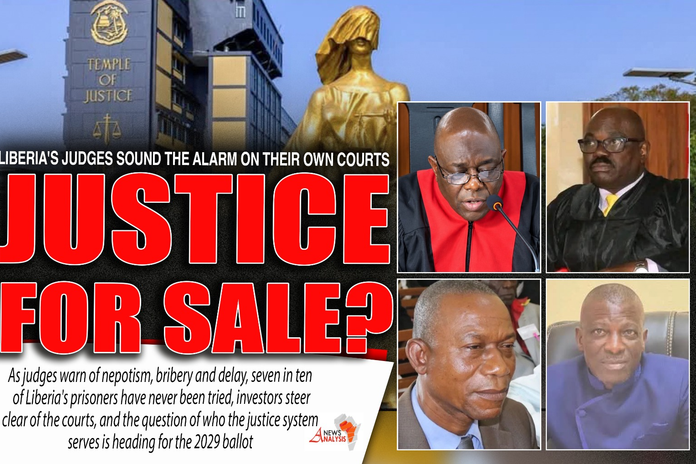
Three and a half years later, the man at the centre of that photograph, former Foreign Minister Dee-Maxwell Saah Kemayah, faces 10 years in prison. On Friday, inside the Temple of Justice in Monrovia, Judge Ousman Feika refused his request for a new trial and sentenced him and several co-defendants over the diversion of more than 25,000 bags of that rice. Prosecutors said the rice ended up on market stalls instead of with disaster victims. Within hours, Kemayah’s lawyers said they would appeal to the Supreme Court.
By the weekend, Weah’s Congress for Democratic Change (CDC) had issued a statement that went well beyond the case. It warned that its patience “must not be mistaken for weakness.” It accused President Joseph Boakai’s government of using courts and prisons as “instruments of political intimidation.” And it raised, without quite stating it, a question now common in Monrovia: after Kemayah, will they come for Weah?
‘Reckless, Provocative’
George Weah is the only African to have been named world footballer of the year. He grew up in a Monrovia slum, governed Liberia from 2018 to 2024, and handed over power peacefully after losing the 2023 election to Boakai, then 78, a veteran politician. Weah, now 60, has made no secret that he wants his old job back.
The CDC’s statement opens by condemning a publication it attributes to Philibert Browne. The party says the publication invokes Weah’s name in a way that is “reckless, provocative, and potentially harmful” to his reputation and his personal safety. It did not say what the publication alleged. It asked the government to guarantee the former president’s “security, dignity, and fundamental rights,” and criticised official “silence.”
There is no public sign that Weah is under investigation. But his party is clearly preparing supporters for that possibility, and setting up any future case against him as political before it begins.
A List of Grievances
To make its case, the CDC lists people. Each name carries a story.
Kemayah. He was Weah’s chief diplomat and now leads his own small party, the Movement for Economic Empowerment. The CDC says Weah chose him to deliver his message at the party’s Martyrs’ Day rally in Kinjor, Grand Cape Mount County, on November 7, six days before he was sentenced. His family has suffered too. His mother, known as Ma-Watta, died in March, and the family links her decline to the stress of his arrest.
Jewel Howard-Taylor. Weah’s vice president, 63 years old and the ex-wife of the jailed former warlord-president Charles Taylor. She has been in Monrovia Central Prison since August on drug-trafficking and money-laundering charges. Her lawyers asked that she be allowed to await trial outside jail because she suffers from asthma. The court refused.
Samuel Tweah. Weah’s finance minister and the most senior official of his government to be prosecuted, accused over the handling of more than US$6.2 million. A jury acquitted him in May, and the CDC celebrated. Then Judge Feika, the same judge who sentenced Kemayah on Friday, ruled that the integrity of the proceedings had been compromised. He set aside the not-guilty verdict, declared a mistrial, and sent all 15 jurors to prison for contempt. Tweah has since written to UN Secretary-General António Guterres, calling his prosecution part of a campaign to weaken the CDC before the 2029 vote.
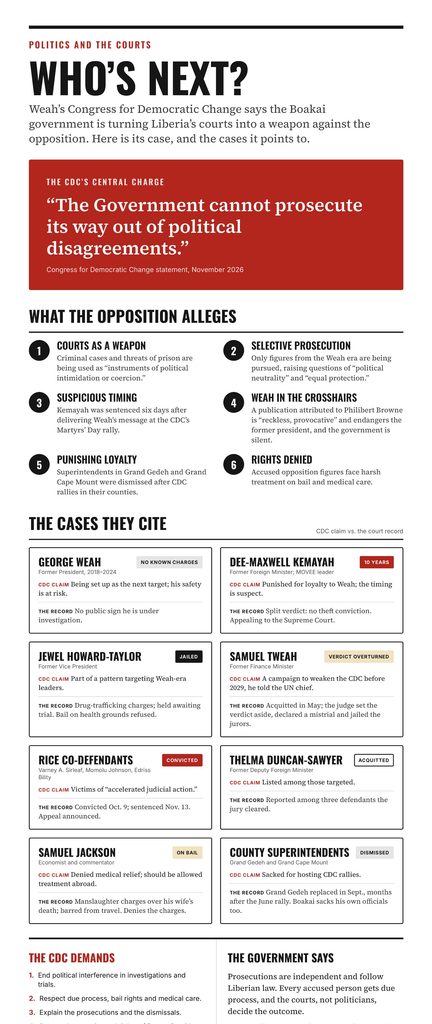
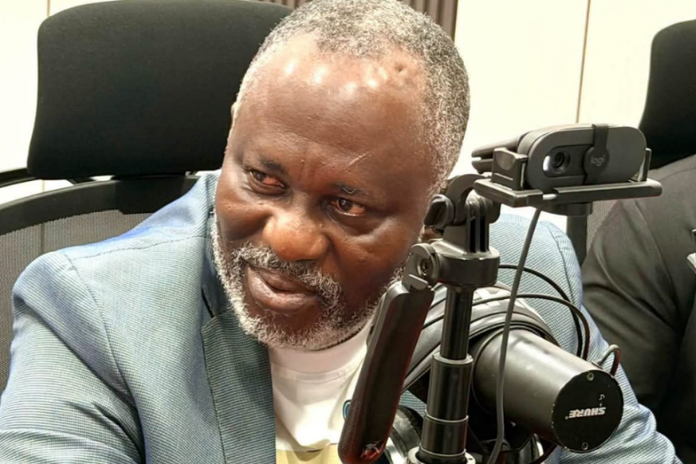
Samuel Jackson. A well-known economist and television commentator. In October, he was seen at the Temple of Justice being helped along by two men because he was struggling to walk. Since then, he has posted a photograph of himself lying in bed and pleaded for permission to travel abroad for medical treatment. He wrote that he wants fair treatment, not sympathy.
County superintendents. The officials who run Grand Gedeh and Grand Cape Mount counties, both of which recently hosted large CDC rallies, lost their jobs. The party says that is no coincidence.
Holes in the Narrative
Look closely and the list is uneven.
The CDC includes Thelma Duncan-Sawyer, Weah’s former deputy foreign minister, among those suffering “accelerated judicial action.” But the jury in the rice case appears to have acquitted her. It cleared three defendants in all. A court determined to punish the opposition does not usually set its targets free.
Jackson’s case is a personal tragedy, not an obvious political prosecution. He is charged with manslaughter and related offences over the March death of his wife, Toni Khumalo Jackson, a South African lawyer. Police say forensic evidence points to negligence. Jackson says she was injured in a fall, and he denies the charges. His health deserves humane treatment from the court. That does not make his prosecution a political act.
The superintendent claim is murky as well. Grand Gedeh received a new acting superintendent in September, months after the CDC’s June rally there. And Boakai has dismissed officials across his own government without explanation this year, including his own justice minister.
The Government’s Own Goals
Still, the government has handed its critics plenty of material.
The Tweah case is the clearest example. Overturning a jury’s acquittal and jailing the jurors who delivered it may have been legally justified. If the proceedings really were compromised, the court had a duty to act. But to a political audience it looks like a system that will not accept a not-guilty verdict for a CDC minister. Every jury that has sat in Criminal Court ‘C’ since then has known what happened to the last one.
Kemayah was convicted on a split verdict. The jury did not find him guilty of theft, and a prosecution witness testified that he halted the rice distribution once reports emerged that sacks were being sold. Liberia’s police chief publicly linked Howard-Taylor to the country’s record cocaine seizure, even as other officials insisted the two cases were separate. And when a president fires people without saying why, others will supply the reasons.
The biggest problem is a simple one. Every high-profile defendant so far served under Weah. Until the anti-corruption drive reaches someone close to Boakai, the charge of “selective justice” will keep landing.
Taking It Abroad
The CDC says it will “document abuses” and take its complaints to “domestic, regional, and international institutions.” In practice, that means West Africa’s regional bloc ECOWAS, foreign embassies and human rights monitors, following the path Tweah has already taken to the United Nations.
The statement closes on a line meant to rally supporters and to be read by diplomats: “Political opposition is not a crime. Loyalty to a former President is not a crime.”
Who Answers the Question?
Liberia is a small country of about five million people. It spent 14 years at war and two decades rebuilding fragile institutions. Its courts are now carrying a heavy load. The government says they are finally delivering accountability. The opposition says they are being used against it. Most Liberians are left somewhere in between: they want officials punished for stealing from flood victims, and they also want to be sure the judges are fair.
Kemayah’s appeal, Tweah’s retrial, Howard-Taylor’s trial and the government’s willingness to prosecute its own people will decide which account wins. For now, the CDC has asked the question. The government has not yet answered it.
Support Independent Journalism
Your support helps FrontPage Africa continue delivering independent, credible, and impactful journalism. Every contribution strengthens our ability to investigate, inform, and hold power accountable while keeping quality journalism accessible to our readers.
Support our journalism or subscribe to receive the latest FrontPage Africa stories and updates.