This sermon by Prophet Joshua Selman, although addressed to the clergy, helps inform this article—a political standpoint. https://www.facebook.com/share/v/1EypKHW5rZ/
https://www.facebook.com/share/r/1H9kHzDi3h/
By: Austin S Fallah – A True Son of the Planet Earth Soil: [email protected]
In politics, power often creates the illusion of independence.
Once a leader has won an election, occupied an executive mansion, received military salutes, appointed ministers, and gained the authority to sign laws, it can become easy to believe that success was achieved alone.
Yet no government, especially in a democracy as fragile and hard-won as Liberia’s, stands alone.
Every administration rests on pillars: the citizens who voted, the communities that mobilized, the civil servants who maintained the state, the party members who sacrificed, the institutions that protected the rule of law, and the bridges that connected leaders to people beyond their immediate circles.
A wise government understands that it must protect these pillars rather than weaken them.
A foolish government may focus on the roof, the furniture, and the appearance of power while ignoring the foundations that make power possible.
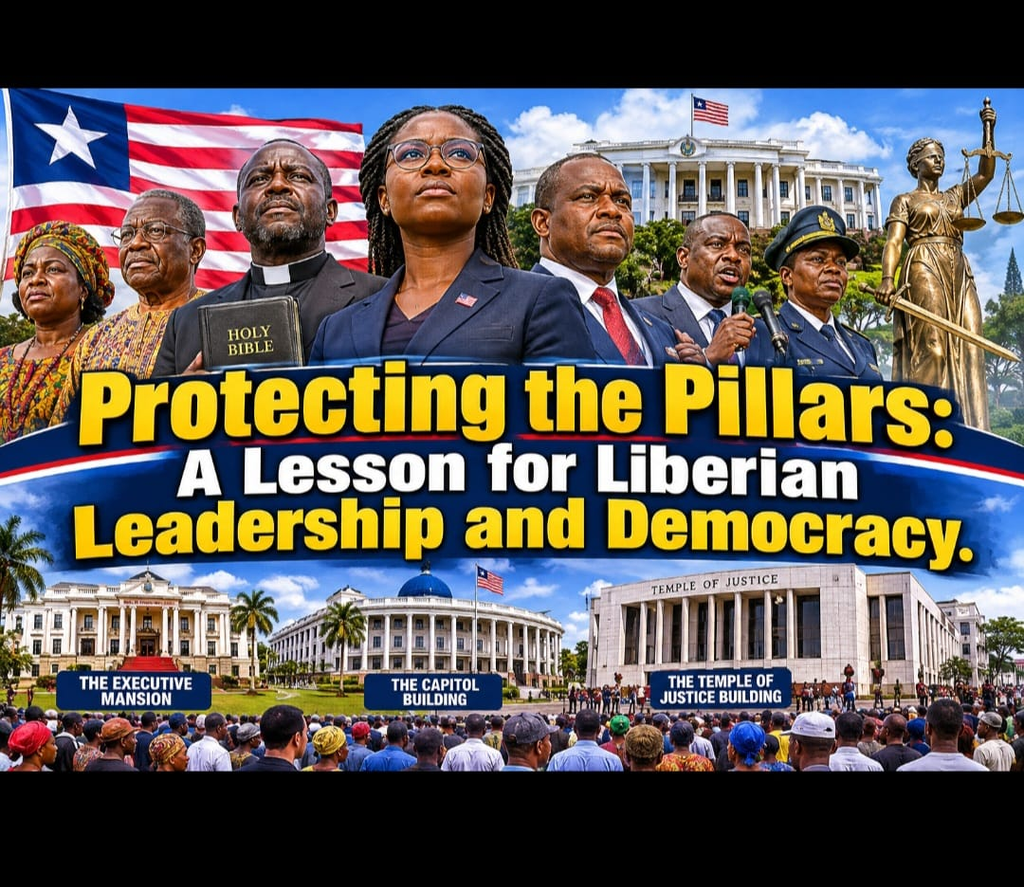
The lesson is simple but profound: any Liberian government must protect the pillars that helped it stand and the bridges that helped it cross.
These pillars should not be understood merely as political loyalists or wealthy supporters.
They include the democratic institutions, public trust, civil society organizations, traditional leaders, young people, women’s groups, the media, the judiciary, the Legislature, and ordinary citizens whose hopes sustain the legitimacy of the state.
A government that alienates these pillars may survive for a period, but it risks eventually collapsing under the weight of its own arrogance.
As the biblical story of Samson reminds us, it does not always take the destruction of an entire building to bring it down.
Samson did not need to hold every wall, every beam, or every corner of the structure.
He identified two important pillars, and when those pillars fell, the entire building came down.
Political leadership works the same way.
A government may possess money, security forces, international partners, and impressive buildings, but if it loses the pillars of public confidence and institutional credibility, its strength can disappear quickly.
Liberia’s history makes this lesson especially important.
The country has experienced periods of political tension, exclusion, conflict, and recovery.
Its people know what happens when leaders treat power as a private possession rather than a public trust.
They know the consequences of governments that ignore grievances, punish criticism, reward only a narrow group of insiders, or behave as though election victories give them unlimited authority.
Liberia’s painful past should teach every administration that stability cannot be built through speeches, appointments, or development projects alone.
Stability must be built through inclusion, fairness, accountability, and respect for the people.
A government may change the roof of a building.
It may repaint the walls, install new furniture, replace old floors, and place attractive decorations in every room.
In political terms, this can mean constructing roads, renovating public buildings, launching programs, attending international conferences, and making ambitious promises.
Such achievements matter, and citizens deserve development.
However, cosmetic improvement cannot compensate for a weak foundation.
A beautiful government building means little if the people inside it are disconnected from the citizens outside it.
A new road means little if communities feel excluded from decision-making.
An impressive national budget means little if public funds are not managed transparently.
A government can change the appearance of the state, but it cannot neglect the pillars of trust, justice, and participation without endangering everything it has built.
One of the most important pillars of any government is public trust.
Citizens may not agree with every decision their leaders make, but they must believe their leaders are acting in the public interest.
Trust grows when government officials explain their decisions honestly, obey the law, listen to criticism, and treat citizens equally.
Trust disappears when public officials use their offices for personal gain, ignore corruption, make promises they do not intend to keep, or speak to citizens only during campaign season.
Once public trust is damaged, rebuilding it becomes difficult.
People begin to doubt even good policies because they suspect hidden motives.
They become less willing to cooperate with government programs, pay taxes, respect public institutions, or believe official information during times of crisis.
For Liberia, where citizens have endured hardship and have often been asked to be patient, public trust is not a luxury; it is a national necessity.
The ordinary market woman, the motorcycle rider, the student, the farmer, the teacher, the health worker, and the unemployed graduate all deserve to feel that government sees them.
They should not have to know a minister, belong to a ruling party, or come from a politically favored county to receive respect or opportunity.
When government becomes distant from the people, it weakens one of its greatest pillars.
Leaders must remember that the same citizens who applaud at rallies also observe daily conditions in their communities.
They see whether schools have teachers, whether clinics have medicine, whether roads are passable, whether jobs are available, and whether justice is applied fairly.
Their judgment may not always be expressed immediately, but election day eventually gives them a voice.
Election days are the fruits of these reminders. Elections are not simply events on a calendar; they are moments of accountability.
They reveal whether leaders protected the bridges that connected them to the people or burned those bridges after gaining office.
A politician may have a large campaign team, powerful slogans, and financial resources, but none of these can permanently replace public confidence.
The voter remembers how they were treated.
The voter remembers whether promises were honored, whether leaders were accessible, whether communities were included, and whether the government governed with humility.
Election day is when citizens assess the leadership being built and ask whether its pillars remain strong.
This is why leaders must be careful not to confuse loyalty with silence.
A strong government should welcome constructive criticism, even when criticism is uncomfortable.
Journalists, civil society organizations, opposition parties, religious leaders, student groups, and community advocates may all serve as important pillars of democratic life.
They can identify problems before those problems become crises.
They can warn leaders when policies are failing.
They can represent communities that may otherwise be ignored.
A leader who attacks every critic may feel powerful in the short term, but such behavior often isolates the government from reality.
When only praise is allowed, leaders hear only what they want to hear.
They become surrounded by people who protect their positions rather than protect the nation.
Protecting pillars does not mean tolerating dishonesty, corruption, or incompetence.
It also does not mean giving permanent rewards to individuals simply because they supported a campaign.
Liberia needs merit-based leadership, not blind patronage.
The lesson of the pillars is not that governments should place friends above the law.
Instead, leaders should value the people and institutions that make democratic government possible.
A president must respect professional civil servants, even when they were hired under a previous administration.
A minister must listen to technical experts, even when their advice is inconvenient.
A political party must respect citizens who did not vote for it.
A government must protect the independence of the courts, even when judicial decisions are unpopular.
These are the pillars that keep a state upright.
The same principle applies to bridges.
Bridges are relationships across differences.
In Liberia, bridges may connect Monrovia to rural counties, young people to established leaders, women to political decision-making, government to civil society, and different ethnic or regional communities to one another.
A wise leader does not destroy these connections for temporary political advantage.
Division may win attention, but unity builds a nation.
Political leaders who insult entire regions, dismiss particular communities, or govern only for their supporters may strengthen their base briefly, but they weaken the country as a whole.
A leader who seeks national progress must build bridges even to people who disagree with them.
Liberia’s democracy requires this kind of maturity.
The country cannot afford politics that treats every election as a battle between enemies.
Political competition is normal, but national destruction is not.
After elections, leaders must govern for the entire Republic of Liberia, not merely for those wearing party colors.
Opposition figures must also recognize that criticism should be responsible and rooted in national interest, not in a desire to see the country fail.
Both government and opposition have a duty to protect the democratic house.
If either side tries to pull down the pillars of peace, the consequences will not affect politicians alone; they will affect families, businesses, schools, hospitals, and future generations.
The Samson metaphor offers another important warning.
Samson’s strength was not only physical; it came from his ability to recognize the structural weakness of the building around him.
Governments should learn from this image because political collapse often begins at points leaders consider small or unimportant.
A delayed salary for public workers, a corrupt contract, a dismissed community complaint, a biased appointment, an attack on a journalist, or an ignored youth movement may seem minor to those in power.
However, these issues can accumulate.
They can become cracks in the pillars.
Eventually, public frustration may grow so deep that no amount of public relations can repair the damage.
Therefore, leaders must govern with foresight.
They must ask not only, “What will benefit us today?” but also, “What will preserve the country tomorrow?”
They must understand that the people who helped them cross a difficult political river may be needed again.
The communities that defended them in hard times, the institutions that validated their victory, and the citizens who gave them legitimacy should not be forgotten once power is achieved.
Gratitude in politics should not be expressed merely through jobs for friends.
It should be expressed through good governance, fair opportunities, accountable leadership, and service to the nation.
Every Liberian politician, whether in government or opposition, should keep this principle in mind.
The same is true for politicians around the world.
Political power is temporary, but the consequences of leadership are lasting.
A leader may lose office, but the condition of the country remains.
A leader may win an election, but citizens will judge whether that victory was used to strengthen the pillars of democracy or weaken them.
The true measure of leadership is not how high a person rises, but whether the institutions and people beneath that person remain stronger because of his or her service.
In the end, Liberia does not need leaders who merely decorate the house of government.
It needs leaders who understand its foundation.
It needs leaders who protect public trust, uphold the rule of law, respect critics, build national unity, and remember the citizens who gave them power.
The roof can be replaced. The walls can be repainted. The furniture can be changed.
But if the pillars are neglected and the bridges are destroyed, the entire structure is at risk.
A wise government protects what holds the nation together, because one day, when elections come again, the people will decide whether those pillars were strengthened, or whether they were allowed to fall.
Support Independent Journalism
Your support helps FrontPage Africa continue delivering independent, credible, and impactful journalism. Every contribution strengthens our ability to investigate, inform, and hold power accountable while keeping quality journalism accessible to our readers.
Support our journalism or subscribe to receive the latest FrontPage Africa stories and updates.