MONROVIA – Liberia’s President Joseph Nyuma Boakai has issued a new executive order setting out how the country’s interim railway office will finish its work and hand over to a permanent, legally established railway authority. The move comes as two global mining companies prepare to share the country’s only major rail line to export iron ore.
By Rodney D Sieh
Executive Order No. 169, signed on October 22, 2026, renews the Liaison Office for the Establishment of the Liberia National Railway Authority (LNRA). For the first time, it also sets out a timetable for winding the office down. Once the Legislature passes a law creating the authority, the office will have 90 days to hand over its records, studies, staff and equipment. It will then be dissolved.
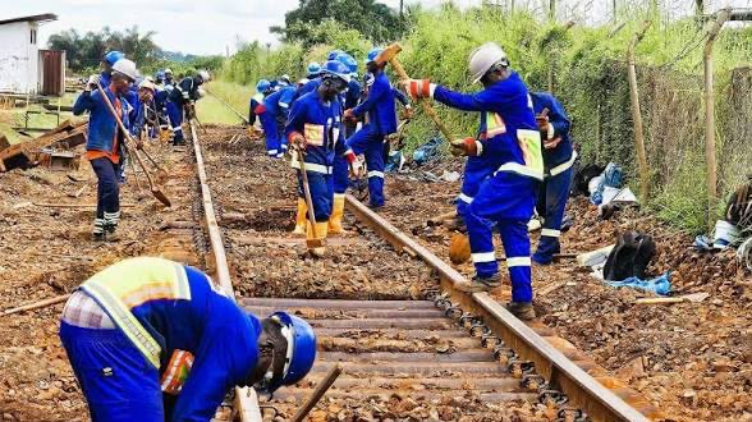
The order matters well beyond Liberia’s borders. The railway between the Nimba mountains and the port of Buchanan is becoming one of West Africa’s most important export routes for iron ore. It carries ore from Liberia and, soon, from neighbouring Guinea, to steel mills in Europe, Asia and the United States.
The order also comes as Liberia hosts the Liberia International Mining and Energy Conference and Exhibition (LIMEC 2026) in Monrovia this week. The conference is organised by the Ministry of Mines and Energy, the Liberia Chamber of Mines and AME Trade Ltd., and will bring together investors, mining companies and government officials. Its agenda includes iron ore expansion and the planned rail and port corridor linking Guinea’s Nimba region to Buchanan. Organisers expect current and planned projects to attract more than $3 billion in new investment.
One Track, Two Giants
The line is currently operated by ArcelorMittal Liberia, a subsidiary of the world’s second-largest steelmaker. In January, the company and the government extended their mineral development agreement to 2050, with a right to renew for another 25 years. ArcelorMittal agreed to pay $200 million for the extension and for reserved rail capacity. It is completing a $1.8 billion expansion expected to lift its shipments from about 5 million tonnes a year to 20 million.
Under that deal, President Boakai said the railway would become independently operated from October 2030.
The second user is Ivanhoe Atlantic, a company linked to mining billionaire Robert Friedland. In December 2025, the Legislature ratified its $1.8 billion rail access and concession agreement. The deal allows Ivanhoe to move high-grade ore from its Kon Kweni mines in Guinea across the border and down the Liberian line to Buchanan. It is the first project carried out under a 2019 treaty between Liberia and Guinea. Liberia is expected to earn more than $1 billion in rail access fees over the life of the project.
Until now, there has been no independent body to referee the arrangement. That is the gap the LNRA is meant to fill.
What the Order Does
Executive Order 169 keeps the Liaison Office under the supervision of the Minister of State for Presidential Affairs. It directs the office to complete a U.S. Trade and Development Agency-funded study of the condition and capacity of the Tokadeh–Buchanan corridor. The office must also finalise a draft LNRA Act with the Law Reform Commission and submit it to the Legislature through the Ministry of State.
The office is further tasked with preparing staffing plans, budgets and funding models for the future authority, including public-private partnerships, along with draft safety and regulatory rules. It must continue engaging mining companies, local communities, ECOWAS and neighbouring countries on regional rail development.
The order is careful about the limits of its own power. It bars the Liaison Office from adopting any regulations or commitments that must await the law. Any rules the office drafts for the future authority will take effect only after the Act is in force. The order’s preamble says the aim is to wind down the office “without creating gaps or extending executive powers beyond the lawful transition period.”
Four Years of Decrees
That caution reflects a long-standing criticism. That caution reflects a long-standing criticism. Liberia’s railway authority has existed only through a chain of executive orders since October 2022, when former President George Weah first created it. President Boakai renewed it in 2024 and again in October 2025 with Executive Order 153, which brought in international technical advisers and provided for a liaison officer.
Rail workers have grown impatient. In February, the National Association for Railway Workers of Liberia petitioned the Legislature to pass a law creating an autonomous authority, separate from the Ministry of Transport. The workers also asked that rail assets left behind by defunct mining companies be placed under the authority’s control.
The new order does not set a deadline for introducing the bill. Instead, it says the bill’s introduction will trigger the transition, and that the office will continue until the law passes or the President revokes the order. Any extension beyond “a reasonable transition period” must be justified in writing and approved by a separate executive order. The order does not define how long that period is.
What It Could Mean for the Sector
For investors, a statutory regulator would offer something executive orders cannot: permanence. An executive order can be amended or revoked by any president. A law passed by the Legislature carries more weight with lenders and with companies making 25-year commitments.
A permanent authority could also settle questions that remain open as traffic on the line grows. These include who sets and enforces the terms on which new users gain access to the track, who inspects a railway carrying heavier and more frequent trains, who decides when the line needs new capacity and who pays for it, and who resolves disputes between companies sharing the track.
The order commits the government to “multi-user, open-access” governance that is fair and transparent to all users. It does not say how disputes between users would be settled. Those details are likely to sit in the draft Act, which has not been made public.
Timing is also a factor. If the railway is to be independently operated by October 2030, as the government has said, a regulator will need to be in place well before then, with staff, rules and a budget of its own.
The Road Ahead
The order lays out a path from preparation through legislative consideration to handover. It requires the liaison officer to submit a final report to both the President and the Legislature before the office is dissolved. Staff will move into the new authority unless they choose to return to their previous posts.
What the order cannot do is pass the law. That decision now rests with the Legislature. Lawmakers moved quickly to ratify the Ivanhoe deal last year. Whether they move as quickly on the body meant to regulate such deals may shape how well Liberia manages its rail boom.
As investors gather in Monrovia this week, the question of who will regulate Liberia’s busiest railway, and when, is likely to be on many of their minds.
Support Independent Journalism
Your support helps FrontPage Africa continue delivering independent, credible, and impactful journalism. Every contribution strengthens our ability to investigate, inform, and hold power accountable while keeping quality journalism accessible to our readers.
Support our journalism or subscribe to receive the latest FrontPage Africa stories and updates.