MONROVIA – A 63-year-old resident of Monrovia’s Airfield area will spend the coming weeks in the Monrovia Central Prison awaiting sentence. On Friday, Criminal Court “E” found him guilty of statutory rape and kidnapping of a 16-year-old boy who, according to the indictment, ran errands and did domestic work at his home.
By Rodney D. Sieh
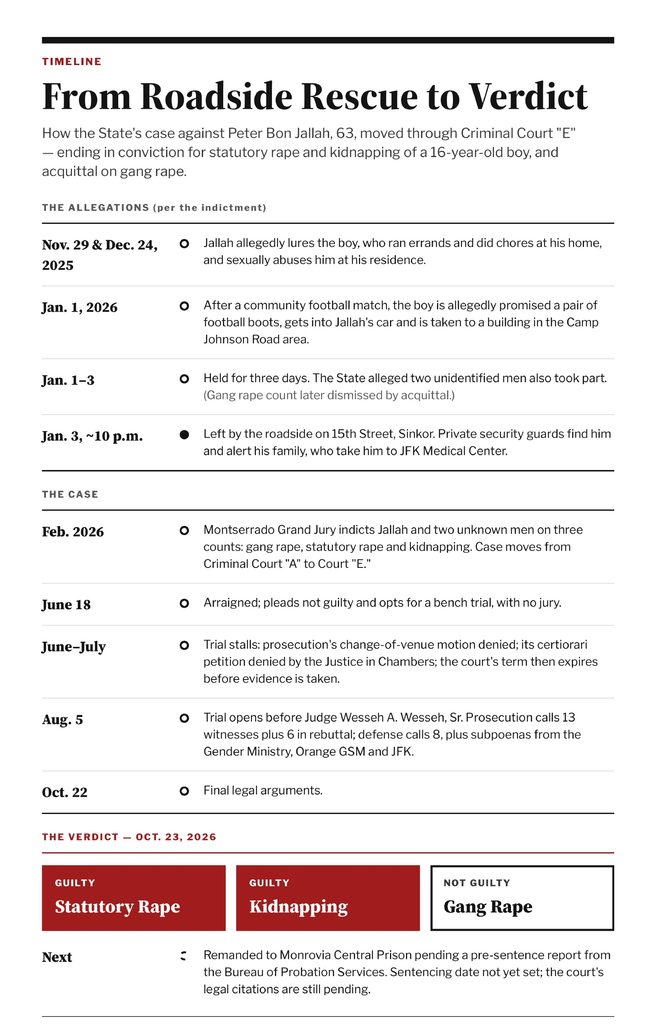
Judge Wesseh Alphonsus Wesseh, Sr., sitting without a jury at the defendant’s own request, found Peter Bon Jallah guilty of statutory rape and kidnapping. He acquitted Jallah of gang rape, the most serious-sounding charge in the three-count indictment. The court ordered the Bureau of Probation Services at the Ministry of Justice to prepare a pre-sentence report “as soon as possible,” and suspended the matter until then.
The verdict closes one chapter of a case that has moved slowly through the system since the boy was found by the roadside in Sinkor on the night of January 3, 2026. It also raises questions about how such cases are prosecuted, what the split verdict means, and why a ruling of this weight was issued with its legal reasoning still unwritten.
What the State Alleged
According to the indictment returned by the Montserrado County Grand Jury in its February 2026 term, the abuse began in late 2025. Prosecutors alleged that on November 29 and December 24, 2025, Jallah lured the boy to his residence and sexually abused him there.
The indictment says the most serious episode began on New Year’s Day. Prosecutors alleged that after the boy played in a community football match, Jallah met him outside his fence and offered to take him to buy football boots. He told the boy to go home, bathe and come back. The boy returned and got into Jallah’s car.
Instead of a shopping trip, the indictment alleges, the boy was taken to a building in the Camp Johnson Road area. He was held there for three days, given noodles that made him dizzy, and abused repeatedly. Prosecutors alleged that two unidentified men took part.
On the night of January 3, the indictment says, the boy was hidden in the back of Jallah’s vehicle and left on the roadside on 15th Street, Sinkor. Private security guards found him and alerted his family. His mother and relatives took him to the John F. Kennedy Medical Center for examination.
Why Gang Rape Fell Away
The court’s ruling does not explain why Jallah was acquitted of gang rape. The two men named alongside him in the indictment were never identified, never arrested and never brought before the court. Jallah was severed from them and tried alone.
Gang rape by definition requires proof that more than one person took part. With the alleged accomplices still unknown, the prosecution may simply have been unable to prove their involvement to the court’s satisfaction. That is an inference, not a finding. The court has not yet said why. Each of the three findings ends with the same note: “legal citations are pending.”
That phrase matters. The public, the defense and any appellate court now have the outcome without the reasoning. Until the full opinion is filed, it is impossible to say which evidence the judge found credible and which he set aside.
A Long Road to Trial
The case was first filed before Criminal Assizes Court “A” before being transferred to Court “E.” Court “E” is Liberia’s specialized court for sexual and gender-based violence. Jallah was arraigned on June 18, 2026, pleaded not guilty, and chose a bench trial.
The trial then stalled. The prosecution’s motion for a change of venue was denied. Prosecutors went to the Supreme Court seeking a writ of certiorari, which the Justice in Chambers also denied, and the case was ordered to proceed. It stalled again when the court’s regular term expired before evidence could be taken. Hearings finally began on August 5 under a reassigned judge.
The record shows a heavily contested trial. The prosecution called 13 witnesses, including the boy himself and police officers, plus six rebuttal witnesses. The defense called eight witnesses, including Jallah himself. It also subpoenaed three institutions: the Ministry of Gender, Children and Social Protection, the mobile operator Orange, and the JFK Medical Center. The Orange subpoena suggests phone records were part of the defense’s case.
The Wider Picture
The case is unusual in one important way: the victim is a boy. Liberia’s 2005 rape law amendment made rape gender-neutral. Advocates nonetheless say sexual abuse of boys remains heavily under-reported, shadowed by stigma and the assumption that only girls are at risk. A conviction in a case involving a male child, especially one in which the accused held a position of trust and patronage over the victim, is rare in Liberia’s courts.
It also shows a familiar pattern. Prosecutors alleged that Jallah had small, everyday power over the boy, as an employer for errands and the man who could buy him football boots. Child-protection workers say that kind of power is often the doorway to abuse.
What Comes Next
Jallah is remanded until the probation report is ready, after which the court will hand down its sentence. Under Liberian law, rape of a minor by an adult is a first-degree felony that can carry a sentence of up to life imprisonment. The defense is expected to have the right to appeal to the Supreme Court once judgment is entered.
For now, the boy’s family has a verdict. What it does not yet have, and what the public is owed, is the court’s written explanation of how it got there.
Support Independent Journalism
Your support helps FrontPage Africa continue delivering independent, credible, and impactful journalism. Every contribution strengthens our ability to investigate, inform, and hold power accountable while keeping quality journalism accessible to our readers.
Support our journalism or subscribe to receive the latest FrontPage Africa stories and updates.