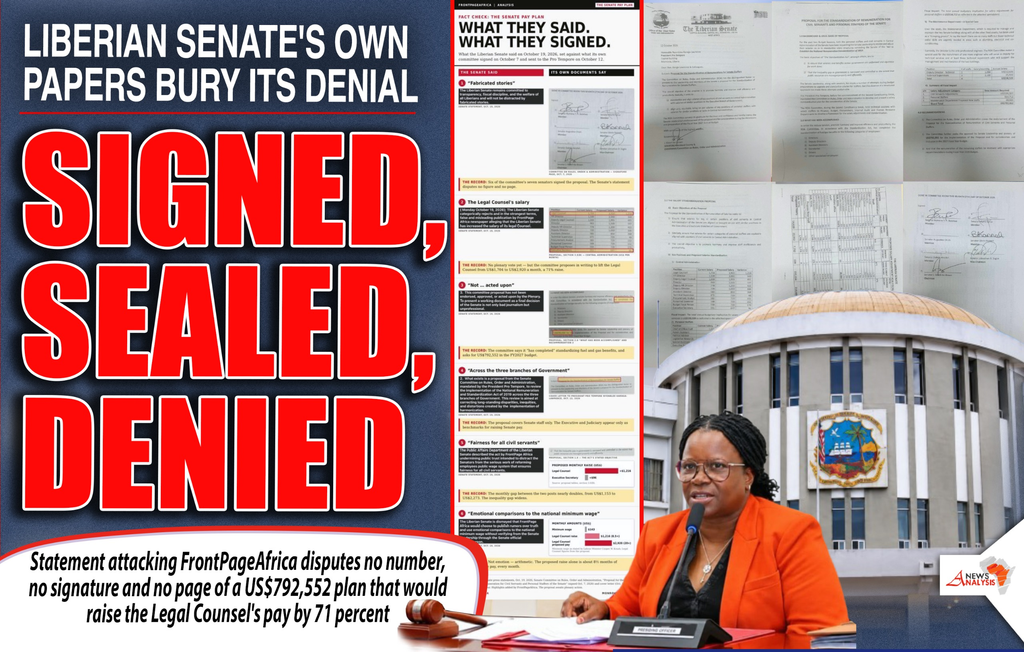
MONROVIA – On Monday, the Liberian Senate under the leadership of Pro Temp Nyonblee Karnga-Lawrence, called FrontPageAfrica’s reporting on a staff salary plan “false,” “misleading” and “fabricated,” and demanded a retraction. What the Senate did not do is more telling. It did not dispute a single figure, did not challenge the authenticity of a single page, and did not say the plan does not exist.
By Rodney D. Sieh
It could not. The plan is on Senate letterhead.
What the documents say
On October 7, 2026, the Senate Committee on Rules, Order and Administration signed a “Proposal for the Standardization of Remuneration for Civil Servants and Personal Staffers of the Senate.” Six of the seven committee members signed it, including Chairman J. Gbleh-bo Brown of Maryland County and Vice-Chairman Johnathan B. Sogbe. On October 12, Senator Brown sent it to President Pro Tempore Nyonblee Karnga-Lawrence. He asked for leadership’s endorsement and for the plan to be included in the Fiscal Year 2027 budget.
The numbers are the committee’s own:
* The Legal Counsel’s monthly pay rises from US$1,704 to US$2,920, an increase of US$1,216, or 71 percent.
* The HR Director rises from US$1,500 to US$2,000, and the Deputy Legal Counsel from US$1,500 to US$1,991.
* Senators’ chiefs of office staff rise from US$1,021 to US$1,500.
* The total annual cost is US$792,552. The covered payroll grows from US$1,830,648 to US$2,623,200, an increase of 43 percent.
The committee’s final recommendation asks the Senate leadership and plenary to approve US$792,552 for the 2027 budget. That is not a rumor. It is a funding request.
A denial that answers a different question
The Senate’s statement rests on one claim: the plenary never voted. That is true, and it is beside the point.
A proposal that six senators have signed, that the Pro Tempore commissioned, and that is formally headed for the national budget is news. Proposals are exactly when the public should hear about them, before the money is spent rather than after.
The statement also confirms the most important fact. It says the review was “mandated by the President Pro Tempore.” By the Senate’s own account, this plan began in the Pro Tempore’s office.
The fine print the statement leaves out
The statement describes the plan as a review “across the three branches of Government.” The documents cover only Senate staff. The other branches appear only as benchmarks for raising Senate pay.
The statement says the plan has not been “acted upon.” Yet section 2.0 of the committee’s report, titled “What Has Been Accomplished,” says the committee “has completed” standardizing fuel and gas benefits for directors, deputy directors, assistant directors, secretaries, drivers and other staff. The Senate should explain whether those benefits are already being paid.
The statement also accuses this newspaper of failing to verify the facts “through the Senate official spokesperson.” The verification is the documents themselves: the Senate’s letterhead, its committee’s signatures and its own arithmetic.
“Harmony” for whom?
The committee says the 2019 National Remuneration and Standardization Act requires the plan. It quotes the Act’s goal of narrowing “the inequality gap in government.” The tables point the other way.
The Legal Counsel’s raise alone, US$1,216 a month, is larger than the entire current salary of nine of the twelve central administration positions listed. At the bottom of the scale, the Executive Secretary gets US$96.
Today the Legal Counsel earns about three times as much as the Executive Secretary. Under the proposal, that would rise to about four and a half times. In dollar terms, the gap between them nearly doubles, from US$1,153 to US$2,273 a month.
A plan written to narrow inequality would widen it.
The comparison the Senate calls “emotional”
The Senate objects to comparisons with the national minimum wage and calls them “emotional.” They are arithmetic. Labour Minister Cooper W. Kruah has reminded employers that Liberia’s Decent Work Act sets a minimum monthly wage of US$143, and he has warned firms caught paying less.
The proposed raise for the Legal Counsel is roughly eight and a half times that minimum wage. The proposed salary is about twenty times it. That is not the language of emotion. It is the reality of a country where many families decide daily between food, school fees and medicine.
The staff have a case, and that is not the issue
Fairness requires saying this clearly: many Senate employees are underpaid, and their complaints are real. In December, staff spokesperson Roosevelt Tulay told reporters there had been no salary increment for Senate staff since 2015. He pointed out that the Senate’s own budget had grown from US$14.6 million to a proposed US$16.4 million for Fiscal Year 2026, while staff salaries stayed flat, and he warned of civil disobedience.
A serious reform would start at the bottom, with the clerks, secretaries and drivers. This plan gives its biggest dollars to the top. And the Senate’s answer to public scrutiny has been to call accurate reporting “fabricated.”
What the Senate should do
If the Senate believes the plan is sound, it should defend it in public. It should publish the full proposal and the attached spreadsheet, explain the 71 percent raise for its Legal Counsel, disclose whether the fuel benefits are already being paid, and commit to a recorded plenary vote.
What it should not do is demand that a newspaper retract a story built on the Senate’s own signed pages. FrontPageAfrica stands by its reporting.
Support Independent Journalism
Your support helps FrontPage Africa continue delivering independent, credible, and impactful journalism. Every contribution strengthens our ability to investigate, inform, and hold power accountable while keeping quality journalism accessible to our readers.
Support our journalism or subscribe to receive the latest FrontPage Africa stories and updates.