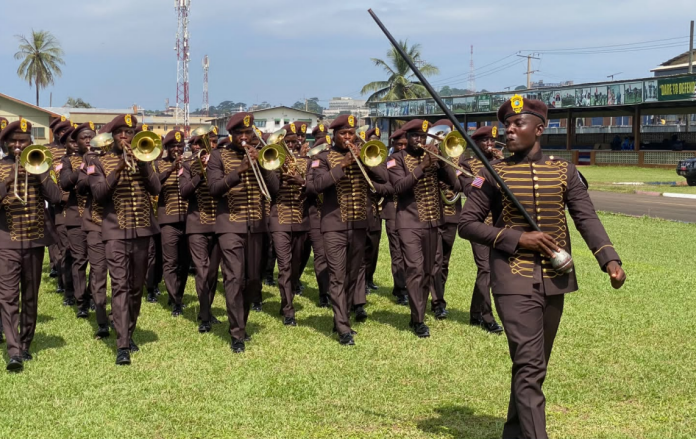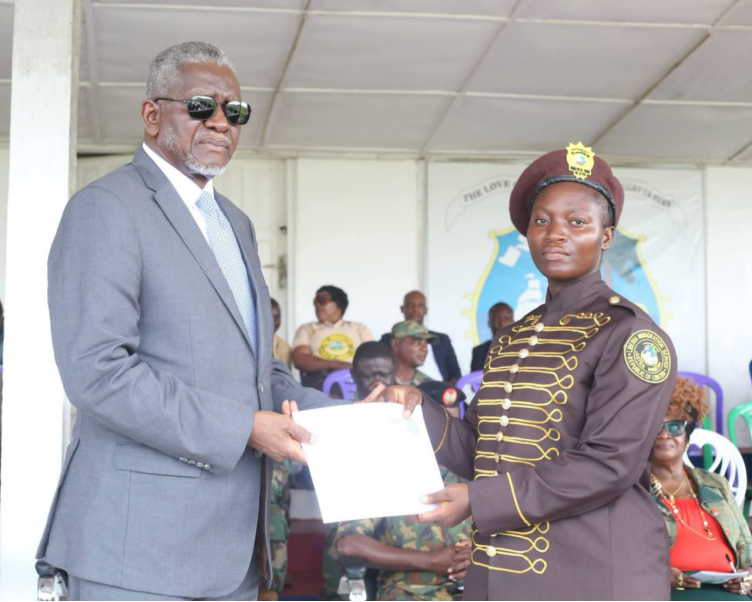
MONROVIA – C. Clarence Massaquoi once commanded Liberia’s national police and led the unit that guarded the head of state. On Friday, he stood before a group of young cadets holding trumpets and drums and described himself as something else: a father who had come home.
By Jaheim T Tumu
“I stand before you today not just as a Guest Speaker, but as a proud father returning home,” Massaquoi told the pioneer graduating class of the Liberia Immigration Service (LIS) Basic Military Band Training. The Armed Forces of Liberia Band Unit ran the program.
For Massaquoi, the day closed something he had left unfinished. He had first proposed a marching band for the immigration service years earlier, when he was Commissioner of what was then the Bureau of Immigration and Naturalization (BIN).
A Vision Interrupted
Massaquoi has held several of the most sensitive security jobs in Liberia. He directed the Special Security Service, the presidential protection detail now called the Executive Protection Service (EPS). He was Commissioner of BIN. He later led the Liberia National Police, and served as its Inspector General until September 2016, when President Ellen Johnson Sirleaf named Col. Gregory Coleman to replace him. Sirleaf said at the time that the government still had confidence in him and would need his skills in another role. Massaquoi has also served as National Security Advisor.
He said his goal at BIN had been to turn the agency “from a checkpoint institution into a full-fledged, disciplined, paramilitary service worthy of its place in the Joint Security Architecture of Liberia.” That is the framework of agencies, led by the army and police, that has protected the country since its civil wars ended in 2003.
He considered a marching band central to that plan. “We started the process; we identified talent, we began consultations,” he said. “But before the first drum could be beaten, I was reappointed by the President to head the Liberia National Police Service. I left with an unfinished agenda in my heart.”
He told the cadets they had finished that work. He thanked the current leadership of the service for “keeping the dream alive.”
More Than Music
A brass band may look like ceremony with little to do with protecting a border. Massaquoi made the opposite case. He said the band training holds lessons a security officer needs in the field.
“You did not just learn music. You went through basic military training. You learned discipline, endurance, teamwork, and precision,” he said. “In a band, if one man is out of step, the whole parade is spoiled. If one trumpet is out of tune, the whole melody is lost. You have learned the greatest lesson of our profession: We succeed together, or we fail together.”
Bands have been part of military life for centuries, and he placed the new unit in that tradition. “The world over, the band is the commander’s voice,” he said. “It sets the pace, it announces his arrival, it comforts troops on long patrols.”
He said the habits learned on the band square, “punctuality, practice, perfection,” would follow the graduates to border posts in Lofa, Grand Cape Mount, Ganta and Maryland. Liberia shares these frontiers with Sierra Leone, Guinea and Côte d’Ivoire, and they are long and porous.
Ending the Silence
He also spoke about the agency’s pride. The LIS is part of the Joint Security, but he said that “for too long, at national parades and state functions, we marched in silence, or to the drums of another institution.”
He said that ends now. The LIS will march to its own music on July 26, Liberia’s Independence Day. It will greet visiting heads of state at Roberts International Airport with its own band, and honor fallen colleagues the same way. “That builds esprit de corps that money cannot buy,” he said.
He listed five benefits of the band:
• Identity and morale
• Discipline and command
• A stronger place in the Joint Security alongside the army and police
• Community trust
• Recruitment for the future
Soft Power at the Border
His strongest argument was about how the public sees the service. He described the band as a tool of soft power.
“An immigration officer is the first and last Liberian a visitor meets,” he said. When the band plays in schools, border towns and county programs, he said, it changes how people see the LIS, “from an enforcement body to a people’s institution. And in modern border management, community trust is our best intelligence.”
Many border agencies around the world have learned the same thing: people living near a frontier are often the first to notice smuggling, trafficking or unusual movement. Massaquoi said that kind of trust “is more powerful than any fence.”
He also pointed to the next generation. “You are the First Notes of a new LIS anthem,” he told the graduates. “The child who hears you play in Bo Waterside today will want to wear this uniform tomorrow.” Bo Waterside is the main crossing into Sierra Leone.
Arms and Accountability
Massaquoi also spoke about a more sensitive reform he had pushed: arming immigration officers.
He said many Liberians had worried about giving guns to a semi-military service in a country still recovering from years of civil war. He said the service has since answered those fears. He cited Bo Waterside, Roberts International Airport, the Ganta border and central Monrovia, and said “there have been no reports of misuse, intimidation, accidental discharge, or harassment of citizens with LIS weapons anywhere.”
He praised officers for “discipline and restraint in carrying arms,” courtesy toward travelers and residents, and professionalism at checkpoints. He warned that being armed brings “a heightened responsibility.” Officers who carry weapons, he said, must “consistently demonstrate professionalism and humility.”
He asked the service to use the new band to build ties with communities at every border point.
A Charge and an Appeal
He gave the graduates a direct charge: “Guard this legacy jealously. Practice every day. Respect your instruments. Teach others. Never let these drums gather dust.”
He then asked LIS Commissioner General Elijah F. Rufus to make the band a permanent unit, with a bandmaster, its own budget line, a home and a mandate to train future classes.
“Instruments are expensive, but discipline is priceless,” he said. “Let this not be a one-time project.”
His closing line summed up why he came. “I came as the man who planted the seed,” he said. “I leave today as the proudest father of the harvest.”
Support Independent Journalism
Your support helps FrontPage Africa continue delivering independent, credible, and impactful journalism. Every contribution strengthens our ability to investigate, inform, and hold power accountable while keeping quality journalism accessible to our readers.
Support our journalism or subscribe to receive the latest FrontPage Africa stories and updates.