MONROVIA — On Thursday, August 13, the prison chapter of Justin Oldpa Yeazehn, better known across Liberia as “ProphetKey”, is expected to come to an end. For six months, the outspoken podcaster and political commentator has been behind the walls of the Monrovia Central Prison after the Supreme Court of Liberia found him guilty of criminal contempt and sentenced him to 180 days in prison on February 13, 2026.
By Selma Lomax, [email protected]
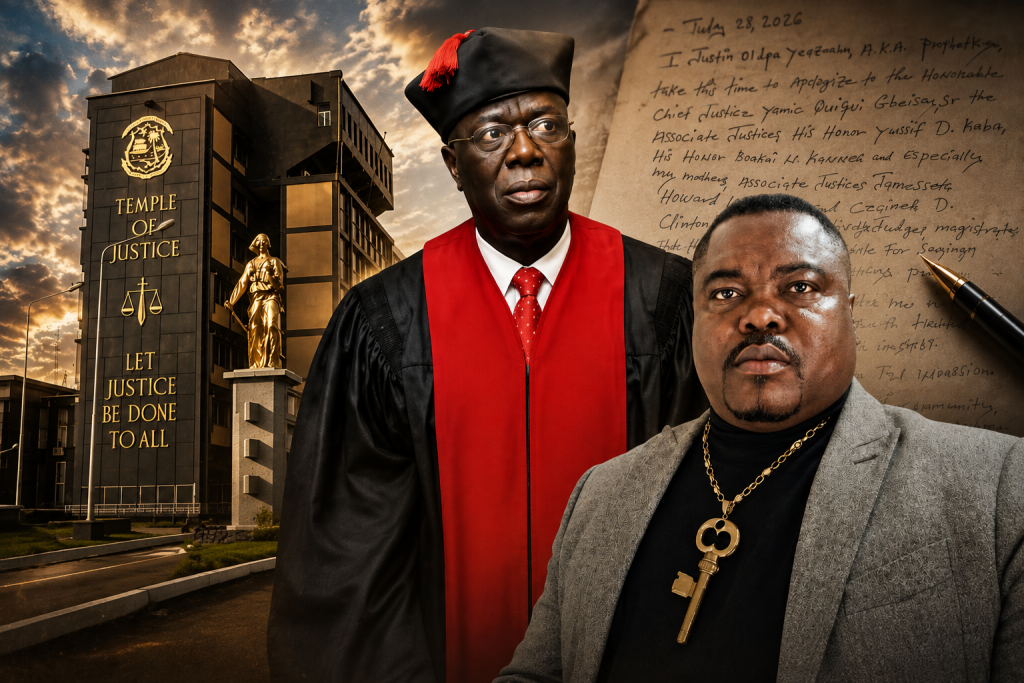
The sentence stemmed from remarks the Court deemed vulgar, degrading and contemptuous, including comments directed at Chief Justice Yamie Quiqui Gbeisay and references to his mother, alongside accusations of corruption against the judiciary that were not supported with proof.
The sentence was ordered to run from February 13 through August 13. But as the date of his expected release approaches, the more compelling story is no longer simply when ProphetKey will leave prison. It is who will emerge from the prison gates.
Will Liberia see the return of the same combative online political commentator who built a formidable following through profanity, confrontation and relentless attacks against political and public figures? Or will the six months behind bars produce a more measured ProphetKey — still outspoken, still politically engaged, but more conscious of the consequences of words spoken before thousands of followers?
That question is now at the center of the conversation surrounding his expected release. The Supreme Court has already made its position clear. ProphetKey was not only sentenced to prison. His release was tied to conditions intended to demonstrate remorse and a commitment to changed conduct, including a public apology and a behavior bond. The Court’s action has therefore transformed his release into something of a public test or whether a man who made confrontation the foundation of his public identity can now embrace restraint without surrendering his political voice.
And ProphetKey himself appears to have recognized the significance of that moment. For years, ProphetKey occupied a peculiar and increasingly influential space in the country’s political landscape. He was not a traditional politician. He was not a conventional journalist. He was an online personality who combined religion, politics, social commentary and entertainment into a style that attracted both passionate supporters and fierce critics. His greatest weapon was his voice.
He spoke loudly, directly and often without the caution associated with traditional media. He attacked political leaders, challenged government officials and routinely used profanity and personal language to make his points.
That style was not accidental. It became his brand. During the administration of former President George Weah, ProphetKey survived politically and commercially on cussing and attacking the government while operating from Morocco. His broadcasts became part of the wider opposition ecosystem, helping to keep criticism of the Weah administration alive among Liberians at home and abroad.
His supporters viewed that period differently from his critics. To his supporters, ProphetKey was fearless. He said what others were afraid to say. He confronted those in power. He used his platform to challenge government officials and mobilize public opinion.
And as Liberia moved toward the 2023 presidential election, his criticism of the Weah administration became part of the broader political environment that helped the opposition Unity Party regain power.
In that sense, ProphetKey became one of the voices that contributed to the political atmosphere that ultimately brought President Joseph Nyuma Boakai to the Executive Mansion. But political power changed hands. And ProphetKey’s microphone did not go silent.
From Opposition Firebrand to Government Critic
The most revealing aspect of ProphetKey’s political journey may be what happened after the Unity Party came to power. He did not simply become a cheerleader for the government he had helped support. Instead, he continued to criticize. That development exposed the deeper nature of his political identity. ProphetKey was never entirely about one political party. His influence was rooted in confrontation itself.
He became popular because he challenged people in power, and once power changed hands, his attention remained fixed on those occupying positions of authority.
That is precisely why his release could become politically significant.
If he returns to his microphone, Liberia’s political establishment will once again have to contend with a commentator who has demonstrated that he is willing to criticize those in government — even political forces whose return to power he previously supported. But the question is whether he will now do so differently.
Six Months Behind Bars and a Letter of Regret
Perhaps the clearest indication of ProphetKey’s current state of mind is the apology letter that surfaced as his sentence approached its conclusion.
In the letter, ProphetKey apologized to Chief Justice Gbeisay, members of the Supreme Court, judges, magistrates and the judiciary as an institution.
He also apologized to Liberian women whom he had insulted through his public commentary. His apology was not merely a private expression of regret. It was part of the conditions attached to his release.
Reports indicate that the Supreme Court required him to publish an apology in three newspapers for five consecutive days and execute a behavior bond as part of the conditions surrounding his release.
In his letter, ProphetKey acknowledged that he had accused members of the judiciary of corruption without proof and expressed remorse for his conduct. He also promised not to repeat his abusive language toward women.
The significance of that apology goes beyond the words on paper.
For a public figure whose identity was built around refusing to back down, acknowledging wrongdoing represents a dramatic departure from the image that made him famous.
The question is whether that departure is permanent.
The Supreme Court’s Warning Will Follow Him
ProphetKey may leave prison on Thursday, but the Supreme Court’s warning will not leave with him. His case has established a clear boundary between political criticism and conduct that the Court considers abusive or contemptuous.
The constitutional debate surrounding his incarceration has been intense. Liberia’s Constitution protects freedom of expression, but Article 15 also places responsibility on individuals for abuses of that freedom. Analysts and legal commentators have therefore debated whether ProphetKey’s punishment represented an excessive restriction on speech or a legitimate response to conduct that went beyond criticism.
That debate will likely continue.
But for ProphetKey personally, there is another consideration. He has already experienced the consequences. He knows that words spoken during an online broadcast can eventually lead to a courtroom. He knows that insulting a powerful institution can have consequences beyond the immediate reaction of social media.
And he knows that a second confrontation with the judiciary could carry a very different weight now that he has already been warned.
The Real Test Begins After Prison
This is why August 13 should not be viewed merely as ProphetKey’s release date. It should be viewed as the beginning of his real test. The prison sentence was imposed by the Court. The next chapter will be written by ProphetKey himself. He will have to decide whether to return immediately to the style that made him famous or reinvent his approach. There is nothing preventing him from remaining a fierce critic.
He can question President Boakai.
He can criticize the Unity Party. He can challenge senators and representatives. He can scrutinize judges and government institutions. He can expose what he believes to be corruption. He can investigate public officials. He can mobilize public opinion.
But there is a fundamental difference between doing all of those things and making unsupported personal accusations. That difference could determine whether ProphetKey remains free to operate his platform or finds himself in another confrontation with the law.
Can He Remain Relevant Without Cussing? This may be ProphetKey’s greatest challenge.
His audience became accustomed to a particular version of him — loud, aggressive, confrontational, and sometimes profane. The question is whether that audience will accept a more disciplined ProphetKey. Can he maintain thousands of viewers by replacing insults with evidence? Can he challenge corruption allegations by presenting documents rather than simply making accusations? Can he attack government policy without attacking people’s families? Can he disagree with women in public life without resorting to abusive language? Can he challenge the judiciary without personally abusing judges? If he can, ProphetKey could discover that his greatest political asset was never the profanity.
It was the audience. The audience will still be there. The microphone will still be there. The issues will still be there. What changes is the method.
A Potential Reinvention
There is an opportunity here for ProphetKey to reinvent himself. He could transform from a controversial online preacher into a more disciplined political commentator. Instead of simply alleging corruption, he could demand documents.
Instead of accusing officials of wrongdoing, he could present evidence. Instead of cussing public officials, he could interrogate their policies. Instead of personal attacks, he could use investigative questions. Such a transformation would not necessarily weaken him.It could strengthen him.
Liberia’s political environment already has enough people shouting. What is often missing is disciplined public scrutiny backed by facts. If ProphetKey can provide that, he could become even more influential.
But There Is Another Path
The alternative is equally possible. He could walk out of prison, switch on his phone, open his microphone and return to the same language and behavior that brought him before the Supreme Court.
If that happens, his apology will face its first serious test. Critics will ask whether the letter represented genuine remorse or simply compliance with a court order. Supporters may argue that his imprisonment changed nothing about the fundamental issues he has raised. And the Supreme Court will likely be watching closely. The danger for ProphetKey is that the public may interpret a return to his old behavior not as courage, but as a refusal to learn from the experience.
The Question of Accountability
There is also a larger lesson embedded in the ProphetKey case. The controversy should not be reduced to whether ProphetKey was right or wrong. It should also force Liberia to confront the quality of public debate. Political accountability requires criticism.
Democracy requires dissent.
Institutions must be questioned. Public officials must be scrutinized. But accountability also requires evidence. A democracy cannot function effectively if accusations become substitutes for proof.
At the same time, institutions cannot demand respect while avoiding legitimate questions about their own conduct.
That is why the debate surrounding ProphetKey’s case will likely survive his release. His imprisonment answered the question of whether the Supreme Court was prepared to punish what it considered contemptuous conduct. It did not necessarily settle the broader debate over how Liberia should balance free expression, public accountability and institutional dignity.
What Will His First Broadcast Look Like?
Perhaps the most anticipated moment after ProphetKey’s release will be his return to the microphone. Liberians will be watching. His supporters will want to hear him. His critics will want to know whether he has changed. Government officials will likely pay attention. And the judiciary may also be interested in whether the commitments contained in his apology become reality.
His first broadcast could therefore carry enormous symbolic weight. If he comes out thanking the Court, acknowledging his mistakes and promising to use his platform more responsibly, it could signal the beginning of a new ProphetKey. If he immediately returns to insults and accusations, the public may conclude that six months in prison changed little. That first appearance could become a defining moment.
From Prisoner to Political Watchdog?
There is another possibility. ProphetKey could emerge from prison more focused on issues and less interested in personalities. He could use his platform to examine government spending, public contracts, corruption allegations, legislative decisions, and institutional performance. He could ask difficult questions and demand answers. That would allow him to retain his identity as a government critic without repeatedly crossing the line into personal abuse.
In many ways, that could be the strongest version of ProphetKey. The man who once relied heavily on profanity could discover the power of documentation. The preacher who built an audience through confrontation could become a watchdog. The online personality who once attracted attention through controversy could command attention through evidence.
The Road Ahead
On Thursday, August 13, the prison doors are expected to open. But ProphetKey’s story will not end there. In many ways, it will begin again. The six months behind bars have given him something few public commentators receive: a forced period of reflection away from the microphone. His apology has given him an opportunity to acknowledge the damage caused by his words.
The Supreme Court’s warning has given him clear notice about the boundaries he is expected to respect. And his history has given him a platform that remains powerful.
What he does with those three things will determine the next chapter of his public life. ProphetKey has already demonstrated that he can attract an audience. He has demonstrated that he can influence political conversations.
He has demonstrated that he can survive political transitions — from his attacks on the George Weah administration while in Morocco to his continued relevance during the Unity Party’s rise and subsequent administration.
Now he has to demonstrate something different. He must show that he can wield influence without abusing it.
That may prove more difficult than cussing. It may prove more difficult than attacking politicians. It may even prove more difficult than surviving six months in prison. Because after August 13, there will be no question about whether ProphetKey has a voice.
The question will be what he chooses to say with it. And whether, after everything that has happened, Liberia will hear a different ProphetKey when he finally speaks again.
Support Independent Journalism
Your support helps FrontPage Africa continue delivering independent, credible, and impactful journalism. Every contribution strengthens our ability to investigate, inform, and hold power accountable while keeping quality journalism accessible to our readers.
Support our journalism or subscribe to receive the latest FrontPage Africa stories and updates.