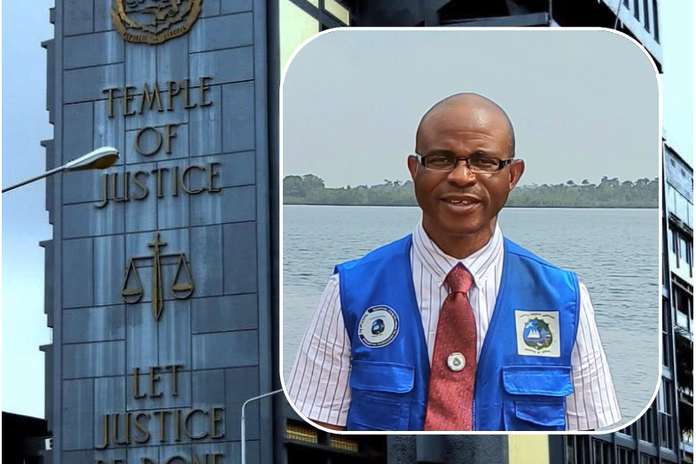
Monrovia – Criminal Court “E” at the Temple of Justice has scheduled a hearing for Monday, November 2, at 10 a.m. on a motion for a new trial filed by Peter Bon Jallah, former National Security Agency, NSA official convicted of statutory rape and kidnapping involving a 16-year-old boy.
By: Willie N. Tokpah
The hearing presents the next crucial test in a closely watched criminal case after Assigned Circuit Judge Wesseh Alphonsus Wesseh Sr., sitting without a jury, found Jallah guilty of two of the three charges brought against him but acquitted him of gang rape.
FrontPage Africa has been informed by court sources that the court has received the motion and will hear arguments on Monday.
Depending on the outcome, the court is expected to proceed with a pre-sentence hearing, followed by the imposition of judgment and sentence, subject to the applicable procedures and any further orders from the judge.
Jallah’s defense is seeking to overturn the verdict, arguing that aspects of the court’s findings are inconsistent with the evidence and that legal and procedural errors warrant a new trial. The motion was filed on October 27, four days after Judge Wesseh delivered the verdict on October 23.
It asked the court to set aside the convictions and reconsider the case. The outcome of Monday’s hearing could determine whether the proceedings move toward sentencing or whether the case returns to trial.
A Split Verdict
On October 23, Judge Wesseh found Jallah guilty of statutory rape and kidnapping but acquitted him of gang rape. The ruling followed a bench trial in which the judge evaluated testimony, documentary evidence, medical findings, forensic evidence, and arguments from both the prosecution and defense.
The three charges arose from allegations involving a 16-year-old boy who reportedly performed paid domestic chores at Jallah’s residence in Monrovia.
According to the indictment, prosecutors alleged that Jallah sexually assaulted the boy on multiple occasions in late 2025 and that a subsequent incident in January 2026 involved the boy being taken to a building in the Camp Johnson Road area, where he was allegedly held for several days and sexually abused.
The indictment also named two unidentified men in connection with the allegations. Those individuals were not brought before the court during Jallah’s trial.
The court ultimately found the prosecution’s evidence sufficient to establish statutory rape and kidnapping but insufficient to sustain a conviction for gang rape. Following the verdict, Jallah was ordered remanded at Monrovia Central Prison, pending a pre-sentence and behavioral report from the Ministry of Justice’s Bureau of Probation Services. The court had not imposed a sentence when the verdict was announced.
Defense Challenged Convictions
In the motion for a new trial, defense lawyer Cllr. G. Wiefueh Alfred Sayeh advances several arguments challenging the legal and evidentiary basis of the verdict.
One central argument is that the kidnapping conviction is inconsistent with the acquittal on the gang rape charge.
The defense contends that the two charges are tied to the same alleged episode of confinement at Camp Johnson Road and argues that the court’s conclusions cannot be reconciled.
The defense also challenged Criminal Court “E”’s jurisdiction over the separate kidnapping charge, arguing that the specialized sexual-offenses court lacks authority to adjudicate that offense in the circumstances of the case.
Another major issue raised in the motion concerns the medical and forensic evidence presented during the trial. The defense argued that the evidence did not adequately establish penetration, which it said is an essential element of the rape charge.
It points to testimony concerning the complainant’s medical examination and to the limitations of the DNA findings presented by the prosecution. The motion further alleged that the defendant did not receive a fair trial.
Among other claims, the defense questions the judge’s handling of telephone records obtained during the proceedings and argues that the court improperly took steps to obtain additional evidence.
These remain arguments advanced by the defense and have not been established as findings of judicial error. Judge Wesseh is expected to consider the motion and any response from the prosecution before deciding whether the legal threshold for a new trial has been met.
Prosecution Presented Extensive Evidence
During the trial, the prosecution presented 13 regular witnesses and six rebuttal witnesses, according to reporting on the court’s written verdict. The witnesses included the complainant, police investigators, medical personnel, and Pascal Bavugirije, a forensic examiner associated with the Rwanda Forensic Institute. The prosecution also relied on DNA analysis involving four clothing exhibits.
Testimony reported during the proceedings indicated that DNA profiles from the exhibits matched Jallah’s reference sample, although the forensic findings did not establish precisely when or how the biological material was deposited.
The defense called eight witnesses, including Jallah, and subpoenaed witnesses from the Ministry of Gender, Children and Social Protection, Orange Liberia, and the John F. Kennedy Medical Center.
Throughout the proceedings, the defense challenged the consistency of the complainant’s account, the interpretation of the forensic findings, and the sufficiency of the state’s evidence.
The prosecution, meanwhile, maintained, during final arguments, that the evidence supported convictions on the charges. Judge Wesseh’s October 23 ruling resolved the trial at the initial level, but the defense’s motion now places the legal sufficiency and consistency of the verdict before the same court for further consideration.
Case History Marked by Delays
The case passed through several procedural stages before the verdict was delivered. Jallah was arrested on January 7, 2026, following a complaint to the police Women and Children Protection Section.
A grand jury subsequently indicted him and two unidentified men on charges of statutory rape, gang rape and kidnapping during the February 2026 term of court.
He was arraigned on June 18, 2026, pleaded not guilty and elected to be tried by a judge rather than a jury. The case was initially assigned to Criminal Assizes Court “A” for Montserrado County before being transferred to Criminal Court “E” for trial.
Proceedings were delayed after the prosecution sought a change of venue.
Following the denial of that request, prosecutors petitioned for a writ of certiorari, but the petition was denied, and the case was ordered to proceed.
The expiration of the court’s regular sitting created another interruption before the matter was reassigned for trial on August 5, 2026. After the prosecution and defense completed the presentation of their cases and delivered final arguments on October 22, Judge Wesseh reserved his ruling for the following day.
The October 23 decision resulted in convictions on statutory rape and kidnapping, alongside an acquittal on gang rape.
Monday’s hearing will determine whether the court upholds its original decision or grants the defense’s request for a new trial. If the motion is denied, the court may proceed toward sentencing after considering the required pre-sentence report and hearing any submissions relevant to the sentence.
If the motion is granted, the case could return to trial in accordance with the court’s order.
The defense has also indicated its intention to appeal the verdict to the Supreme Court of Liberia, although the timing and procedural requirements of any appeal will depend on the court’s subsequent actions and applicable law.
For now, Jallah remains subject to the court’s remand order while the proceedings continue. The November 2 hearing is therefore expected to be a decisive moment because of the defendant’s former position within the country’s national security establishment and the seriousness of the offenses at issue.
The hearing is scheduled to begin at 10 a.m. Monday, November 2, at Criminal Court “E,” Temple of Justice, Monrovia.
Support Independent Journalism
Your support helps FrontPage Africa continue delivering independent, credible, and impactful journalism. Every contribution strengthens our ability to investigate, inform, and hold power accountable while keeping quality journalism accessible to our readers.
Support our journalism or subscribe to receive the latest FrontPage Africa stories and updates.