Monrovia – Two months into Liberia’s biggest-ever drug cases, a troubling question remains unanswered: who is actually being held accountable?
By Gerald C. Koinyeneh, [email protected]
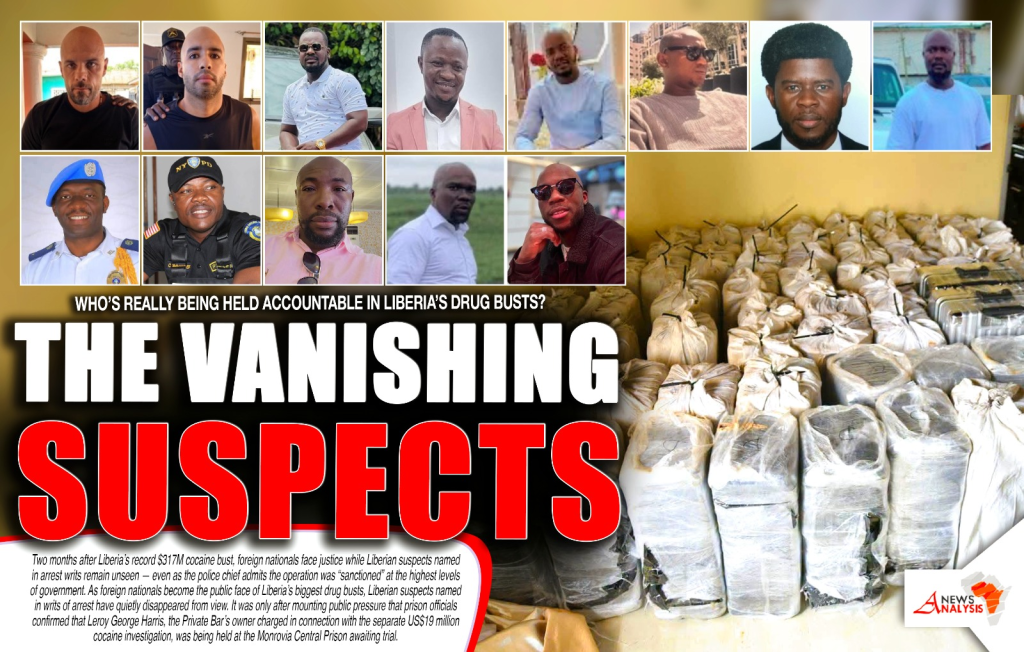
Foreign nationals arrested in the record US$317 million Duazon warehouse cocaine bust have become the most visible faces of the investigation, while Liberian suspects named in writs of arrest—including suspects in the earlier US$19 million Roberts International Airport cocaine case—have largely disappeared from public view, with little visible movement toward trial.
At the same time, the scandal has moved deeper into Liberia’s security establishment. A deputy police commissioner was dismissed after allegedly admitting to taking a bribe, three senior security officers were reportedly sent to court over alleged links to a cocaine-trafficking syndicate, and a former LDEA commander was rearrested while attempting to leave the country.
Then came an extraordinary admission from Liberia’s Inspector General of Police, Gregory O.W. Coleman, who said the Duazon operation was “definitely sanctioned by state actors at the very, very senior level” of government.
He did not identify those officials. That admission has only sharpened the question many Liberians are now asking: If the police chief says senior state actors were involved, why does the visible face of justice remain largely two foreign nationals?
Two Cases, One Pattern: The Vanishing Suspects
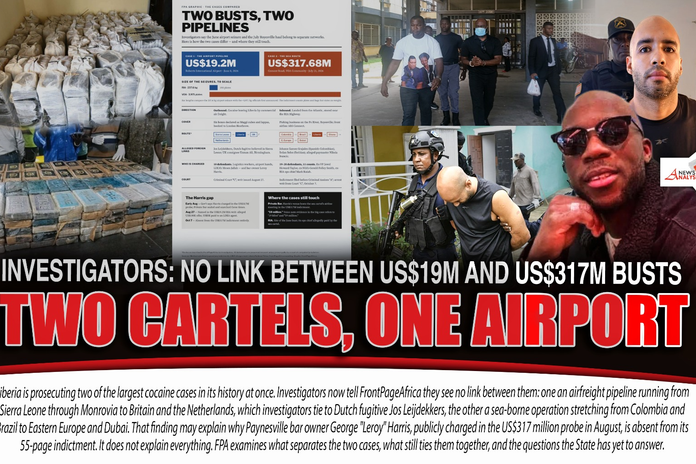
Something does not add up in the way Liberia has handled its two largest drug busts of 2026. In June, authorities intercepted 237.6 kilograms of cocaine valued at about US$19 million at Roberts International Airport. Five people were eventually charged, including Oscar Browne and Michael Browne, who was charged in absentia after reportedly fleeing across the border into Sierra Leone.
A month later, the country was confronted with an even larger discovery: nearly 4,000 kilograms of cocaine, valued at roughly US$317 million, found inside a warehouse in Duazon, outside Monrovia.
Two foreign nationals—Johann David Garces Grajales and Srdan Seles—were arrested at the scene. Grajales was reportedly carrying Spanish and Colombian passports, while Seles is a Serbian national.
They quickly became the public faces of Liberia’s largest drug investigation.
But the Duazon case does not involve only two suspects.
Among those named in connection with the case are Edison Brown, Mohammed Alpha Bah, Jammel V. Jallah, Christopher Sayee, Christian L. Nyantee, Caycee Nelson, a man identified only as Sekou, Nana Tom, a man identified only as Michael, and Abednego.
The charges include importation of controlled drugs, unlicensed exportation, unlicensed sale and transportation of controlled substances, unlicensed possession, illicit trafficking, criminal conspiracy, criminal facilitation, criminal solicitation and illegal possession of a firearm under various provisions of Liberia’s Penal Law.
Yet since the charges were announced, the public has seen little evidence of those Liberian suspects being brought before the courts.
There have been writs of arrest. There have been names on charge sheets. But where are the suspects?
Where are the arrests? Where are the arraignments? Where are the trial dates? For the public, the answers remain unclear. The result is a widening perception that while the two foreign nationals are being visibly prosecuted, several Liberian suspects have effectively vanished from the case. That perception is particularly troubling because the investigation itself has increasingly pointed inward.
Coleman’s Admission Changed the Conversation
In late July, IGP Coleman told a government press briefing that the operation was “definitely sanctioned by state actors at the very, very senior level” of government.
He did not name the officials. But the significance of the statement lies in who made it. This was not an opposition politician or an activist making an allegation. It was Liberia’s top police officer speaking about an operation at the center of the country’s largest drug-trafficking investigation. The admission created another layer to the case.
If senior state actors authorized or sanctioned the operation, who were they? Were they government officials? Security officials? Political actors? Business interests? And, most importantly, are they being investigated? The public has yet to receive clear answers.
The Scandal Inside the Security Forces
Meanwhile, the investigation has produced consequences within Liberia’s own security institutions. Deputy Commissioner for Crime Services Johnny Bolar Dean was dismissed after reportedly admitting that he accepted a US$10,000 bribe in exchange for favorable treatment of suspects in custody. The episode raised questions about internal accountability within the Liberia National Police, including how Dean rose to such a senior position and whether warning signs were missed.
Separately, three senior security officers—including the Chief of Highway Patrol, the Chief of Financial Crimes and the Deputy Commander of the LDEA at Roberts International Airport—were reportedly forwarded to court over alleged connections to a cocaine-trafficking syndicate.
Then came the rearrest of Moses Jallah, a former LDEA deputy commander at Roberts International Airport who was already facing obstruction-related charges. Jallah was reportedly taken back into custody after attempting to leave the country through the same airport where the cocaine was intercepted.
These developments suggest that the drug investigations are not simply exposing foreign traffickers. They are exposing vulnerabilities—and alleged wrongdoing—within Liberia’s own security system.
Harris Is Held. Kuiah Remains a Question.
Other names have also emerged. Leroy Harris, owner of the nightclub Private Bar, was charged in connection with the separate US$19 million cocaine investigation. But it was only after mounting public pressure that the Bureau of Corrections and Rehabilitation confirmed that Harris was being held at the Monrovia Central Prison awaiting trial. That confirmation raised another question: why did it take public pressure for authorities to clarify the status of a suspect already publicly linked to such a major drug case?
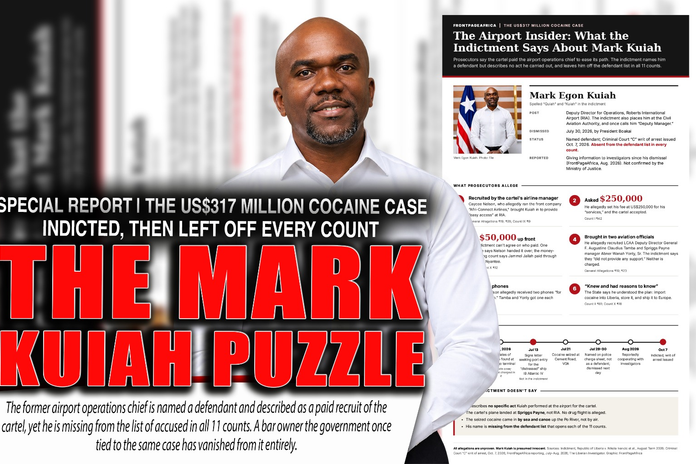
Then there is Mark Egon Kuiah, the former Deputy Director of the Liberia Airport Authority. President Joseph Nyuma Boakai dismissed Kuiah over his alleged connection to the drug bust. Yet authorities have not clearly established publicly whether Kuiah has been charged.
If he has been charged, what are the charges? Where is he? Is he in custody? Has he been released on bail? If he has not been charged, why was he dismissed? These are basic questions in a case of extraordinary national importance, but clear public answers remain elusive.
U.S. Pushing Accountability
Amid the growing scrutiny, the United States Government has reaffirmed its support for Liberia’s efforts to strengthen its security and justice institutions.
In a statement issued Monday, the U.S. Embassy said Chargé d’Affaires Joe Zadrozny met with IGP Coleman and Executive Protection Service Director Sam Gaye.
The Embassy said the meeting provided an opportunity to reiterate that the United States “stands firmly” with its Liberian partners as the country works to strengthen its security and legal institutions. It said a just and accountable legal system is important not only to Liberia but also to regional stability and the longstanding relationship between Liberia and the United States. The Embassy also reaffirmed its continued partnership with the Liberian Government and people, saying it looks forward to broadening cooperation aimed at enhancing the security and prosperity of both countries.
Analysts say the timing of the engagement is significant. Liberia is facing its most serious drug-trafficking investigations in recent memory, while questions about accountability are increasingly extending beyond traffickers to officials and security personnel allegedly connected to the cases.
What This Pattern Suggests
Taken together, the cases present an uncomfortable picture.
Liberia’s drug investigations have exposed alleged wrongdoing not only among suspected traffickers but also within parts of the security establishment tasked with stopping them. Yet the most visible prosecution remains that of the two foreign nationals arrested at the Duazon warehouse.
The Liberian suspects named in arrest writs remain largely invisible.
Some have reportedly fled. Some have been dismissed from government positions. Some have been identified in court documents. Others remain the subject of unanswered questions. And the senior “state actors” referenced by the police chief remain unnamed.
Observers say this is where the credibility of Liberia’s drug investigations will ultimately be tested. The issue is not simply whether the government can seize cocaine. It is whether it can follow the evidence wherever it leads. That means identifying and prosecuting those who allegedly imported, financed, transported, stored or facilitated the drugs—regardless of nationality, political connections, wealth or position.
The government does not have to parade suspects before the public to prove that justice is being done. But it does owe the public transparency about who has been arrested, who has been charged, who is on the run, who has been released on bail and where the cases stand in court.
Because two months into Liberia’s biggest drug cases, the central question remains unanswered: If senior state actors were involved, who are they—and will Liberia’s justice system reach them? Until the government provides those answers, the vanishing suspects will remain as troubling as the drugs themselves.
Support Independent Journalism
Your support helps FrontPage Africa continue delivering independent, credible, and impactful journalism. Every contribution strengthens our ability to investigate, inform, and hold power accountable while keeping quality journalism accessible to our readers.
Support our journalism or subscribe to receive the latest FrontPage Africa stories and updates.