The Governments of Liberia and Japan have signed a food assistance agreement valued at Two Hundred and Fifty Million Japanese Yen (250 million), reaffirming Japan’s longstanding commitment to supporting Liberia’s food security, agricultural development and broader national development priorities.
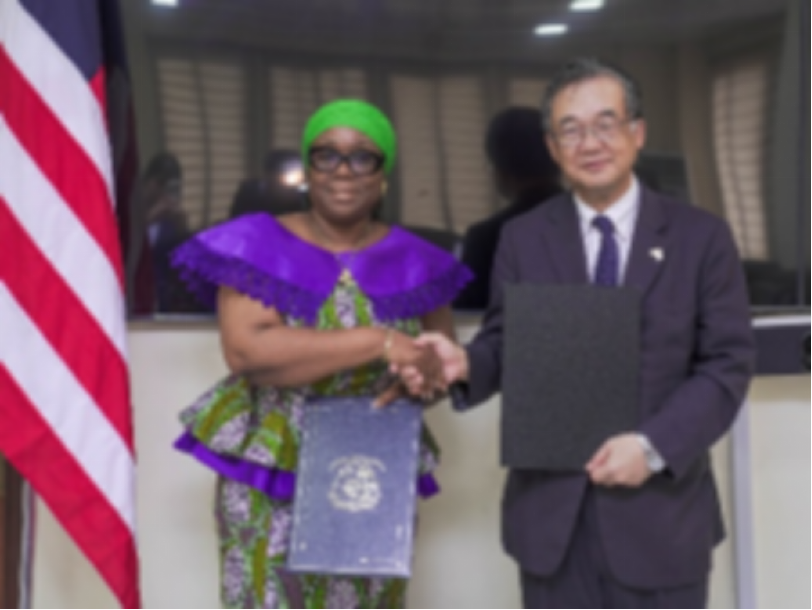
The agreement was signed on Monday, November 2 by Liberia’s Minister of Foreign Affairs, Sara Beysolow Nyanti, and Japan’s Ambassador to Liberia, Mr. Hiroshi Yoshimoto, on behalf of their respective governments.
At the signing ceremony, Ambassador Yoshimoto commended Foreign Minister Nyanti for undertaking significant institutional reforms to strengthen the management and administration of the Japanese Counterpart Value Fund Secretariat, describing the changes as an important step toward improving the effectiveness, coordination and sustainability of Japan’s development assistance to Liberia.
The reforms, undertaken under the leadership of Minister Nyanti, included the transfer of the Japanese Counterpart Value Fund Secretariat from the Ministry of Foreign Affairs to the Ministry of Commerce and Industry.
The institutional adjustment is intended to enhance the management, coordination and utilization of resources generated through Japan’s food assistance program.
Ambassador Yoshimoto emphasized that the KR Food Aid Program remains an important component of Japan’s Grant Aid Program, through which the Japanese Government supports partner countries in addressing critical development challenges.
He disclosed that the latest agreement, valued at ¥250 million, reflects Japan’s continued commitment to helping Liberia address food insecurity, particularly through the provision of rice, which remains a major staple food for thousands of Liberian households.
“I am pleased that Japan is able to carry out this program every year in partnership with the Liberian Government to provide the much-needed rice for the people of Liberia,” Ambassador Yoshimoto stated.
He further explained that the program extends beyond the direct provision of food supplies, as proceeds generated from the sale of the rice are intended to support Liberia’s broader development objectives.
“In addition to delivering the food supplies under the program, one important goal of the KR Food Assistance, as you are aware, is to ensure that the money raised from the sale of the food supplies supports Liberia’s broader development objectives,” he added.
In her remarks, Foreign Minister Nyanti expressed profound appreciation to the Government and people of Japan for their continued generosity and longstanding partnership with Liberia.
Responding to Ambassador Yoshimoto’s commendation, Minister Nyanti said the institutional reforms were undertaken in the best interest of Liberia and form part of the government’s broader commitment to strengthening public institutions, improving institutional efficiency and ensuring that development resources are effectively managed and utilized.
She emphasized that Liberia deeply values Japan’s development assistance, particularly its contribution to food security, economic cooperation, and the advancement of the country’s national development priorities.
The Foreign Minister highlighted President Joseph Nyuma Boakai, Sr.’s vision of transforming Liberia into a self-sufficient nation in rice production, reducing the country’s dependence on imported rice while empowering local farmers and strengthening domestic agricultural capacity.
She noted that agriculture occupies a central position in President Boakai’s development agenda, the ARREST Agenda for Inclusive Development, with the first letter, “A,” representing Agriculture.
According to Minister Nyanti, achieving food self-sufficiency requires sustained investment in agriculture, effective institutional coordination, strong international partnerships and the strategic utilization of available resources to stimulate domestic production and economic growth.
She also commended the sustainability component of Japan’s KR Food Aid Program, particularly the mechanism through which proceeds from the sale of donated rice are reinvested in development initiatives.
The Foreign Minister observed that the program’s benefits extend beyond immediate food assistance, providing Liberia with an additional mechanism for mobilizing resources to support national development priorities.
She stressed that the effective management of counterpart funds is essential to ensuring that international assistance produces tangible and lasting benefits for the Liberian people.
The signing of the ¥250 million KR Food Aid Agreement represents another important milestone in the longstanding diplomatic relations between Liberia and Japan. It underscores the two countries’ shared commitment to strengthening development cooperation, promoting food security, and advancing sustainable economic growth.
The ceremony was attended by the Deputy Minister for Legal Affairs, Cllr. Jeddi Mowbray Armah; Deputy Minister for International Cooperation and Economic Integration, Dr. Ibrahim Al-bakri Nyei; Assistant Minister for International Cooperation, Leon Talery and other officials of the Ministry of Foreign Affairs.
The Ministry of Foreign Affairs reiterates the Government of Liberia’s appreciation to Japan for its continued partnership and support toward the country’s development aspirations.
Support Independent Journalism
Your support helps FrontPage Africa continue delivering independent, credible, and impactful journalism. Every contribution strengthens our ability to investigate, inform, and hold power accountable while keeping quality journalism accessible to our readers.
Support our journalism or subscribe to receive the latest FrontPage Africa stories and updates.