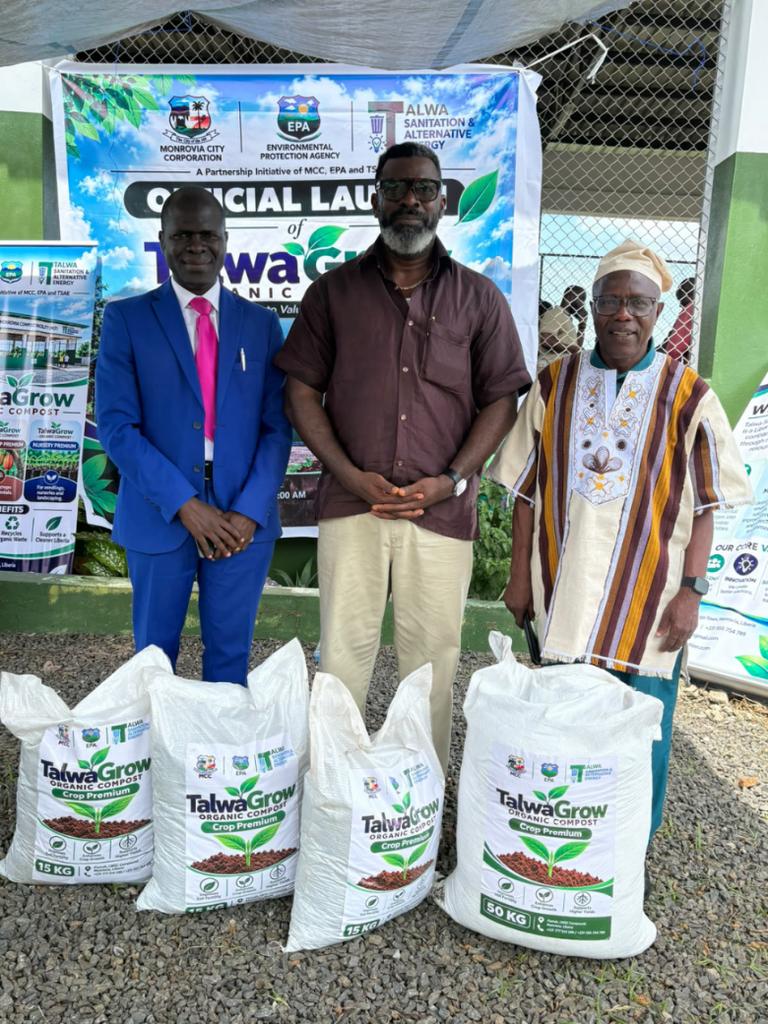
MONROVIA – The Executive Director of the Environmental Protection Agency (EPA), Dr. Emmanuel King Urey Yarkpawolo, said laboratory tests found no detectable toxic heavy metals in samples of TalwaGrow Organic Compost, as the product was formally launched at the Fiamah facility in Monrovia.
By Selma Lomax, [email protected]
Dr. Yarkpawolo spoke on Wednesday at the launch of TalwaGrow Organic Compost, held at the composting facility located within the compound of the Liberia Water and Sewer Corporation (LWSC) in Fiamah. The event brought together officials of the Monrovia City Corporation (MCC), LWSC, Novasphere, and Talwa Sanitation & Alternative Energy, the private company that operates the facility.
Policy in action
The EPA chief described the launch as a demonstration of what Liberia’s Solid Waste Management Policy can achieve when put into practice. He said the initiative shows how an everyday environmental challenge can become an opportunity for cleaner communities, healthier soils, and private-sector enterprise.
In fulfillment of that policy, Dr. Yarkpawolo said, the EPA, with support from Novasphere, built the composting facility to help transform organic waste into a useful agricultural resource. Vegetable scraps and other biodegradable materials that would otherwise be discarded can be processed into compost to improve soil condition and support crop production, he explained. Recovering such materials also reduces the volume of waste that must be disposed of.
Lab results
Dr. Yarkpawolo stressed that a product meant for Liberia’s farms must be backed by evidence. He disclosed that the EPA laboratory assessed two compost samples made from market vegetable waste, including cassava leaf stems, palava sauce stems, and potato green stems, mixed with sawdust and water.
According to him, the toxic heavy metals tested for, lead, cadmium, and arsenic, were below detection limits in both samples. “No detectable contamination from these tested metals was found,” he said, describing the outcome as encouraging for the materials examined and for the potential of the initiative.
The EPA boss, however, noted that the results also pointed to room for improvement. To enhance the overall quality of the compost, the agency has advised the operators to raise its nitrogen content by adding more nitrogen-rich organic material, such as leafy green waste.
He said the findings underscore why laboratory testing must remain a permanent part of the production process. Testing, he noted, identifies both encouraging findings and practical steps for improvement. “Our responsibility is to help this facility produce consistent, dependable compost that farmers can use with confidence,” he said.
A partnership model
Dr. Yarkpawolo outlined the roles of each partner in the project. The Monrovia City Corporation provides administrative management of the facility, while the Liberia Water and Sewer Corporation hosts it within its Fiamah compound. The EPA provides environmental regulatory oversight and laboratory assessment.
Talwa Sanitation & Alternative Energy, led by its Chief Executive Officer, Mr. Samuel T. Duo, operates the facility and is bringing TalwaGrow to the market. The EPA boss thanked Novasphere for supporting the establishment of what he called an important investment. “This initiative depends on partnership,” he said.
The EPA chief urged the partners to maintain proper waste separation and keep unsuitable materials out of the compost stream. He also called on them to implement the recommendations made by the EPA laboratory. According to Dr. Yarkpawolo, a well-managed facility can support sanitation services, create opportunities for Liberian businesses, and return valuable organic matter to the country’s soils.
He congratulated Talwa Sanitation & Alternative Energy, the MCC, and all workers and technical teams supporting the initiative. He urged them to build on the launch with the care and quality control needed to make TalwaGrow a reliable product for Liberia.
Dr. Yarkpawolo also extended appreciation to the Government and People of Canada for providing financial support to the initiative.
Why it matters
Waste management remains a major challenge for Monrovia, where large volumes of market and household waste must be collected and disposed of daily. Composting offers one way to divert biodegradable material from disposal sites and convert it into a product with agricultural value.
The TalwaGrow launch is also significant as an example of the public and private sectors working together under a national policy framework. The government, through the EPA and MCC, provides regulation, oversight, and management. A private company handles operations and marketing. Development partners supply the funding and technical support that make the investment possible.
For farmers, the EPA’s testing is intended to provide assurance that the compost is safe to use. Heavy metals such as lead, cadmium, and arsenic are of concern in agricultural inputs because they can build up in soils over time. The absence of detectable levels in both tested samples is therefore a positive early indicator, although the EPA chief was clear that quality control must continue beyond the launch.
With the launch complete, attention now turns to whether the Fiamah facility can consistently deliver compost of reliable quality. The EPA’s advice on increasing nitrogen content, along with continued laboratory testing and strict waste separation, will be central to that effort.
Support Independent Journalism
Your support helps FrontPage Africa continue delivering independent, credible, and impactful journalism. Every contribution strengthens our ability to investigate, inform, and hold power accountable while keeping quality journalism accessible to our readers.
Support our journalism or subscribe to receive the latest FrontPage Africa stories and updates.