“No more 7-days Walaha for public discussion for addressing critical national concerns, and then it dies.”
The issues of alleged drug cartel activity, trafficking, and the destruction of our youth through addiction, exploitation, and prostitution cannot be ignored or suppressed.
By: Austin S Fallah – A True Son of the Planet Earth Soil: [email protected]
These matters will continue to be raised responsibly through social media platforms, newspapers, and other lawful channels until those responsible, including anyone who enabled or benefited from such conduct, are thoroughly investigated and held accountable under the law.
Those implicated should understand that accountability may come now or in the foreseeable future through the appropriate legal processes and courts of competent jurisdiction.”
Liberia’s commitment to the Open Door policy, openness, investment, and international engagement is essential to its economic future.
As a nation rebuilding institutions, creating employment opportunities, and seeking a stronger role in regional and global affairs, Liberia cannot isolate itself from foreign businesspeople, investors, visitors, or workers.
An open-door policy can encourage trade, entrepreneurship, tourism, technology transfer, and diplomatic cooperation.
However, openness must never be confused with lawlessness.
A nation that welcomes legitimate business but fails to prevent drug trafficking, money laundering, fraud, and organized criminal activity places its citizens, especially its young people, at great risk.
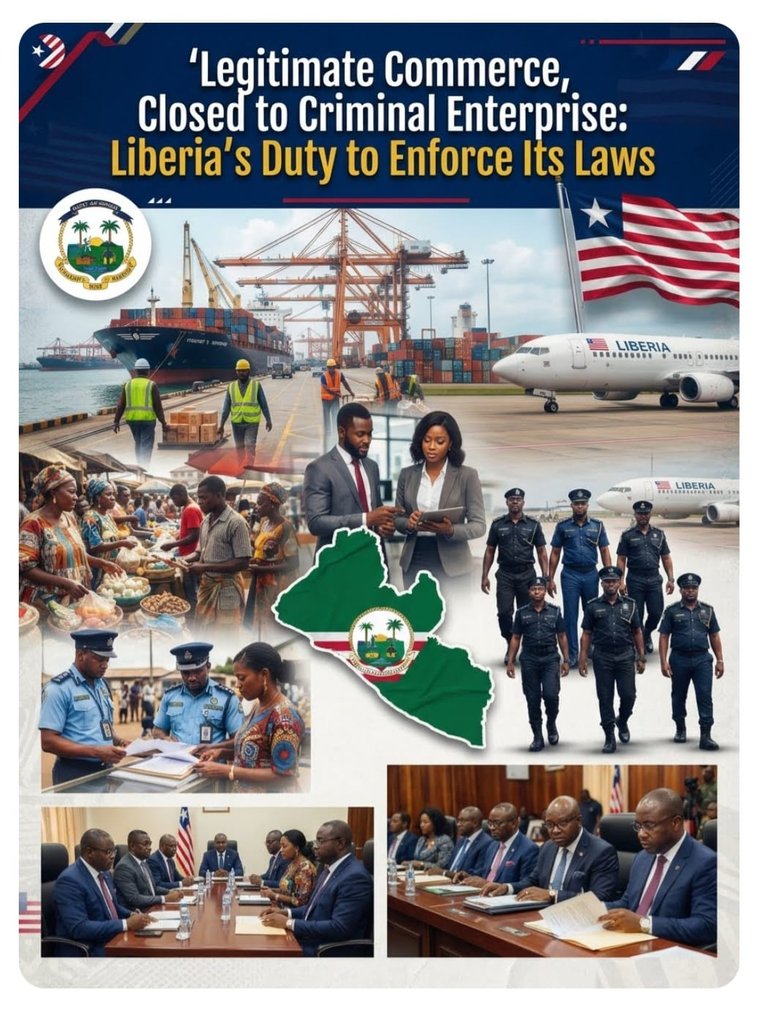
Liberia must therefore strengthen the enforcement of its laws, punish convicted offenders fully and fairly, and make clear that its borders and economy are open to lawful commerce, not to narcotics, illegal money-doubling schemes, or criminal networks.
The central question is whether laxity, corruption, and weakness in enforcing Liberia’s laws have contributed to the influx of drug cartels, traffickers, and financial criminals.
The answer, in significant part, is yes.
Criminal organizations do not normally choose countries at random.
They search for places where border controls are weak, law enforcement agencies lack resources, investigations can be influenced, prosecutions are slow, and penalties are either not imposed or not taken seriously.
Where corruption is widespread or suspected, criminal networks see opportunity.
They may believe that officials can be bribed, documents can be manipulated, evidence can disappear, or cases can be delayed until public attention fades.
This does not mean that every public official is corrupt or that every law enforcement officer is ineffective.
Liberia has many dedicated police officers, immigration officers, prosecutors, judges, community leaders, and citizens who serve their country honestly.
Yet even a small number of compromised officials or weak institutions can create a wide opening for criminal enterprise.
Drug trafficking is particularly dangerous because it damages more than individual victims.
It can weaken entire communities and generations.
Young people are often the first targets of traffickers because youth unemployment, poverty, peer pressure, and limited opportunity can make quick money appear attractive.
A young person who begins by delivering a package, storing an item, or acting as a courier may later become trapped in addiction, violence, debt, or criminal prosecution.
Drug traffickers understand this vulnerability.
They do not care about Liberia’s future, its families, or its national security.
Their purpose is profit.
If they can turn young people into customers, couriers, guards, informants, or street-level sellers, they will do so without remorse.
The consequences of widespread drug activity are severe.
Drug abuse can contribute to school dropout, mental health crises, domestic violence, theft, gang involvement, and loss of productivity.
Families are forced to watch their children struggle with addiction.
Communities experience greater fear and insecurity.
Hospitals and social services face additional burdens.
Law enforcement agencies become overstretched.
In the long run, a country that allows narcotics to circulate freely risks losing a portion of its most energetic and promising generation.
Liberia cannot afford such a future. Its young people should be encouraged to pursue education, skills training, farming, entrepreneurship, public service, sports, and innovation, not be pulled into destructive drug networks.
Equally troubling is the growth of illegal money-doubling and financial fraud schemes.
Such schemes often promise desperate people that their money can be multiplied quickly and without effort.
They may be presented as investment opportunities, informal lending arrangements, online businesses, foreign exchange ventures, import-export deals, or charitable programs.
In reality, many are fraudulent operations designed to take money from ordinary people and disappear before victims can recover their losses.
These crimes are especially harmful in a country where many citizens work hard for small incomes and where families may invest their savings in hopes of improving their lives.
Illegal money-doubling is not a harmless private transaction.
It is a form of economic exploitation. Victims may lose school fees, rent money, market capital, medical funds, or money saved for a family emergency.
When fraud becomes common, people lose confidence not only in private businesses but also in public institutions that are expected to protect them.
A society cannot build a strong economy where dishonesty is rewarded, and victims are ignored.
Legitimate investors also become cautious when they see fraud, money laundering, and weak regulation.
Thus, failure to confront financial crime can discourage the very investment Liberia needs for development.
Some Liberians have raised concerns about foreign nationals who may be involved in drug trafficking, illegal money-doubling, and other criminal activities.
These concerns should be taken seriously when they are supported by credible evidence.
No country should allow foreigners—or citizens—to use its territory as a base for crime.
However, Liberia must be careful not to turn legitimate concern about criminal behavior into blanket suspicion of people from a particular country, region, or ethnic background.
It is wrong and dangerous to assume that all people from East Asia, West Africa, Europe, the Americas, or any other part of the world are criminals because a few individuals may be accused or convicted of crimes.
Criminality is a matter of individual conduct, evidence, and legal responsibility, not nationality.
This distinction is important for both justice and diplomacy.
Liberia benefits from peaceful relations with foreign countries and from the contributions of lawful immigrants, investors, students, and professionals.
Many foreign nationals come to Liberia to operate legitimate businesses, create jobs, pay taxes, and participate respectfully in society.
They should not be demonized because of the actions of criminal individuals.
At the same time, no foreign national should be above the law.
Immigration status, wealth, business connections, or nationality must not become a shield against prosecution.
If a person, Liberian or foreign national, is arrested, investigated, prosecuted, and found guilty in a court of law, that person should face the full legal consequences of the crime.
The rule must be simple and equal: Liberia welcomes lawful residents and investors, but it should not protect criminals.
For this reason, the government must strengthen enforcement at every stage of the justice system.
Arrest alone is not enough. Public announcements about raids and seizures may create temporary confidence, but they mean little if cases do not lead to careful investigation, lawful prosecution, and appropriate punishment after conviction.
Law enforcement agencies need training in modern investigative methods, evidence collection, financial tracing, cybercrime detection, and intelligence sharing.
Prosecutors need adequate staffing and resources to prepare strong cases.
Courts need the capacity to hear cases without unnecessary delay.
Witnesses must be protected from intimidation.
Evidence must be stored securely.
Police officers and immigration officials must be paid and supervised adequately so that they are less vulnerable to bribery and corruption.
Border security must also be a national priority. Liberia’s ports, airports, land crossings, and coastal waters can be exploited by traffickers if monitoring is weak.
Criminal networks frequently use false declarations, hidden compartments, forged travel documents, shell companies, and corrupt intermediaries.
The government should invest in screening technology, trained customs personnel, drug detection capacity, and coordinated intelligence operations.
It should also cooperate closely with neighboring countries, regional bodies, and international law enforcement agencies.
Drug trafficking and money laundering are rarely local crimes.
They often involve networks that cross several borders, move funds through different jurisdictions, and use modern communication tools to avoid detection.
Liberia cannot defeat such networks alone, but it must be a serious and reliable partner in regional and international enforcement efforts.
Anti-corruption measures are equally necessary.
A country cannot fight organized crime successfully if criminals can buy protection from officials.
Liberia should enforce strict asset declaration rules for public officials in sensitive positions, including customs, immigration, police, port authorities, financial regulators, and the judiciary.
Internal affairs units should investigate allegations of misconduct promptly and independently.
Officials found guilty of accepting bribes, assisting traffickers, leaking information, or obstructing justice should face serious penalties.
The public must see that corruption is not merely condemned in speeches but punished in practice.
Transparency can also help restore trust.
When drug seizures occur or suspected money-laundering operations are uncovered, the government should provide accurate public information without compromising active investigations.
Citizens deserve to know whether cases are progressing through the courts and whether convicted offenders are receiving lawful sentences.
Civil society organizations, journalists, religious leaders, traditional leaders, and community groups can play an important role by educating the public and demanding accountability.
A free press, acting responsibly and based on verified facts, can expose fraud and corruption that might otherwise remain hidden.
Education and prevention should accompany punishment.
Strong penalties are necessary for traffickers, fraud organizers, and money launderers, but prevention can reduce the number of people drawn into criminal activity in the first place.
Schools should teach students about the dangers of narcotics, online fraud, gambling-like investment schemes, and quick-money promises.
Communities should organize awareness campaigns in markets, churches, mosques, campuses, and rural towns.
Young people need realistic alternatives: vocational training, apprenticeships, sports programs, access to small business support, and job opportunities.
A teenager with hope, skills, and a path toward a decent livelihood is less likely to be manipulated by a drug dealer or fraud operator.
The banking and telecommunications sectors also have responsibilities.
Financial institutions should follow anti-money-laundering rules, verify suspicious transactions, and report unusual patterns to the appropriate authorities.
Mobile money operators and telecommunications companies should cooperate, within the law, with investigations into scams and financial crimes.
Digital platforms have made it easier for criminals to reach victims, but they can also be used to warn the public and trace illegal activity.
Liberia should update its laws and enforcement tools to meet the realities of cyber-enabled fraud and transnational financial crime.
Ultimately, Liberia’s open-door policy must be guided by national interest and the rule of law.
Openness does not mean that anyone can enter, operate, or profit without scrutiny.
It does not mean that drugs can be imported, young people can be recruited into trafficking, or citizens can be cheated through illegal money-doubling schemes.
It does not mean that criminal networks may hide behind business licenses, foreign passports, political connections, or financial power.
A truly open and respectable nation is one that welcomes legitimate trade while firmly rejecting exploitation and criminality.
Liberia’s image in international diplomacy depends not only on its speeches and agreements but also on the strength of its institutions.
Countries earn respect when they demonstrate that their laws apply fairly to everyone, that their borders are protected, that corruption is confronted, and that organized crime cannot operate with impunity.
The government must therefore ensure that all persons arrested are treated lawfully, all accused persons receive due process, and all individuals found guilty by competent courts are punished to the full extent of the law. Justice must be firm, but it must also be fair.
Liberia should remain open to business, friendship, investment, and international cooperation.
But it must close every available door to illicit drugs, drug trafficking, money laundering, financial fraud, and all activities that threaten national security and destroy the future of its young people.
The choice is not between openness and security. Liberia can and must have both.
“Liberians will not accept any attempt to silence public discussion for seven days to prevent the nation from addressing critical national concerns.
The issues of alleged drug cartel activity, trafficking, and the destruction of our youth through addiction, exploitation, and prostitution cannot be ignored or suppressed.
These matters will continue to be raised responsibly through social media platforms, newspapers, and other lawful channels until those responsible, including anyone who enabled or benefited from such conduct, are thoroughly investigated and held accountable under the law.
Those implicated should understand that accountability may come now or in the foreseeable future through the appropriate legal processes and courts of competent jurisdiction.”
By: Austin S Fallah – A True Son of the Planet Earth Soil:
Liberia’s commitment to the Open Door policy, openness, investment, and international engagement is essential to its economic future.
As a nation rebuilding institutions, creating employment opportunities, and seeking a stronger role in regional and global affairs, Liberia cannot isolate itself from foreign businesspeople, investors, visitors, or workers.
An open-door policy can encourage trade, entrepreneurship, tourism, technology transfer, and diplomatic cooperation.
However, openness must never be confused with lawlessness.
A nation that welcomes legitimate business but fails to prevent drug trafficking, money laundering, fraud, and organized criminal activity places its citizens, especially its young people, at great risk.
Liberia must therefore strengthen the enforcement of its laws, punish convicted offenders fully and fairly, and make clear that its borders and economy are open to lawful commerce, not to narcotics, illegal money-doubling schemes, or criminal networks.
The central question is whether laxity, corruption, and weakness in enforcing Liberia’s laws have contributed to the influx of drug cartels, traffickers, and financial criminals.
The answer, in significant part, is yes.
Criminal organizations do not normally choose countries at random.
They search for places where border controls are weak, law enforcement agencies lack resources, investigations can be influenced, prosecutions are slow, and penalties are either not imposed or not taken seriously.
Where corruption is widespread or suspected, criminal networks see opportunity.
They may believe that officials can be bribed, documents can be manipulated, evidence can disappear, or cases can be delayed until public attention fades.
This does not mean that every public official is corrupt or that every law enforcement officer is ineffective.
Liberia has many dedicated police officers, immigration officers, prosecutors, judges, community leaders, and citizens who serve their country honestly.
Yet even a small number of compromised officials or weak institutions can create a wide opening for criminal enterprise.
Drug trafficking is particularly dangerous because it damages more than individual victims.
It can weaken entire communities and generations.
Young people are often the first targets of traffickers because youth unemployment, poverty, peer pressure, and limited opportunity can make quick money appear attractive.
A young person who begins by delivering a package, storing an item, or acting as a courier may later become trapped in addiction, violence, debt, or criminal prosecution.
Drug traffickers understand this vulnerability.
They do not care about Liberia’s future, its families, or its national security.
Their purpose is profit.
If they can turn young people into customers, couriers, guards, informants, or street-level sellers, they will do so without remorse.
The consequences of widespread drug activity are severe.
Drug abuse can contribute to school dropout, mental health crises, domestic violence, theft, gang involvement, and loss of productivity.
Families are forced to watch their children struggle with addiction.
Communities experience greater fear and insecurity.
Hospitals and social services face additional burdens.
Law enforcement agencies become overstretched.
In the long run, a country that allows narcotics to circulate freely risks losing a portion of its most energetic and promising generation.
Liberia cannot afford such a future. Its young people should be encouraged to pursue education, skills training, farming, entrepreneurship, public service, sports, and innovation, not be pulled into destructive drug networks.
Equally troubling is the growth of illegal money-doubling and financial fraud schemes.
Such schemes often promise desperate people that their money can be multiplied quickly and without effort.
They may be presented as investment opportunities, informal lending arrangements, online businesses, foreign exchange ventures, import-export deals, or charitable programs.
In reality, many are fraudulent operations designed to take money from ordinary people and disappear before victims can recover their losses.
These crimes are especially harmful in a country where many citizens work hard for small incomes and where families may invest their savings in hopes of improving their lives.
Illegal money-doubling is not a harmless private transaction.
It is a form of economic exploitation. Victims may lose school fees, rent money, market capital, medical funds, or money saved for a family emergency.
When fraud becomes common, people lose confidence not only in private businesses but also in public institutions that are expected to protect them.
A society cannot build a strong economy where dishonesty is rewarded, and victims are ignored.
Legitimate investors also become cautious when they see fraud, money laundering, and weak regulation.
Thus, failure to confront financial crime can discourage the very investment Liberia needs for development.
Some Liberians have raised concerns about foreign nationals who may be involved in drug trafficking, illegal money-doubling, and other criminal activities.
These concerns should be taken seriously when they are supported by credible evidence.
No country should allow foreigners—or citizens—to use its territory as a base for crime.
However, Liberia must be careful not to turn legitimate concern about criminal behavior into blanket suspicion of people from a particular country, region, or ethnic background.
It is wrong and dangerous to assume that all people from East Asia, West Africa, Europe, the Americas, or any other part of the world are criminals because a few individuals may be accused or convicted of crimes.
Criminality is a matter of individual conduct, evidence, and legal responsibility, not nationality.
This distinction is important for both justice and diplomacy.
Liberia benefits from peaceful relations with foreign countries and from the contributions of lawful immigrants, investors, students, and professionals.
Many foreign nationals come to Liberia to operate legitimate businesses, create jobs, pay taxes, and participate respectfully in society.
They should not be demonized because of the actions of criminal individuals.
At the same time, no foreign national should be above the law.
Immigration status, wealth, business connections, or nationality must not become a shield against prosecution.
If a person, Liberian or foreign national, is arrested, investigated, prosecuted, and found guilty in a court of law, that person should face the full legal consequences of the crime.
The rule must be simple and equal: Liberia welcomes lawful residents and investors, but it should not protect criminals.
For this reason, the government must strengthen enforcement at every stage of the justice system.
Arrest alone is not enough. Public announcements about raids and seizures may create temporary confidence, but they mean little if cases do not lead to careful investigation, lawful prosecution, and appropriate punishment after conviction.
Law enforcement agencies need training in modern investigative methods, evidence collection, financial tracing, cybercrime detection, and intelligence sharing.
Prosecutors need adequate staffing and resources to prepare strong cases.
Courts need the capacity to hear cases without unnecessary delay.
Witnesses must be protected from intimidation.
Evidence must be stored securely.
Police officers and immigration officials must be paid and supervised adequately so that they are less vulnerable to bribery and corruption.
Border security must also be a national priority. Liberia’s ports, airports, land crossings, and coastal waters can be exploited by traffickers if monitoring is weak.
Criminal networks frequently use false declarations, hidden compartments, forged travel documents, shell companies, and corrupt intermediaries.
The government should invest in screening technology, trained customs personnel, drug detection capacity, and coordinated intelligence operations.
It should also cooperate closely with neighboring countries, regional bodies, and international law enforcement agencies.
Drug trafficking and money laundering are rarely local crimes.
They often involve networks that cross several borders, move funds through different jurisdictions, and use modern communication tools to avoid detection.
Liberia cannot defeat such networks alone, but it must be a serious and reliable partner in regional and international enforcement efforts.
Anti-corruption measures are equally necessary.
A country cannot fight organized crime successfully if criminals can buy protection from officials.
Liberia should enforce strict asset declaration rules for public officials in sensitive positions, including customs, immigration, police, port authorities, financial regulators, and the judiciary.
Internal affairs units should investigate allegations of misconduct promptly and independently.
Officials found guilty of accepting bribes, assisting traffickers, leaking information, or obstructing justice should face serious penalties.
The public must see that corruption is not merely condemned in speeches but punished in practice.
Transparency can also help restore trust.
When drug seizures occur or suspected money-laundering operations are uncovered, the government should provide accurate public information without compromising active investigations.
Citizens deserve to know whether cases are progressing through the courts and whether convicted offenders are receiving lawful sentences.
Civil society organizations, journalists, religious leaders, traditional leaders, and community groups can play an important role by educating the public and demanding accountability.
A free press, acting responsibly and based on verified facts, can expose fraud and corruption that might otherwise remain hidden.
Education and prevention should accompany punishment.
Strong penalties are necessary for traffickers, fraud organizers, and money launderers, but prevention can reduce the number of people drawn into criminal activity in the first place.
Schools should teach students about the dangers of narcotics, online fraud, gambling-like investment schemes, and quick-money promises.
Communities should organize awareness campaigns in markets, churches, mosques, campuses, and rural towns.
Young people need realistic alternatives: vocational training, apprenticeships, sports programs, access to small business support, and job opportunities.
A teenager with hope, skills, and a path toward a decent livelihood is less likely to be manipulated by a drug dealer or fraud operator.
The banking and telecommunications sectors also have responsibilities.
Financial institutions should follow anti-money-laundering rules, verify suspicious transactions, and report unusual patterns to the appropriate authorities.
Mobile money operators and telecommunications companies should cooperate, within the law, with investigations into scams and financial crimes.
Digital platforms have made it easier for criminals to reach victims, but they can also be used to warn the public and trace illegal activity.
Liberia should update its laws and enforcement tools to meet the realities of cyber-enabled fraud and transnational financial crime.
Ultimately, Liberia’s open-door policy must be guided by national interest and the rule of law.
Openness does not mean that anyone can enter, operate, or profit without scrutiny.
It does not mean that drugs can be imported, young people can be recruited into trafficking, or citizens can be cheated through illegal money-doubling schemes.
It does not mean that criminal networks may hide behind business licenses, foreign passports, political connections, or financial power.
A truly open and respectable nation is one that welcomes legitimate trade while firmly rejecting exploitation and criminality.
Liberia’s image in international diplomacy depends not only on its speeches and agreements but also on the strength of its institutions.
Countries earn respect when they demonstrate that their laws apply fairly to everyone, that their borders are protected, that corruption is confronted, and that organized crime cannot operate with impunity.
The government must therefore ensure that all persons arrested are treated lawfully, all accused persons receive due process, and all individuals found guilty by competent courts are punished to the full extent of the law. Justice must be firm, but it must also be fair.
Liberia should remain open to business, friendship, investment, and international cooperation.
But it must close every available door to illicit drugs, drug trafficking, money laundering, financial fraud, and all activities that threaten national security and destroy the future of its young people.
The choice is not between openness and security. Liberia can and must have both.
Support Independent Journalism
Your support helps FrontPage Africa continue delivering independent, credible, and impactful journalism. Every contribution strengthens our ability to investigate, inform, and hold power accountable while keeping quality journalism accessible to our readers.
Support our journalism or subscribe to receive the latest FrontPage Africa stories and updates.