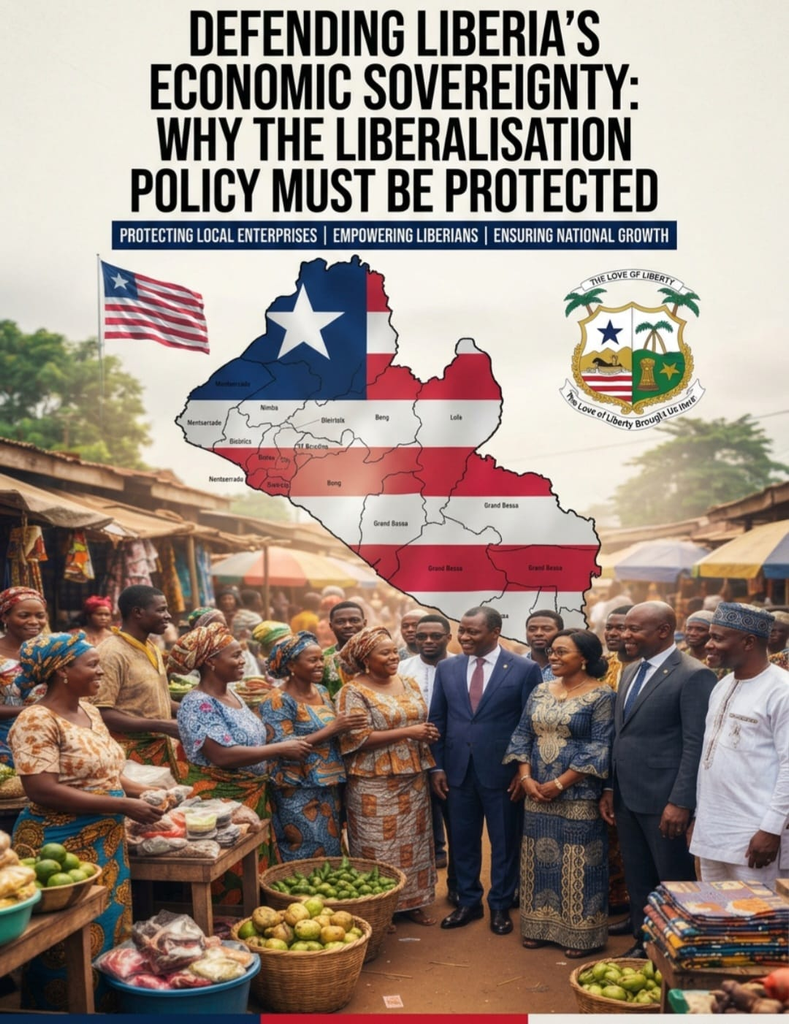
https://www.tiktok.com/t/ZPLc9uvrr
Hon. Edward Wesee: “True independence goes beyond the flag; it is secured when a nation’s wealth remains in the hands of its own people.”
Hon. Alexander Torbor Kun: “Protecting the Liberianization Policy is not about closing doors to the world, but ensuring Liberians have a seat at the table in their own home.”
“Economic sovereignty is the backbone of national pride—when we empower local businesses, we build a self-reliant Liberia.”- Austin S. Fallah.
By: Austin S Fallah – A True Son of the Planet Earth Soil: [email protected].
Liberia cannot achieve meaningful economic independence if Liberians remain spectators in the most basic sectors of their own economy.
For decades, ordinary Liberians have watched foreign nationals dominate small retail shops, transportation businesses, petty trading, construction supply stores, restaurants, and other commercial activities that could provide livelihoods for Liberian families.
In response to this imbalance, Liberia adopted a Liberianization policy that reserves certain categories of business exclusively for Liberian citizens.
The purpose of this policy is simple: to give Liberians a fair opportunity to participate in, own, and benefit from their national economy.
However, a law on paper is not enough.
The Liberian government must actively protect and enforce the Liberianization policy, especially in businesses legally reserved for Liberians.
At the same time, Liberians themselves must stop serving as fronts for foreign nationals who are prohibited from operating in those sectors.
When a Liberian accepts money, gifts, or small payments to register a business in his or her name while a non-Liberian secretly owns and controls it, that Liberian is not advancing the interests of the country.
Instead, he or she is helping to destroy the very legal protection designed to create economic opportunities for Liberian citizens.
Liberia cannot complain about foreign domination of reserved businesses while some Liberians willingly participate in schemes that undermine their own laws.
If Liberians want foreign nationals to respect Liberian laws, Liberians must first respect and defend those laws themselves.
The Liberianization policy is not merely about restricting foreigners; it is fundamentally about economic justice, national development, and self-determination.
Every country has the right to establish rules that protect the economic interests of its citizens.
In many countries, foreign nationals face restrictions on land ownership, retail trade, professional licensing, employment, and investment in sensitive sectors.
These restrictions are not always acts of hostility toward outsiders.
Rather, they reflect the understanding that citizens should not be excluded from the basic economic opportunities available in their own homeland.
Liberia’s policy should be understood in the same way.
It recognizes that local people need space to build businesses, accumulate capital, employ others, and create stable communities.
Small and medium-sized businesses are especially important because they are often the first path to economic mobility.
A small grocery shop, transportation enterprise, tailoring business, local restaurant, building-materials store, or market stall may appear modest, but such businesses can support entire families.
They can pay school fees, provide healthcare, create employment for relatives and neighbors, and allow business owners to reinvest in their communities.
When these enterprises are reserved for Liberians, the law is attempting to ensure that the profits generated by these activities remain in Liberia and contribute directly to Liberian households.
When foreigners illegally control businesses that are reserved for Liberians, the intended benefits of the policy are weakened.
Profits may be sent out of the country rather than reinvested locally.
Decisions about employment and purchasing may be made without regard for the long-term development of Liberian communities.
More importantly, Liberian entrepreneurs are placed at a disadvantage.
A foreign-backed business may have access to greater capital, international supply chains, cheaper imports, and larger networks.
A young Liberian entrepreneur using personal savings or a small loan cannot easily compete against a business that is secretly financed and controlled by someone with significantly more resources.
If such arrangements are allowed to continue, the reserved-business law becomes meaningless.
The problem becomes even more serious when Liberians agree to act as fronts for foreign nationals.
Fronting occurs when a Liberian’s name, citizenship, or documents are used to register a business that is actually financed, owned, and managed by a non-Liberian.
The Liberian may receive a small monthly payment, a one-time bribe, or a minor share of the profit.
In many cases, the Liberian has little actual authority over the business.
The foreign national makes the decisions, controls the money, purchases the goods, hires the workers, and collects the profits.
The Liberian owner exists only on paper.
This practice is harmful for several reasons.
First, it is dishonest.
It deliberately deceives the government and violates the spirit, if not the letter, of the Liberianization policy.
Second, it prevents genuine Liberian entrepreneurs from accessing opportunities that the law intended to reserve for them.
Third, it creates a culture in which laws are treated as obstacles to be bypassed rather than standards to be followed.
Finally, it weakens Liberia’s bargaining position.
If foreign nationals see that Liberians are willing to sell their legal protections for small amounts of money, they will have little incentive to respect the country’s regulations.
Liberians must therefore stop accepting “peanuts” in exchange for their names and citizenship.
A short-term payment may solve an immediate financial problem, but it can cause long-term damage to the individual and the country.
A person who fronts for a foreign-owned business may receive a few dollars today, but he or she gives up the possibility of building a real business that could benefit the family for years.
The country also loses. Instead of developing Liberian-owned enterprises, skills, and wealth, Liberia becomes dependent on outsiders to control even sectors that are supposed to belong to its citizens.
This is not an argument that Liberia should reject foreign investment or treat foreign nationals unfairly.
Foreign investment can be valuable.
Liberia needs investment in infrastructure, manufacturing, agriculture, energy, technology, education, and other sectors that create jobs and transfer skills.
Foreign businesses that operate legally, pay taxes, obey labor laws, and respect national regulations can contribute positively to national development.
Liberia should welcome investors who are willing to work within the law and form transparent, mutually beneficial partnerships with Liberians.
However, welcoming foreign investment does not mean surrendering every sector of the economy.
There must be a distinction between lawful investment and unlawful economic control.
Foreigners should be allowed to invest in areas open to foreign participation, particularly where large capital, advanced technology, or specialized expertise is needed.
But businesses clearly reserved for Liberians should remain genuinely Liberian.
If the government allows every reserved sector to be taken over through fake registrations and fronting arrangements, then there is no meaningful difference between a protected sector and an unprotected one.
The government has a major responsibility in this matter.
It cannot simply announce a policy and assume that everyone will obey it.
Effective enforcement requires strong institutions, regular inspections, reliable business registration procedures, and consequences for violations.
Government agencies responsible for commerce, investment, immigration, taxation, and local administration must cooperate.
A business should not be considered Liberian-owned merely because a Liberian name appears on a document.
Authorities should examine who provided the capital, who controls the bank account, who makes management decisions, who imports the goods, who signs contracts, and who receives the profits.
These are the facts that reveal the true ownership of a business.
Liberia should also establish clear penalties for fronting.
Both the foreign national who secretly controls a reserved business and the Liberian citizen who knowingly serves as a false owner should face consequences.
These could include fines, suspension or cancellation of business licenses, denial of future registration privileges, tax investigations, and, in serious cases, criminal prosecution.
Enforcement should be fair and based on evidence, not on harassment or discrimination.
The goal is not to punish people unnecessarily; the goal is to protect the integrity of the law.
At the same time, enforcement must not focus only on poor Liberians who may be tempted by financial hardship.
The government must investigate the larger networks behind illegal business ownership.
Often, fronting arrangements involve powerful businesspeople, brokers, corrupt officials, and middlemen who profit from the system.
If enforcement targets only the visible Liberian whose name appears on the paperwork while ignoring the actual financiers and controllers, the problem will continue.
Liberia needs a serious anti-corruption approach that addresses the entire chain of illegal activity.
Education is also necessary.
Many Liberians may not fully understand the damage caused by fronting.
Some may see it as an ordinary business arrangement or a harmless way to earn money.
Public awareness campaigns should explain why the Liberianization policy exists and how illegal fronting affects employment, local ownership, tax revenue, and national development.
Schools, community organizations, radio programs, traditional leaders, religious institutions, and civil society groups can all help spread this message.
Citizens must understand that economic sovereignty is not an abstract political slogan.
It affects whether Liberian children will inherit businesses, skills, jobs, and opportunities in the future.
Still, moral appeals alone will not solve the problem.
Liberia must make it easier for genuine Liberians to start and grow businesses.
If citizens face high registration fees, lack of access to credit, poor infrastructure, unreliable electricity, excessive taxes, and bureaucratic delays, they may feel unable to compete.
The government should therefore combine enforcement of reserved-business laws with programs that support Liberian entrepreneurs.
These programs might include affordable loans, business training, mentorship, simplified registration, market access, tax incentives for small enterprises, and government procurement opportunities for qualified Liberian-owned companies.
Such support is essential because a policy that reserves businesses for Liberians must do more than exclude foreign competitors.
It must prepare Liberians to succeed.
A Liberian business owner should be able to obtain inventory, manage finances, maintain records, understand customer service, use technology, and compete honestly.
The goal should not be permanent dependence on protection.
The goal should be to build strong Liberian businesses that can eventually compete across West Africa and beyond.
Critics may argue that strict enforcement of the Liberianization policy could discourage investment or raise consumer prices.
These concerns should be considered, but they do not justify abandoning the policy.
The answer is not to permit illegal control of reserved businesses.
Rather, Liberia should design its enforcement carefully, transparently, and predictably.
Investors should know exactly which sectors are open to them, which are reserved for Liberians, and what requirements apply to partnerships.
Clear rules reduce uncertainty and make legitimate investment more attractive.
At the same time, ensuring that Liberians control reserved sectors helps create a broader domestic business class, which is necessary for long-term stability.
Liberians must also reject the mentality that only foreigners can successfully run businesses.
This belief is damaging and untrue.
Liberians are capable of managing shops, farms, transport companies, restaurants, factories, professional services, and large enterprises.
What many people lack is not intelligence or ambition, but access to capital, training, networks, and fair opportunities.
The Liberianization policy is one tool for creating those opportunities.
But it will fail if Liberians themselves surrender it through fronting arrangements.
There is a powerful moral principle at stake.
A people cannot demand that others respect their laws while they openly participate in breaking them.
Liberians cannot expect foreign nationals to honor restrictions on reserved businesses if some Liberians are willing to help them evade those restrictions for a small payment.
Respect for the law begins at home.
Citizens must recognize that their signatures, names, and citizenship documents have value.
They should not be rented out cheaply to undermine the economic future of their country.
Ultimately, Liberia’s future depends on Liberians taking greater control of their economy.
This does not require hatred of foreigners, nor does it require closing the country to investment.
It requires confidence, discipline, and a commitment to national laws.
The government must protect the Liberianization policy through serious enforcement, transparent registration procedures, anti-corruption measures, and support for local entrepreneurs.
Foreign nationals must comply with the laws governing the sectors in which they operate.
Most importantly, Liberians must refuse to serve as fronts for illegal businesses.
The choice is between short-term personal gain and long-term national progress.
Fronting may provide temporary money, but it steals opportunities from other Liberians and weakens the country’s economic foundation.
Protecting reserved businesses, by contrast, can help build a generation of genuine Liberian owners, employers, and investors.
Liberia’s laws were created to defend Liberian economic participation.
Those laws can only work when Liberians themselves decide that their country’s future is worth more than a bribe.
Support Independent Journalism
Your support helps FrontPage Africa continue delivering independent, credible, and impactful journalism. Every contribution strengthens our ability to investigate, inform, and hold power accountable while keeping quality journalism accessible to our readers.
Support our journalism or subscribe to receive the latest FrontPage Africa stories and updates.