“If you have no training in Finance, Economics, Accounting, Budgeting, Public Administration, or Public Policy, please avoid misleading people online. The national budget is a highly technical document best explained by experts at the Ministry of Finance and Development Planning, the National Legislature, and universities. It is not “Recess Money to share with friends,” “Pepper Kala,” or “Soon Morning Dry Rice Money” discussion. You may have the right to your understanding of the budget, but that does not give you the right to confuse the masses with information you do not understand.”
By: Austin S Fallah – A True Son of the Planet Earth Soil:[email protected]
“The Ministry of Finance and Development Planning must begin explaining the 2027 budget to people in the leeward counties, in their dialects, what it entails, and how it will benefit them directly. This is a national responsibility.”
In Liberia, as in many developing democracies, national budgets and public policy documents often become subjects of intense debate on social media.
Citizens, activists, commentators, journalists, and self-proclaimed experts regularly analyze government spending plans, revenue projections, borrowing proposals, and development priorities.
This public interest can be healthy because national financial instruments affect every citizen.
They determine whether schools receive funding, hospitals have medicine, roads are maintained, civil servants are paid, and vulnerable communities receive social protection.
However, public discussion becomes harmful when individuals without sufficient academic preparation, practical experience, or access to official financial information present speculation as professional analysis.
The difference between informed scrutiny and empty propaganda is especially important in a country such as Liberia, where public trust in government institutions remains fragile and where development resources must be used carefully.
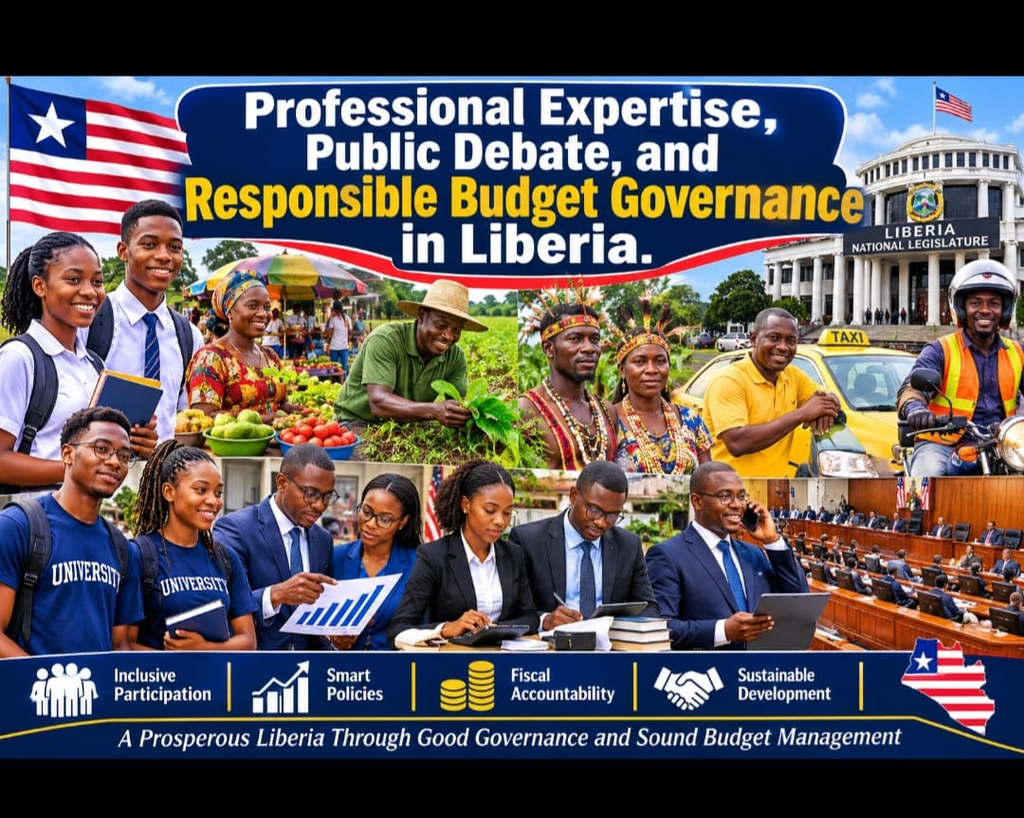
Comparing trained financial professionals with unqualified social media commentators reveals the importance of expertise, institutional process, and responsible communication in national budget governance.
While citizens have the right to question government actions and demand accountability, preparing, interpreting, and approving national financial instruments require specialized knowledge.
National budgets are not casual documents to be divided among friends or debated only through slogans.
They are complex legal, economic, and policy instruments designed to guide a country’s development.
Therefore, professionals should be allowed to perform their duties, legislators should be given room to review budget proposals carefully, and the public should be encouraged to participate in national debate responsibly and with an understanding of the limits of personal expertise.
The first major difference between professional financial analysis and social media commentary is the depth of knowledge required to understand how a national budget is created.
A budget is not simply a list of money coming in and money going out.
It is a policy statement that reflects a government’s priorities, constraints, and long-term goals.
To prepare it, economists, accountants, public finance specialists, statisticians, procurement experts, sector ministries, development planners, and legal professionals must work together.
They must estimate government revenue from taxes, customs duties, natural resources, grants, fees, and other sources.
At the same time, they must calculate the cost of education, health care, security, agriculture, infrastructure, public administration, debt service, and other national responsibilities.
This process involves difficult choices.
If more funds are allocated to road construction, for example, less money may be available for hospital equipment or teacher training unless government revenue increases.
If the government borrows to finance infrastructure, it must consider future debt repayment obligations.
If salaries are increased without corresponding revenue, the country may face budget deficits or delayed payments.
These are not simple matters that can be resolved through emotional online arguments.
They require data, forecasting models, economic assumptions, expenditure ceilings, and knowledge of public financial management laws.
A trained professional may examine inflation trends, exchange-rate risks, expected export revenue, and global commodity prices before making recommendations.
A social media commentator, in contrast, may see one large figure in a budget and immediately assume that the money is being wasted, without understanding the legal commitments, operational needs, or economic assumptions behind the figure.
The comparison does not mean that every government professional is automatically correct or that every citizen lacks useful insight.
Professionals can make mistakes, institutions can be inefficient, and public officials can sometimes act in ways that deserve criticism.
Nevertheless, there is an important difference between questioning a budget and pretending to understand it without the necessary evidence or training. Constructive criticism is based on facts, documents, comparisons, and a willingness to learn.
Propaganda, on the other hand, often depends on exaggeration, personal attacks, misleading figures, and claims that are designed to create anger rather than understanding.
When people describe themselves as economists, accountants, financial professionals, or public policy experts simply because they have an online audience, they may confuse the public and weaken informed democratic debate.
Liberia’s history makes this issue particularly significant.
The country has endured civil conflict, economic instability, weak infrastructure, public health emergencies, and institutional challenges.
These experiences have made citizens understandably sensitive to issues of corruption, poverty, unemployment, and unequal access to public services.
Many Liberians have good reasons to demand transparency from those who manage public funds.
In fact, public accountability is essential to rebuilding trust between the government and the people.
Yet distrust should not lead to the rejection of every official process or every professional recommendation.
If every national budget is treated as a suspicious attempt to distribute “food money,” “recess money,” or private benefits among political allies, then citizens may lose sight of the actual purpose of budgeting: organizing limited public resources to meet national needs.
The expression that national financial instruments are not “Pepper Kala,” dry rice, food money, or recess money carries an important message.
It emphasizes that public funds are not personal property.
They are not informal gifts to be shared according to friendship, political loyalty, or personal pressure.
A national budget belongs to the people of Liberia, but belonging to the people does not mean that it can be handled carelessly or divided casually.
Rather, it means that government officials have a duty to manage public resources responsibly, transparently, and according to law.
The budget should support public goods: roads that connect farmers to markets, schools that educate children, clinics that save lives, electricity that supports businesses, clean water systems that prevent disease, and security institutions that protect communities.
Comparing informal expectations with formal budget procedures shows why professional management is necessary.
In informal community settings, people may expect leaders to distribute small amounts of money quickly to meet immediate needs.
Such expectations are understandable in a society where poverty and unemployment remain serious problems.
However, the national budget cannot operate in the same way as a personal wallet or community contribution. Government funds must follow appropriations, procurement rules, audit requirements, payroll systems, project designs, and legislative authorization.
If public money is distributed without planning and documentation, the result may be short-term satisfaction but long-term underdevelopment.
A road project may stop halfway, health facilities may remain understaffed, and schools may lack textbooks because resources were not allocated according to a coherent plan.
The Legislature plays a central role in protecting the public interest during this process.
In a constitutional democracy, the executive branch may prepare and submit a budget, but lawmakers have the responsibility to review, debate, amend, and approve it.
This separation of responsibilities is essential.
Legislators are expected to ask difficult questions: Are the revenue projections realistic?
Why has a ministry requested more funding than in the previous year?
What outcomes are expected from a proposed infrastructure project?
Are there safeguards against waste and corruption?
How will rural counties benefit?
What is the impact of the budget on women, young people, persons with disabilities, and low-income families?
These questions cannot be answered properly through online rumors or political slogans.
They require hearings, documents, testimony from experts, committee review, and careful analysis.
Giving the Legislature space to perform its constitutional duty does not mean silencing the public.
Instead, it means respecting the difference between public participation and legislative decision-making.
Citizens, civil society organizations, professional associations, and the media should have opportunities to review budget information and raise legitimate concerns.
Journalists should investigate questionable expenditures.
Civil society groups should advocate for underserved communities.
Academics should publish independent analyses.
Economists and accountants outside government should challenge official assumptions when evidence supports their concerns.
This kind of engagement strengthens democracy.
However, responsible engagement should be distinguished from reckless online commentary that makes accusations without proof or presents personal opinions as technical conclusions.
A useful comparison can be made with medicine.
When someone becomes seriously ill, family members may offer advice based on personal experience, social media posts, or traditional beliefs.
Their concern may be genuine, but a trained physician is still needed to diagnose the illness, interpret laboratory results, prescribe treatment, and monitor recovery.
The patient should not ignore all questions from family members, but neither should the patient allow unqualified opinions to replace medical expertise.
National budgeting works in a similar way.
Citizens have a right to be concerned about the health of the economy, but trained professionals are needed to interpret fiscal data, assess financial risks, and develop workable policy options.
Public debate should support, not replace, professional and institutional processes.
At the same time, professional expertise must remain accountable to the public.
The call to allow professionals to work should never become an excuse for secrecy, arrogance, or exclusion.
Experts should communicate in language that ordinary citizens can understand.
Government institutions should publish accessible budget summaries, explain major spending priorities, and report regularly on implementation.
Technical documents can be difficult, but citizens should not be made to feel that public finance is beyond their right to understand.
The solution is not to reduce national budgeting to simplistic social media arguments; the solution is to improve civic education and government communication.
Liberia would benefit from stronger public education on how budgets are made and implemented.
Schools, universities, community organizations, radio stations, and professional bodies can help citizens understand basic concepts such as revenue, expenditure, deficit, debt, appropriations, audits, and procurement.
Such education would reduce the influence of misinformation and make public participation more meaningful.
Instead of merely saying that a budget is too large or too small, citizens could ask more precise questions: What percentage is allocated to education?
How much is devoted to rural health care?
What is the expected source of financing?
Are project costs consistent with previous spending? Has the government reported on the outcomes of last year’s budget?
These are the kinds of questions that move public discussion from propaganda toward accountability.
Furthermore, the distinction between qualified professionals and self-proclaimed experts should encourage humility on all sides.
A person may have strong political opinions without being a trained economist.
Another person may possess financial credentials but lack sensitivity to the lived experiences of poor communities.
Effective public policy requires both technical competence and public awareness.
Professionals must understand the realities faced by market women, farmers, students, unemployed graduates, business owners, and rural residents.
Citizens, meanwhile, should recognize that technical policy decisions often involve trade-offs that are not immediately visible.
A mature national conversation requires respect between experts and the public rather than hostility between them.
Ultimately, Liberia’s development depends on institutions that function according to law, evidence, and the common good.
National financial instruments should not be treated as entertainment for social media conflict or as informal resources for private distribution.
They should be prepared by competent professionals, examined by elected lawmakers, monitored by independent institutions, and understood by an engaged public.
The goal should not be to silence criticism but to improve its quality.
Citizens must remain vigilant, but they should reject misinformation.
Professionals must be given the opportunity to do their work, but they must remain transparent and accountable.
Legislators must have the time and space to scrutinize budget proposals, ask the right questions, and approve laws that reflect national priorities.
When these responsibilities are respected, the budget becomes more than a financial document.
It becomes a roadmap for national progress.
It can help Liberia invest in people, strengthen institutions, expand economic opportunity, and deliver development that benefits society as a whole.
Responsible public debate, professional competence, and legislative oversight are not opposing forces.
They are complementary pillars of good governance.
Support Independent Journalism
Your support helps FrontPage Africa continue delivering independent, credible, and impactful journalism. Every contribution strengthens our ability to investigate, inform, and hold power accountable while keeping quality journalism accessible to our readers.
Support our journalism or subscribe to receive the latest FrontPage Africa stories and updates.