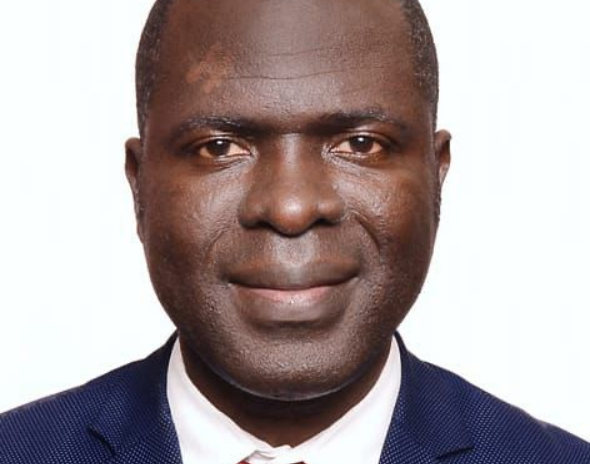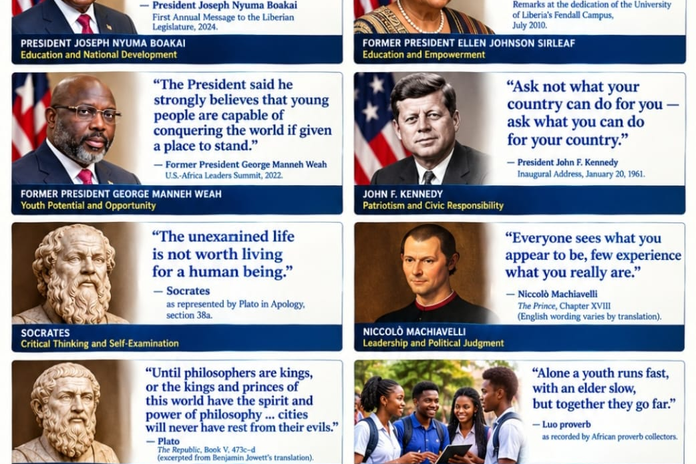
President Joseph N. Boakai: “The 2003 Accra Comprehensive Peace Agreement, born of regional diplomacy…”
Former President Ellen Johnson Sirleaf: “Without peace and security, there can not be development or prosperity.”
Former Interim/Transitional President Charles Gyude Bryant: Transitional President Bryant promised that his government would “scrupulously and meticulously” implement the peace agreement.
ECOWAS / President John Kufuor: At the opening of the 2003 Liberian talks, President Kufuor warned:
“Civil war in [Liberia] wants to engulf the whole subregion.”
ECOWAS → regional diplomacy → Accra Comprehensive Peace Agreement → Bryant transitional government → disarmament/peacebuilding → 2005 elections → Sirleaf presidency → peaceful democratic transitions →Weah → Boakai.
Austin S Fallah:The Triumph of Diplomacy: “The Accra Comprehensive Peace Agreement stands as a powerful testament to the triumph of diplomacy over conflict, demonstrating that dialogue, compromise, and collective political responsibility can open the door to peace and democratic renewal in Liberia.”
Austin S Fallah: Legacy of Peace: “The legacy of the Accra Comprehensive Peace Agreement extends beyond the end of Liberia’s conflict; it reminds us that lasting democracy is built through reconciliation, inclusive dialogue, respect for institutions, and a shared commitment to peace.”
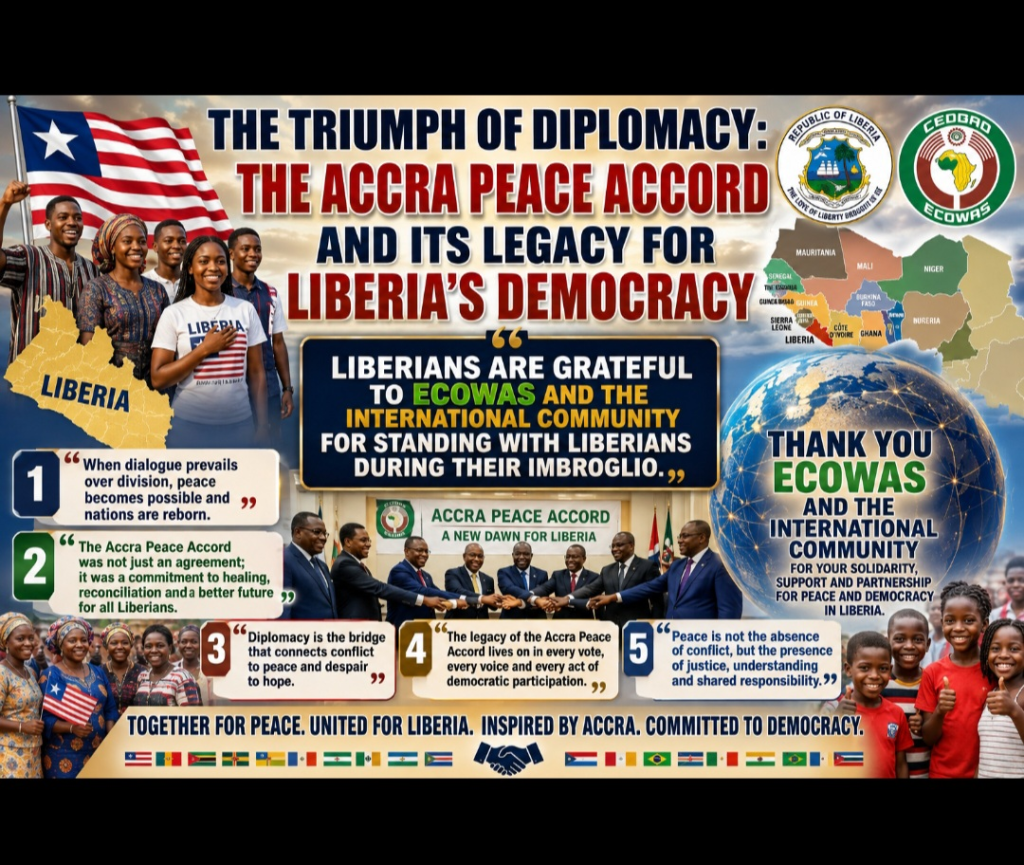
Austin S. Fallah: Gratitude to ECOWAS and the International Community: “Liberians remain profoundly grateful to ECOWAS and the international community for standing with the Liberian people during our imbroglio. Their diplomatic engagement, solidarity, and commitment to peace helped Liberia navigate a difficult chapter and create the foundation for democratic recovery.”
By: Austin S Fallah – A True Son of the Planet Earth Soil: [email protected]
The echoes of war often remain long after the guns fall silent, leaving scars that stretch across generations. Liberia, a nation defined by its prolonged conflicts, witnessed a series of failed accords that left its people yearning for lasting peace and stability.
However, in the midst of despair, a beacon of hope emerged, the Accra Peace Accord, signed on August 18, 2003.
This pivotal agreement not only marked the end of the Second Liberian Civil War but also paved the way for a new participatory multiparty democracy that would lead Liberians into the latter part of the 21st century and beyond.
The accord, formulated under the auspices of the Economic Community of West African States (ECOWAS), showcased the power of diplomacy and regional cooperation; it demonstrated that through collaboration and commitment, even the most entrenched conflicts could yield to a collective determination for peace.
To fully appreciate the significance of the Accra Peace Accord, one must first understand the context in which it was born.
Liberia had endured two devastating civil wars, the first from 1989 to 1996 and the second from 1999 to 2003.
The wars were driven by a multitude of factors: political disenfranchisement, ethnic tensions, and the power struggle, transforming a once-thriving nation into a battlefield where innocent lives were lost, families were torn apart, and communities were destroyed.
By the time the Accra Peace Accord came to fruition, the toll was vast.
An estimated 250,000 people had died, over a million were displaced, and hundreds of millions of properties were destroyed.
The spirit of the Liberian people, indomitable as it was, had been severely tested.
The role of the international community, particularly ECOWAS, can not be overstated in the journey toward peace.
ECOWAS, an organization committed to promoting regional stability and development, took it upon itself to mediate the conflict and lay the groundwork for dialogue.
Utilizing diplomacy, they brought together warring factions that had long been adversaries.
The negotiations, although fraught with challenges, culminated in an agreement that outlined a path toward peace, disarmament, and democratic governance.
This diplomatic effort fostered unity and mutual responsibility among the conflicting parties, underscoring the belief that true reconciliation could be achieved only through collective effort.
One of the most profound aspects of the Accra Peace Accord was its comprehensive framework for transitioning Liberia from a state of war to one of peace and democracy.
The agreement laid out clear stipulations for disarmament, demobilization, and reintegration of combatants, which were crucial steps toward restoring order.
Moreover, it established a transitional government that included representatives from all warring factions, recognizing inclusive representation as a cornerstone of lasting peace.
This approach was revolutionary for a nation that had been torn apart by exclusionary political practices, created by some of its own sons abd daughters.
By acknowledging varied voices within the political landscape, the accord facilitated healing and rebuilding, a critical element for any post-conflict society.
As a direct result of the Accord, Liberia began to emerge from the shadows of conflict, slowly but steadily rekindling the hope that had been extinguished.
The transitional government set the stage for the first post-war elections in 2005, which were marked by a high voter turnout and a palpable sense of optimism.
The election of Old-Ma-Dawo Ellen Johnson Sirleaf as Liberia’s first female president symbolized a significant step forward.
Liberia’s Political Maradona victory was not just a milestone for gender equality; it was a testament to the collective aspiration for democratic governance in a nation that had once experienced the terror of autocracy and civil strife.
The democratic gains achieved in the years that followed can largely be traced back to the commitments made during the Accra Peace Accord.
However, the journey towards a functional democracy was anything but straightforward.
The scars of civil war ran deep, and the lingering effects were palpable in society.
Rebuilding trust among communities and fostering national unity required immense patience, perseverance, and dedication.
Initiatives aimed at national reconciliation were crucial for addressing historical grievances and promoting a culture of dialogue.
Additionally, reinforcing institutions that upheld the rule of law and ensured accountability became paramount.
The support of the international community, particularly through monitoring and technical assistance, played a vital role, illustrating how cooperation beyond borders can yield transformative outcomes.
Importantly, the legacy of the Accra Peace Accord extends beyond Liberia’s shores.
As the West African region grappled with its own challenges, political instability, civil unrest, and economic woes, the success of Liberia’s peace process became an exemplar of the potential for diplomacy and regional solidarity.
ECOWAS’s involvement in Liberia set a precedent for how regional organizations can intervene effectively in conflict situations, promoting peace and fostering democratic governance.
By taking a proactive stance, ECOWAS not only demonstrated its commitment to regional stability but also asserted the importance of collective security and mutual assistance.
The hope is that this model of achievement can serve as a guide for other conflict-affected nations, promoting dialogue and cooperation in a world often divided by discord.
Today, as Liberia stands on the threshold of a new era, the achiof ev ements made possible by the Accra Peace Accord conti,nue to inspire optimism.
The establishment of multiparty democracy has provided a platform for citizens to engage actively in the political process.
Plenty of social media platforms for civic education and grassroots movements have emerged, emphasizing the importance of participatory governance.
The intellectual, intelligent, patriotic, nationalist, and well-schooled, emerging generation of Liberians recognizes the value of their rights and the impact of their voices in shaping the direction of their nation.
This involvement reflects an enduring commitment to the principles laid out in the peace accord, principles that advocate for respect, unity, and the sanctity of human dignity.
Nevertheless, it is essential to recognize that the journey is far from complete.
Challenges remain, not only in Liberia but across the continent, as nations grapple with issues of governance, resource distribution, and social inequities.
The commitment to democracy must be guarded and nurtured, ensuring that the transformative ideals encapsulated in the Accra Peace Accord are upheld through ongoing civic engagement and responsibility.
Liberians must remain vigilant against potential regression into conflict, ensuring that dialogue prevails over divisiveness.
The Accra Peace Accord stands as a testament to the power of diplomacy, regional cooperation, and the resilience of a people determined to rise above their past.
The international peacebuilding, particularly through ECOWAS, illustrated the potential for collaborative efforts to mediate conflicts and foster democratic processes.
As Liberia continues to navigate the complexities of governance and peacebuildthe the ing, it stands as a symbol of hope for other nations grappling with the challenges of post-conflict recovery.
I remember my final thesis in my Master of Law program at the Hamline University School of Law; I used the Accra Peace Agreement as an embodiment of peace in Sudan.
The aspirations ignited by the Accra Peace Accord must be kept alive, as they carry the promise of a future where peace, democracy, and unity reign, providing a brighter path for generations to come.
Liberians will forever be grateful for this monumental achievement; it reminds us that peace is not merely the absence of war, but a state of active goodwill, mutual respect, and a shared vision for a better tomorrow.
Support Independent Journalism
Your support helps FrontPage Africa continue delivering independent, credible, and impactful journalism. Every contribution strengthens our ability to investigate, inform, and hold power accountable while keeping quality journalism accessible to our readers.
Support our journalism or subscribe to receive the latest FrontPage Africa stories and updates.