Prof. Wilson K Tarpeh: Facebook Page Reels: ” The most expensive liquor is a tear; it is 1% water and 99% feelings. Think before you hurt someone.”
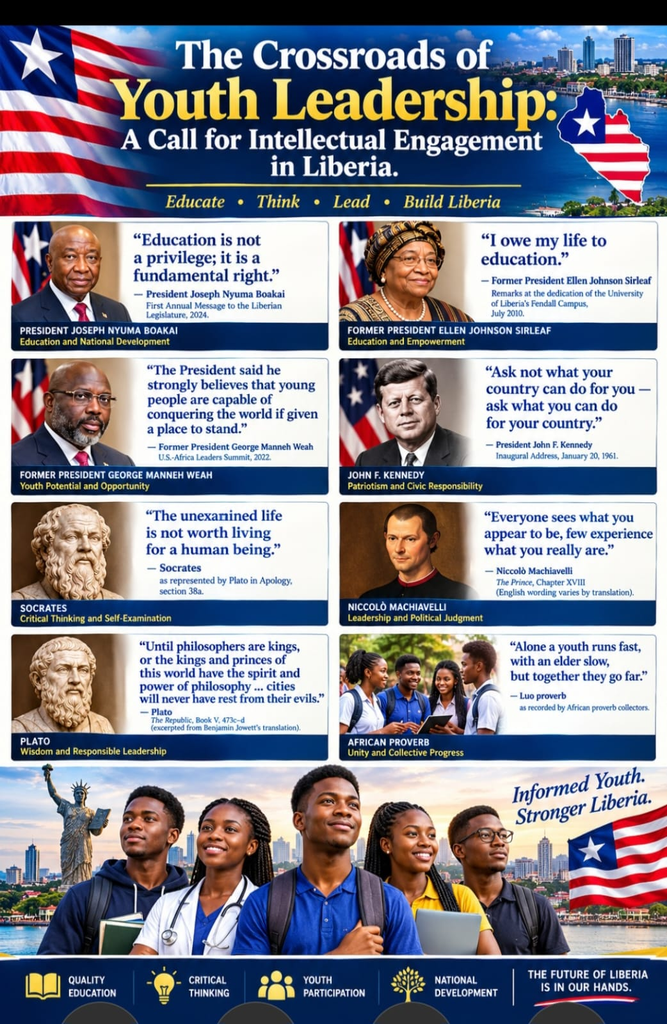
African Proverb — Unity and Collective Progress: “Alone a youth runs fast, with an elder slow, but together they go far.” — Luo proverb, as recorded by African proverb collectors. A related saying, “If you want to go fast, go alone; if you want to go far, go together,” is widely attributed to Africa, although its precise origins are disputed. Connection to the theme: Liberia’s future depends on cooperation between young people and elders, students and scholars, communities and institutions, and citizens across political differences. Youth leadership must embrace collaboration rather than division.
President Joseph Nyuma Boakai — Education and National Development: “Education is not a privilege; it is a fundamental right.” – President Joseph Nyuma Boakai, First Annual Message to the Liberian Legislature, 2024. This statement emphasizes that Liberia cannot build a prosperous future without ensuring that its young people have access to quality education. Connection to the theme: At the crossroads of youth leadership, education must become the foundation of intellectual engagement. Young people should use knowledge to question injustice, develop solutions, and participate meaningfully in national affairs.
Former President Ellen Johnson Sirleaf — Education and Empowerment; “I owe my life to education.” — Former President Ellen Johnson Sirleaf, remarks at the dedication of the University of Liberia’s Fendall Campus, July 2010. Former President Sirleaf reflected on education as the force that helped her develop her abilities, challenge barriers, and pursue her destiny. Connection to the theme: Her words remind Liberian youth that intellectual development is not merely about obtaining a degree. It is about expanding one’s thinking, overcoming limitations, and acquiring the capacity to transform society.
Former President George Manneh Weah — Youth Potential: “The former President said he strongly believes that young people are capable of conquering the world if given a place to stand.” — Reported statement from former President George Manneh Weah’s address at the U.S.-Africa Summit, 2022. The Executive Mansion rightly highlighted the importance of creating opportunities for young people to realize their potential through hard work; honest plans must give its youth opportunities to contribute beyond political slogans. Young people need access to education, research, innovation, meaningful employment, and decision-making.
Former US President John F. Kennedy — Patriotism and Civic Responsibility: “Ask not what your country can do for you—ask what you can do for your country.” — Former US President John F. Kennedy, Inaugural Address, January 20, 1961. Connection to the theme: Liberian youth should move beyond asking what the country owes them and consider what they can contribute: scholarship, entrepreneurship, public service, responsible citizenship, and the pursuit of justice.
Socrates:Critical Thinking and Self-Examination: “The unexamined life is not worth living for a human being.” — Socrates, as represented by Plato in Apology, section 38a. Connection to the theme: Intellectual engagement requires young people to examine their beliefs, question political promises, evaluate evidence, and challenge their own assumptions. A generation that refuses to think critically risks becoming vulnerable to manipulation and misinformation.
Niccolò Machiavelli — Leadership and Political Judgment: “Everyone sees what you are; as experience, what you really are.”Connecting people ction to the theme: Youth leadership should be judged not by public image, political affiliation, or eloquent speeches, but by integrity, sound judgment, consistency, and demonstrable service to the Liberian people.
Plato — Wisdom and Responsible Leadership:
“Until philosophers are kings, or the kings and princes of this world have the spirit and power of philosophy … cities will never have rest from their evils.” Connection to the theme: Liberia needs leaders who combine authority with wisdom, evidence-based reasoning, moral discipline, and a commitment to the public good. Leadership without intellectual depth can produce the very problems it seeks to solve.
By: Austin S. Fallah – True Son of the Planet Earth Soil: [email protected]
Liberia stands at a decisive crossroads.
Its young people, who make up a significant portion of the population, have the energy, creativity, and ambition to transform the nation’s political, social, and economic future.
Yet energy without direction can be exploited, and ambition without knowledge can be manipulated.
The central question facing Liberian youth is not whether they should participate in politics; they should.
The question is how. Should young Liberians enter the political arena as informed citizens, not as emotional followers of personalities, slogans, or temporary rewards? Yes they must.
They must evaluate leaders by their records, policies, integrity, and willingness to serve the public, not by sugar-coated promises or fashionable rhetoric.
Politics can create opportunities, build schools, improve hospitals, strengthen roads, protect communities, and expand employment.
However, politics can also divide families, inflame communities, and encourage citizens to treat fellow Liberians as enemies simply because they support different candidates or parties.
In a country with a history marked by conflict, exclusion, and rebuilding, political engagement must be approached with seriousness.
Liberia cannot afford another generation that is clueless about its civic power, vulnerable to propaganda, or willing to sacrifice its future for the immediate benefits offered by some so-called political actors.
The words of Prof. Wilson K. Tarpeh on his Facebook page provide an important moral foundation for this discussion: “The most expensive liquor is a tear; it is 1% water and 99% feelings. Think before you hurt someone.”
This statement is especially relevant in Liberia’s political environment.
Political choices are not merely private choices.
They can affect employment, education, safety, justice, family stability, and national unity.
When leaders deceive citizens, when supporters insult one another, or when young people are encouraged to fight for politicians who will abandon them after elections, tears often follow.
Those tears may belong to a mother whose child has been harmed by electoral violence, a graduate who remains unemployed because of poor governance, or a family that loses hope because leaders place personal interest above national development.
For this reason, Liberian youths and young people must be careful about whom they follow.
Some politicians and political activists cannot carry young people even an inch when the need arises.
They may call on youths to attend rallies, post messages online, defend them in arguments, and even confront opponents.
Yet when those same youths need scholarships, jobs, legal assistance, medical help, or a meaningful opportunity, many of these leaders disappear.
A young person who risks dignity, safety, and reputation for a politician should ask a difficult but necessary question: What has this individual done, and what is this individual prepared to do, for Liberia beyond election season?
Too often, the political relationship between leaders and youths becomes transactional.
A politician distributes money, T-shirts, food, or transportation at a rally, and some citizens feel obligated to offer unquestioning loyalty in return.
Such an arrangement is dangerous because it reduces citizenship to a short-term bargain.
A T-shirt cannot educate a child.
A small amount of cash cannot create lasting employment.
A ride to a political gathering cannot repair a broken health system.
Even sartorial displays- matching party caps, colorful campaign clothing, and expensive outfits- should not be mistaken for evidence of competence or commitment.
Political fashion may create excitement, but it does not build a nation.
Liberia’s youth must reject the idea that political loyalty requires blind obedience.
Genuine leadership welcomes questions.
A responsible leader should be able to explain policies on education, agriculture, infrastructure, public health, youth employment, corruption, national security, and reconciliation.
If a leader becomes intransigent whenever citizens ask reasonable questions, that behavior should raise concern.
Democracy is not a system in which leaders demand praise while refusing accountability.
Democracy depends on citizens who question, investigate, compare, and vote based on factual evidence.
Unfortunately, political propaganda often thrives because it is emotionally appealing.
It may be loud, dramatic, and full of insults.
It may describe opponents as traitors, enemies, or useless people.
It may use invective to provoke anger rather than facts to encourage understanding.
Young people should recognize that a politician who relies entirely on insults may lack a serious plan for national development.
Criticism is necessary in democracy, but criticism should be supported by undoubted evidence and constructive alternatives.
Calling another person names is easy; presenting a realistic plan to improve Liberia is much harder.
The political language used during campaigns can also be deliberately circumlocutory and periphrastic.
In other words, some speakers use many complicated words to avoid giving clear answers.
A leader may speak for an hour without explaining how jobs will be created, where funding will come from, or how public resources will be protected.
Such speeches can sound intelligent while saying very little.
Young voters should not be impressed by long, prolix speeches.
The most meaningful political message is not always the loudest or longest one.
A clear, honest plan is more valuable than a performance filled with vague promises.
At the same time, young Liberians should not dismiss knowledge because it seems difficult or recondite.
Civic education, constitutional principles, budgeting, public policy, and electoral laws can appear complex.
Yet these subjects matter because they determine how power is used.
If young people don’t understand how government works, they will be easily deceived by those who do.
Intellectual engagement does not mean every young person must become a lawyer, professor, or political scientist.
It means that young people should make an effort to learn the issues that affect their lives.
They should read, attend public discussions, listen to multiple viewpoints, verify claims, and ask questions before making decisions.
Social media has made this responsibility even more urgent.
A false statement can travel across Liberia in minutes.
Edited videos, fabricated quotations, tribal accusations, and misleading headlines can create hostility among people who have never met.
In a turbulent political period, misinformation can be more dangerous than many citizens realize.
As frequent users of digital platforms, young people must become responsible consumers and distributors of factual information.
Before sharing a message, they should ask: Who created this information?
Is there evidence? Is the source trustworthy?
Does this message promote peace, or does it encourage hatred?
A politically mature youth does not forward every sensational message.
Instead, that youth understands that words can either heal a nation or deepen its wounds.
Liberia’s past should also guide its future.
The country’s history, from its founding to the present, contains important lessons about power, inequality, conflict, resilience, and national identity.
Antiquity’s lessons may not answer every modern problem, but history shows the consequences of letting a small group monopolize political power while others feel unheard.
It also shows the damage caused when citizens are divided along ethnic, regional, economic, or party lines.
Looking back is not about staying trapped in the past.
It is about making informed decisions for tomorrow, because time waits for no one.
As long as there is day, there will be night, and vice versa.
This simple reality should teach young people that political fortunes change.
The politician who is powerful today may be out of office tomorrow.
The party that seems popular today may lose public trust tomorrow.
Therefore, youth should not sacrifice friendships, education, moral values, or personal safety for politicians whose influence may be temporary.
These Liberians have seen this, and will continue to see it.
Nations endure longer than administrations.
Communities endure longer than campaigns.
Families endure longer than political slogans.
A wise young person builds relationships across political differences because national development requires cooperation after elections are over.
One major obstacle to progress is the Desuetude of civic responsibility.
When citizens stop attending community meetings, fail to understand their rights, refuse to hold leaders accountable, or believe that politics is only for certain Liberians, democracy weakens.
Civic responsibility must not fall into disuse.
Young people should participate in respectful student organizations, professional community service, local development projects, debate clubs, advocacy groups, and peaceful political movements.
Most will say I am sounding Western, but whatever that is happening in the west for the common good, can also happen in Liberia for the good of all.
These activities prepare them for leadership and teach them that leadership is service, not merely the pursuit of office.
Young people must also resist political violence.
There is no honorable expiation for violence that destroys lives, burns property, or leaves communities divided.
Apologies after an election cannot fully repair the pain caused by intimidation or bloodshed.
No candidate is worth the life of a Liberian youth.
No political party is worth the destruction of a neighborhood.
Those who recruit young people to intimidate voters, spread fear, or attack opponents are not empowering youth; they are exploiting them.
Such individuals may appear powerful, but their conduct is morally reprobate because it treats human beings as tools rather than citizens with dignity.
Liberia needs youths who will demand peaceful elections and responsible leadership.
This demand is not optional; it is exigent.
The country faces pressing challenges: unemployment, inadequate educational resources, rising living costs, weak infrastructure, limited health services, environmental concerns, and the need for stronger institutions.
These problems cannot be solved with insults, empty celebrations, or worship of personality.
They require disciplined planning, qualified leadership, transparent institutions, and active citizens.
Young people should judge leaders by measurable standards.
Did the leader fulfill previous promises?
Does the leader have a practical plan for creating jobs?
Does the leader respect the rule of law?
Does the leader promote national unity rather than division?
Does the leader have credible associates?
Is the leader willing to disclose how public funds will be used?
Does the leader encourage education, entrepreneurship, and peace?
These questions are more valuable than the excitement of a campaign rally.
It is equally important to understand that a leader’s failure should not automatically lead to hopelessness or recidivism in national politics.
Liberia must not repeatedly return to the same destructive political habits: blind loyalty, violence, corruption, ethnic manipulation, and the glorification of leaders who fail the people.
If citizens continue rewarding bad behavior, then bad leadership will continue.
But if youth demand accountability and refuse to be bought by temporary gifts, political culture can change.
Making decisions today that will benefit young people and their children tomorrow is the best way to build a prosperous Liberia for all to live in.
This means valuing education over political distraction, skills training over dependence, entrepreneurship over hopelessness, and national unity over partisan hatred.
It means choosing leaders who understand that public office is a public trust.
It also means recognizing that every young person has a role in Liberia’s progress, whether as a voter, teacher, farmer, business owner, activist, student, artist, or community organizer.
Liberian youth should not be carried away by the good-for-nothing propaganda of sugar-coated words.
Sweet words may sound attractive today, but the better question is whether they will produce better conditions tomorrow.
A promise should be examined, not merely applauded.
A leader should be assessed, not worshiped.
A political movement should be joined only when it promotes peace, truth, justice, and development.
Ultimately, those who make the loudest promises will not secure Liberia’s future.
It will be secured by citizens who think critically, act responsibly, and refuse to surrender their future to manipulation.
Liberia’s youth have the strength to lead the nation toward prosperity, but they must lead with knowledge, courage, and moral discipline.
At this crossroads, intellectual engagement is not a luxury. It is a national necessity.
Support Independent Journalism
Your support helps FrontPage Africa continue delivering independent, credible, and impactful journalism. Every contribution strengthens our ability to investigate, inform, and hold power accountable while keeping quality journalism accessible to our readers.
Support our journalism or subscribe to receive the latest FrontPage Africa stories and updates.