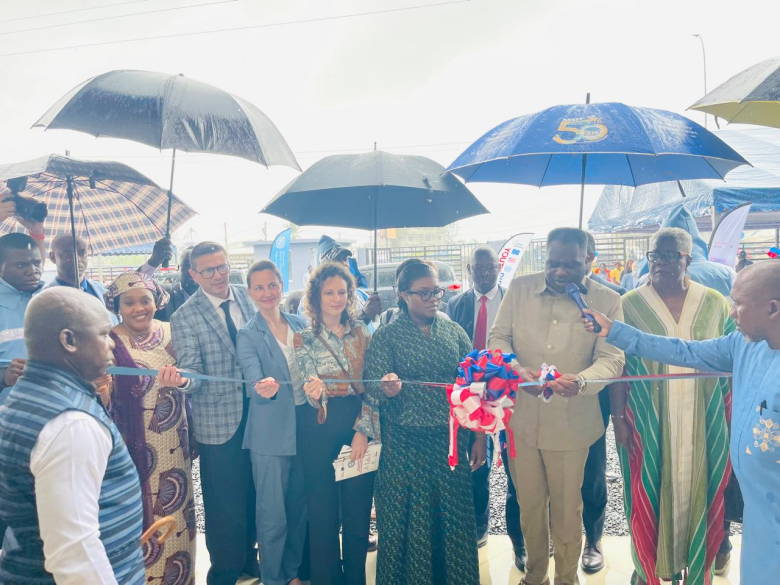
MONROVIA – Vice President Jeremiah Kpan Koung has dedicated the newly constructed Business and Domestic Occupational Training Center (BDOTC) Hospitality Training Center, describing the facility as a significant investment in Liberia’s human capital and a critical step toward expanding employment opportunities for young people through technical and vocational education.
By Francis G. Boayue
Speaking Thursday, August 6 at the dedication ceremony in Monrovia, Vice President Koung said the modern training facility represents hope and opportunity for thousands of young Liberians seeking practical skills to compete in the country’s growing tourism and hospitality sectors.
He reaffirmed the Boakai Administration’s commitment to strengthening technical and vocational education as a key pillar of its development agenda, emphasizing that investments in skills development will accelerate job creation, economic growth and national transformation.
The Hospitality Training Center is expected to provide hands-on instruction in hospitality management, tourism services, food preparation, accommodation management and other industry-related disciplines aimed at producing a highly skilled workforce for Liberia’s expanding tourism sector.
Liberia Tourism Authority (LTA) Director General, Princess Eva Cooper, described the project as a milestone for the country’s tourism industry, noting that developing a competent workforce remains essential to improving service delivery, attracting investment and creating sustainable employment.
She said the center demonstrates Liberia’s commitment to positioning tourism as a driver of economic diversification and national development.
Youth and Sports Minister Cornelia W. Kruah said the facility would help bridge the long-standing gap between education and employment by equipping young Liberians with practical, market-oriented skills demanded by employers.
She described the center as a model for future technical and vocational education initiatives across the country.
Also speaking, Alexandre Vial, Country Director of the International Institute for Cooperation and Development (IECD) underscored the importance of demand-driven technical and vocational education in preparing Liberia’s youth for meaningful employment.
Vial said strengthening workforce skills is essential to supporting the country’s hospitality industry while creating opportunities for entrepreneurship and private sector growth.
Delivering brief remarks, Education Minister Jarso Maley Jallah praised the collaboration between the Government of Liberia and its international partners, describing the project as a successful example of how partnerships can deliver tangible development outcomes.
She thanked development partners for investing in Liberia’s future and urged stakeholders to view technical and vocational education as a pathway to innovation rather than a second-choice educational option.
“We are changing the narrative of technical vocational education in Liberia,” Minister Jallah declared. “It is no longer something people pursue because they have no other option. Smart people also attend technical vocational institutions, and this is the story we intend to rewrite.”
Minister Jallah highlighted Liberia’s more than 300-mile Atlantic coastline as one of the country’s greatest untapped assets, arguing that strategic investment in tourism could generate significant economic returns.
Drawing comparisons with the British and U.S. Virgin Islands, she noted that territories with a combined coastline of approximately 167 miles generate billions of dollars annually from tourism, demonstrating Liberia’s enormous but underutilized potential.
“The opportunity to invest in tourism is now,” she said. “We have what it takes, and this center is a model that should be replicated across the country.”
She further pledged to work alongside other government institutions to ensure Liberia’s tourism sector becomes a major contributor to national economic growth.
Speaking on behalf of the United Nations system in Liberia, Virpi Stucki, Chief of the Fair Production, Sustainability and Trade Division at the United Nations Industrial Development Organization (UNIDO), described the handover ceremony as more than the inauguration of a building.
“Today is more than a ceremony,” she said. “It is a celebration of partnerships, commitment, and a shared belief in the potential of Liberia’s young people.”
Stucki credited the European Union, the Agence Française de Développement (AFD), the International Institute for Cooperation and Development (IECD) and the Government of Liberia for making the project possible through collaborative investment.
She noted that while the European Union financed the infrastructure under the Youth Rising Project, other partners contributed equipment, technical expertise, and institutional support to ensure the center becomes a sustainable training institution.
According to Stucki, Liberia’s hospitality and tourism industries hold enormous potential for employment creation, but success will depend on providing practical, demand-driven skills that respond to labor market needs.
She stressed that the long-term success of the project will depend on maintaining high educational standards, preserving the facility, and strengthening partnerships with the private sector.
“I encourage businesses to recruit graduates from this institution because they will possess the practical experience that industry requires,” she said.
Stucki urged students to maximize the opportunity before them, reminding them that investing in youth skills remains one of the most effective investments any country can make.
The BDOTC Hospitality Training Center forms part of broader efforts by the Government of Liberia and its international development partners to expand technical and vocational education, strengthen workforce development and prepare young Liberians for productive careers in the hospitality and tourism industries.
Support Independent Journalism
Your support helps FrontPage Africa continue delivering independent, credible, and impactful journalism. Every contribution strengthens our ability to investigate, inform, and hold power accountable while keeping quality journalism accessible to our readers.
Support our journalism or subscribe to receive the latest FrontPage Africa stories and updates.