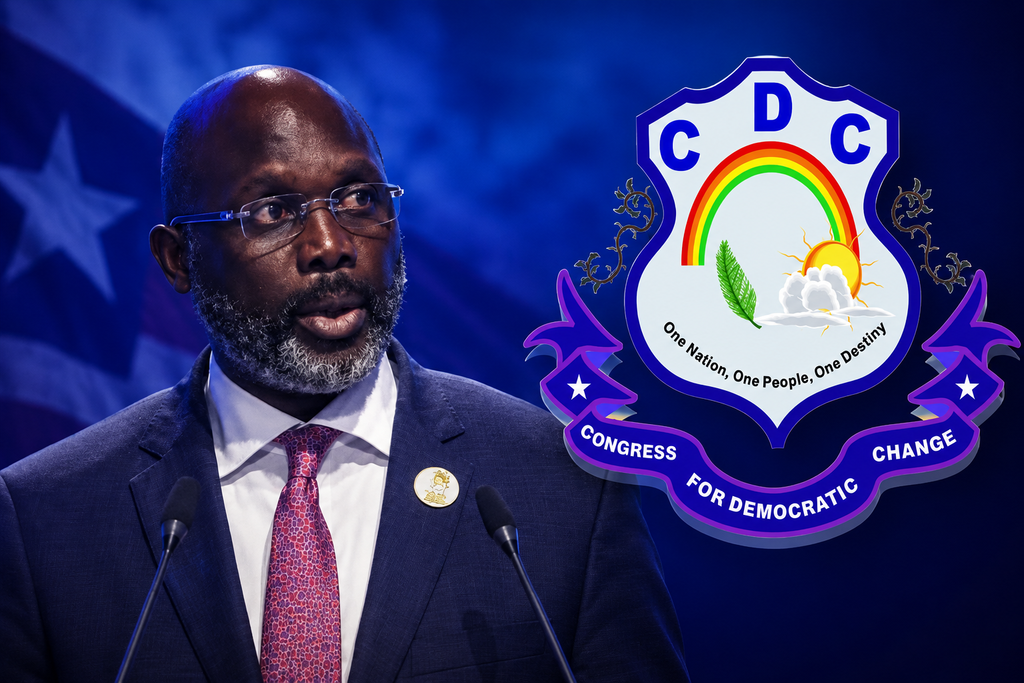
Monrovia – Former President George Weah’s statement, issued under his own name as “Political Leader of the Congress for Democratic Change,” was among the most forceful he has made since leaving office. He described Taylor as “the latest victim” of what he called rising authoritarian tendencies that have “historically plunged societies, including ours, into chaos,” and said he had personally spoken to the former Vice President, who denies the allegations against her in full. He criticized Justice Minister N. Oswald Tweh directly, saying the government’s Wednesday news conference offered only “blanket accusations without providing any supporting explanation of how they were formulated.” And he framed the entire episode as part of a broader pattern, telling Liberians that President Boakai “seeks to rule as a tyrant” despite inheriting power through what Weah called a peaceful democratic transition.
By Rodney D. Sieh, [email protected]
The Core Claim: A Post-Transition Crisis
At the heart of Weah’s statement is a timeline argument. He said the two major cocaine discoveries driving this investigation, which he valued at nearly half a billion dollars combined, were brought into Liberia only after the CDC had already handed over power to the Boakai administration — and that officials themselves have admitted as much. That claim tracks, roughly, with the two seizures this newspaper has previously reported: a US$19.2 million bust at Roberts International Airport in June, and the far larger US$319 million stash house seizure in Paynesville that followed. Combined, those two figures total closer to US$338 million than to the “nearly half a billion dollars” Weah cited, though the government has not published a single consolidated figure for everything seized this year, and Weah’s office did not detail how it arrived at its own total.
What Our Own Reporting Found
Where Weah’s statement runs into difficulty is not the seizure dates, but the claim built on top of them: that the government has “fabricated and concocted” any connection between this network and the CDC administration. That is a stronger claim than the facts already reported by this newspaper can support. A member of the Joint National Security Investigative Team told FrontPageAfrica, on condition of anonymity, that the Croatian-Ukrainian network at the center of the case “set up shop between 2021 and 2022, under the previous government of former President George Weah,” continued operating until the end of 2023, suspended activity, and returned to Liberia in 2025 with local security, protection and cover-business arrangements already established. Separately, sources told this newspaper that it was Sheikh Bassirou Kante who introduced then-First Lady Jewel Howard-Taylor to the network’s Croatian and Ukrainian principals in Dubai in early 2022 — a meeting that, if the government’s timeline is accurate, took place while Weah was president and Taylor was his sitting Vice President.
A Timeline That Complicates the Denial
None of this means the two timelines are the same thing. When a criminal network was first established in Liberia, and when a specific multimillion-dollar shipment physically arrived and was seized, are two different questions, and Weah’s claim about the seizure dates may well be accurate on its own narrow terms. But his statement does not draw that distinction. It asserts, without qualification, that any suggestion of a CDC-era connection to this network is invented by the Boakai government for political purposes — and on that specific point, this newspaper’s own reporting, gathered independently of the government’s own statements, points the other way. Liberians weighing Weah’s defense of his former Vice President, and his broader charge that this investigation is politically motivated, will have to weigh that tension for themselves.
Weah’s Broader Charges: Authoritarianism and a Threat to Return
Beyond the timeline dispute, Weah’s statement makes a series of far more serious allegations against the sitting government: that Taylor was prevented from traveling in violation of her constitutional rights, that she was “harassed and detained,” and that the administration is engaged in a pattern of “extrajudicial” conduct against political opponents. He said he has been in contact with regional and continental leaders to raise concerns about the state of Liberian democracy, and pledged to return home to “rally the CDC along with all well-meaning Liberians” to resist what he called a “tyrannical attempt” to undermine the country’s democratic gains, using what he described as all lawful political and legal means available under the Constitution. Those are claims this newspaper has not independently verified, and the government has offered its own account — including Minister Tweh’s insistence that Taylor is presumed innocent and entitled to full due process — that differs sharply from Weah’s characterization of the arrest as unlawful harassment.
A New Front in an Already Widening Story
Whatever the merits of either side’s account, Weah’s statement adds a significant new dimension to a scandal that was already reshaping Liberian politics well before Wednesday. This newspaper has previously reported on a separate, quieter rivalry playing out inside the Boakai government itself, between Vice President Jeremiah Koung and Senate Pro Tempore Nyonblee Karnga-Lawrence, over positioning ahead of Liberia’s 2029 election. Weah’s decision to frame Taylor’s arrest as an attack on the opposition, and to threaten a return home to mobilize the CDC, opens a second and considerably louder front — one that pits a former president directly against a sitting one, with Liberia’s largest drug investigation in years as the battleground. How the government responds to that challenge, and whether it can back its case against Taylor with evidence specific enough to answer Weah’s objections point by point, will likely determine whether this becomes remembered as a decisive moment in Liberia’s anti-trafficking effort or as the opening chapter of a bitter political rematch.
Support Independent Journalism
Your support helps FrontPage Africa continue delivering independent, credible, and impactful journalism. Every contribution strengthens our ability to investigate, inform, and hold power accountable while keeping quality journalism accessible to our readers.
Support our journalism or subscribe to receive the latest FrontPage Africa stories and updates.