Monrovia – The fate of former Chief Justice Cllr. Gloria Musu Scott and three family members who are serving life sentence for murder hangs in the balance as the Supreme Court of Liberia is poised to hand down its verdict on an appeal filed by defense lawyers against the lower court’s guilty verdict.
By Victoria Wesseh
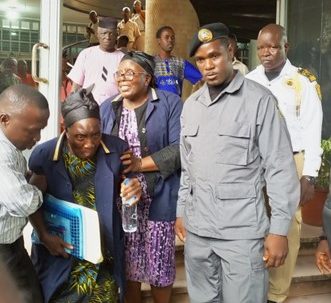
Criminal Court “C” found Cllr. Scott and her three family members guilty of murdering her daughter, Charloe Musu at her (Scott) residence in Brewerville outside Monrovia.
The Supreme Court verdict is expected to be handed down today Wednesday, August 28,2024, when the fate of Liberia’s former second female Chief Justice Cllr. Gloria Musu Scott and three of her family members are to be decided.
The high court might have the seating ceremony of newly appointed and commissioned Associate Justice Ceaineh Clinton Johnson.
It is still not clear whether the Supreme Court will close for its March Term of court, while awaiting the opening of the October term of court.
Background
During legal arguments in the Gloria Scott murder case on July 16,2024, state prosecutors told the Supreme Court that they Convicted Justice Scott on Circumstantial Evidence.
Some legal analysts said that the line of questioning by justices of the Supreme Court may indicate that the life imprisonment imposed against former Chief Justice Gloria Musu Scott and three of her family members will be reversed.
The jury of Criminal Court “C” in last year unanimously pronounced Justice Scott and her co-defendants guilty of allegedly using a kitchen knife to stab Charloe Musu to death. Based on the jury’s verdict, Judge Roosevelt Willie immediately sentenced the defendants to life imprisonment, despite the defendants challenging the judge’s decision, and appealed against it to the highest court, which appeal arguments was held on Tuesday, July 16.
During the arguments, Cllr. Bobby Livingstone, lead government lawyer who pressed for the conviction of former Chief Justice Gloria Musu Scott and three of her family members, told the justices that the state case was based on circumstantial evidence.
While arguing for nearly three hours, Cllr. Livingstone repeated that “our case theory was based on circumstantial evidence since defendants failed to point out who did the killing.”
Circumstantial evidence is indirect evidence that does not, on its face, prove a fact in issue but gives rise to a logical inference that the fact exists. At that point, Chief Justice Chief Justice Sie-A-Nyene Yuoh asked Cllr. Livingstone whether all of the defendants took the knife at the same time to stab Charloe Musu to death.
Former Associate Justice Kabineh M. Ja’neh, the lead defense lawyer, raised five key issues in his counterargument.
Firstly, he questioned whether the state had met the evidential standard of proof “beyond a reasonable doubt,” as required by law, to individually and collectively convict the defendants of the capital crime of murder. Alternatively, he challenged whether the state had established a prima facie case against the defendants sufficient to justify a judgment of conviction.
Cllr. Ja’neh further argued the state’s lawyers failed to present a single eyewitness to the alleged murder, as detailed in the indictment. He contended that the state did not prove its case beyond a reasonable doubt, citing conflicting forensic and circumstantial evidence introduced during the trial.
Support Independent Journalism
Your support helps FrontPage Africa continue delivering independent, credible, and impactful journalism. Every contribution strengthens our ability to investigate, inform, and hold power accountable while keeping quality journalism accessible to our readers.
Support our journalism or subscribe to receive the latest FrontPage Africa stories and updates.