Monrovia- The Chairman of the Senate Committee on Public Accounts and Audit Amara Konneh has observed that the increase in macro-economic stability in Liberia, low inflation and the execution of the over US$1billion budget have not positively impacted the lives of ordinary Liberians across the country.
By Obediah Johnson
Senator Konneh is representing the people of Gbarpolu county in the 55th National Legislature. He previously served as a Minister of Finance and Development Planning during the administration of ex-Liberian President Ellen Johnson-Sirleaf.
According to him, the decline in the exchange rate between the United States and Liberian dollars is not bringing any relieve to ordinary Liberians.
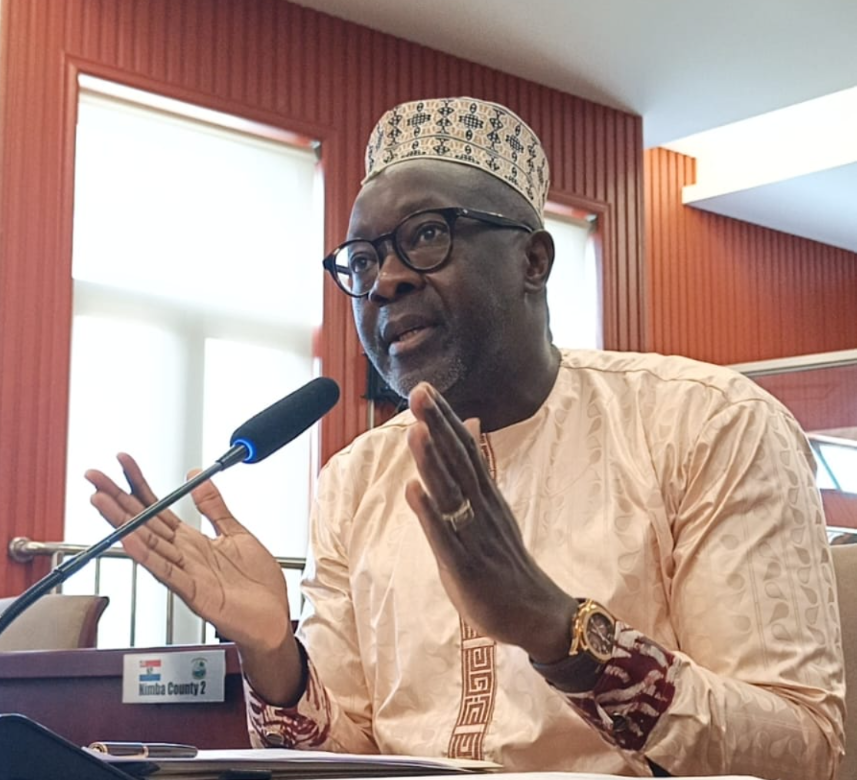
He made these comments during the confirmation hearing of the Central Bank of Liberia (CBL) Deputy Governor for Economic Policy-designate Euphemia Sweh Monmia
Senator Konneh stressed that despite Liberia’s current low inflation rate of 4.6%, the prices of basic commodities, including rice, cement remain high across the country.
He put the cost of a 25kg bag of rice in some parts of Gbarpolu county at US$22, US$15 for a bag of cement, which are far above the US$17 and US$8 they are being sold in Monrovia.
Currently, Senator Konneh claimed that the cost of a gallon of fuel in the county is also sold for L$1,500.
He maintained that the more than 87% increment in the prices of basic commodities in western Liberia cannot easily transition citizens from mud to bricks houses.
He said present hike in the cost of petroleum products are negatively contributing to the increase in basic commodities citizens need for survival.
Growth inflation dynamics
Senator Konneh noted that despite efforts being applied by the economic management team of Liberia to improve the country’s economy, inflation remains higher than growth.
“The economy is more stable now; the interest is that macro environment is stable and growth is expected to be more than 5% this year. We’ve worked hard from December 2024 to present to bring down inflation. However, inflation is still higher than growth. So, that dynamics is contributing to the legitimate noise amongst citizens.”
He said Liberians are not feeling the impact of the decline in inflation as the prices of goods and tuition fees for students continue to increase.
“Our money, the Liberian dollars is stronger here today against the US dollar. But with all of that we should see some relieve (on our people) technically. Eventhough inflation is 4.6% real on paper, but in Bopolu, Gbarpolu county, Kinjor in Cape Mount closed to where the biggest mining company in our country is operating today, and Tubmanburg, the prices are still high. The people are not feeling the impact of this impressive number. Prices are rising higher on top of an already price flow.”
He observed that the current situation is strangulating growth in real income.
Senator Konneh wondered why the prices of major goods are not reducing, despite the appreciation of the local currency.
He further alarmed over the unproductive capacity of both the mining and agriculture sectors, with manufacturing only contributing to 8% growth in the economy.
He maintained that though 87% of Liberians are in the informal sector, they are not captured in the Liberian economy.
Senator Konneh said government should intensify efforts to accelerate growth and decelerate inflation.
On US$1billion budget
He further observed that despite the passage of the US$1.25billion national budget, students of the Monrovia Consolidated School System (MCSS) were constrained to stage protests for the return of their teachers to the classrooms over unpaid salaries.
He added that many public schools are in deplorable conditions, while the University of Liberia remains closed.
Senator Konneh indicated that citizens would only celebrate the execution of the US$1.25billion budget, if it impact their lives positively.
“We keep announcing low inflation, but inflation should be reflected in the consumer price index on the ground.This US$1billion budget should be celebrated because it is felt.”
High importation of fuel
Senator Konneh disclosed that 30% of Liberia’s economy runs on imported fuel.
He accused the Liberia Petroleum and Refining Company (LPRC) and the Ministry of Commerce of using March last year exchange rate circular to set the price of petroleum products for May without consulting the CBL.
He added that consumers were unknowingly paying the price at various filling stations as a result of the blunder from the two agencies.
Meanwhile, Senator Konneh has underscored the need for the executive to regulate and supervise price control to help alleviate some of the constraints citizens are experiencing.
He stressed that inter-agency coordination would address most of the problems confronting Liberians.
High petroleum Taxes
Senator Konneh pointed out that additional two levy fees being charged petroleum importers to the already existing including Goods and Services Tax (GST) and road fund are contributing to the increase in the prices of petroleum and diesel on the Liberian market.
He said the Economic Management Team (EMT) must sit with the relevant authorities to address the situation as lawmakers do not intend to take arbitrary actions to affect the smooth execution of the national budget.
“Our people are paying for the price at the pump through the transportation cost and the prices rice they eat. The importers are getting wealthier; the government is getting fatter US$1.3billion budget-about 80% goes to recurrent cost and we in the government are getting fatter everyday and the skinning man out there is paying for the price.”
He maintained that government should consider providing a “tax holiday” to importers to alleviate sufferings they are encountering on a daily basis.
Senator Konneh observed that Small and Medium Enterprises (SMEs) are the engine of growth of the Liberian economy.
He said CBL monetary policy alone cannot fix the supply and pricing.
He noted that a shorter pay-back period for loan credited from commercial banks is strangulating the growth of many SMEs in Liberia.
Senator Konneh called on the CBL to be intentional towards ensuring low interest rate for SMEs and the reduction of risks to the sustenance of their businesses.
He said steps should be taken by the bank towards the publication of the daily exchange rate and the setting of a variation interest rate for both SMEs and large businesses.
He observed that despite the passage of the Small Business Empowerment Act of 2016, no single Liberian company has benefited.
Amongst other things, the Act calls for at least 25% of public procurement and contracts for goods and services to be allocated to Liberian owned Micro, Small and Medium-sized (MSMEs),
Senator Konneh said government must be deliberate to provide support to MSMEs operating in the country, adding that, “the interest rate is killing our people.”
Support Independent Journalism
Your support helps FrontPage Africa continue delivering independent, credible, and impactful journalism. Every contribution strengthens our ability to investigate, inform, and hold power accountable while keeping quality journalism accessible to our readers.
Support our journalism or subscribe to receive the latest FrontPage Africa stories and updates.