MONROVIA – What appeared to be the conclusion of one of the most closely watched criminal trials in the country has evolved into a new legal battle as allegations of jury tampering continue to cast a shadow over the outcome of the high-profile economic sabotage case involving former government officials.
By Victoria G Wesseh
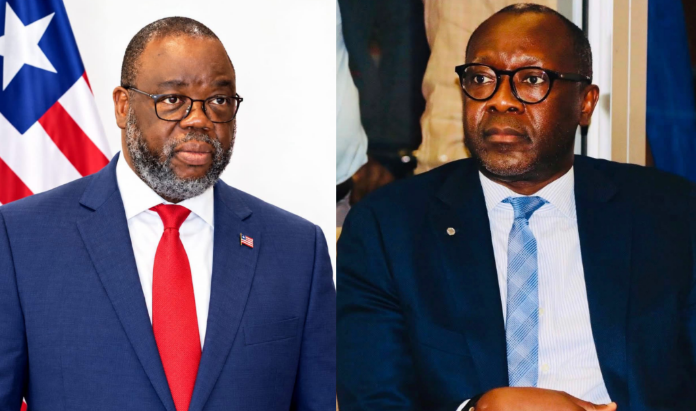
The Supreme Court, sitting in Chambers, has sent down its mandate in a proceeding brought by former Finance and Development Planning Minister Samuel D. Tweah and others who sought to stop Criminal Court “C” from investigating allegations that jurors may have been improperly influenced during the trial.
The development marks another chapter in a case that has captivated public attention for months and raised broader questions about accountability, the integrity of Liberia’s justice system, and public confidence in the country’s courts.
At the center of the dispute are allegations made by three jurors who, following the conclusion of the trial, separately reported that attempts had been made to influence members of the jury during the proceedings.
Their complaints prompted Criminal Court “C” to begin an inquiry aimed at determining whether the jury’s deliberations had been compromised.
The investigation, however, became the subject of a legal challenge when Tweah and other defendants petitioned the Supreme Court, seeking to halt the proceedings.
The petitioners argued that the lower court should not continue with the inquiry and requested the intervention of the nation’s highest court.
With the Supreme Court’s mandate now issued, the matter returns to Criminal Court “C,” which is expected to proceed in accordance with the High Court’s directive regarding the investigation.
The controversy stems from the government’s economic sabotage case against several former officials of the administration of former President George Manneh Weah.
Among those charged were former Finance and Development Planning Minister Samuel D. Tweah, Moses Cooper, Stanley Ford, Jefferson Karmo, and Nyanti Tuan. Prosecutors alleged that the defendants were involved in actions that resulted in the unlawful handling and expenditure of public funds, accusations that carried significant political and legal implications.
From the outset, the case attracted widespread public interest because it involved senior former government officials and allegations touching on the management of state resources.
Court hearings were closely monitored by members of the public, legal practitioners, civil society organizations and political observers.
The defendants consistently denied any wrongdoing, insisting that they had acted within the bounds of the law and that the prosecution had failed to establish criminal liability.
When the jury eventually returned its verdict, the outcome reflected a divided panel. Tweah and Cooper were acquitted and ordered released from all charges, a decision welcomed by their supporters as a vindication of their long-standing claims of innocence.
For the remaining defendants, Ford, Karmo, and Tuan, the jury was unable to reach unanimous decisions, resulting in hung verdicts and leaving their legal futures unresolved.
Just as the proceedings appeared to be drawing to a close, a new controversy emerged.
Three jurors came forward with separate complaints alleging that members of the jury had been subjected to outside influence during the trial.
While details of the allegations have yet to be fully disclosed in open court, the complaints were serious enough to prompt judicial scrutiny.
The allegations immediately sparked concern among legal observers, who noted that any attempt to influence jurors strikes at the heart of the judicial process.
The principle of an impartial jury is considered one of the cornerstones of a fair trial.
Any suggestion that jurors were pressured, induced, threatened, or improperly contacted has the potential to undermine confidence in a verdict and raise questions about the integrity of the proceedings.
As a result, Criminal Court “C” moved to investigate the claims in an effort to determine whether misconduct occurred and whether any laws governing the administration of justice had been violated.
Rather than ending with the jury’s verdict, the case has now opened a new legal front focused on the allegations themselves.
The defendants’ effort to stop the investigation underscored the importance of the issue and the potential consequences of any findings by the court.
Support Independent Journalism
Your support helps FrontPage Africa continue delivering independent, credible, and impactful journalism. Every contribution strengthens our ability to investigate, inform, and hold power accountable while keeping quality journalism accessible to our readers.
Support our journalism or subscribe to receive the latest FrontPage Africa stories and updates.