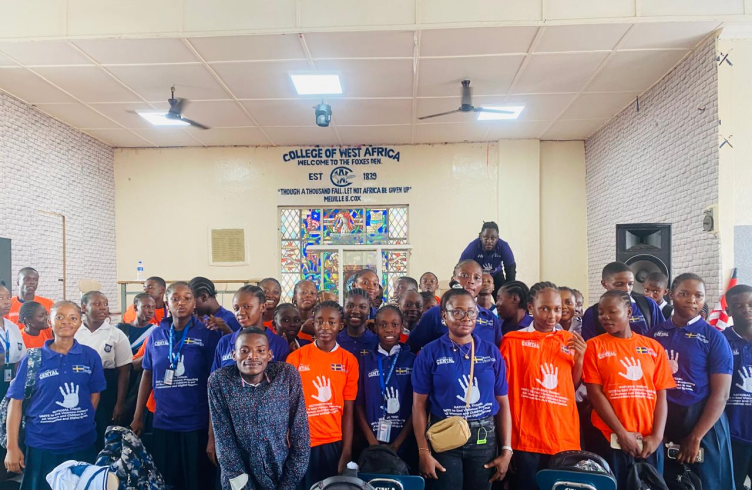
Monrovia –The Center for Transparency and Accountability in Liberia (CENTAL) on Tuesday engaged students of the College of West Africa (CWA) in a one day dialogue aimed at addressing the growing threat of digital violence within schools and online communities.
By Patience M. Jones, Contributing Writer
The engagement was held on Ashmun Street in Monrovia as part of activities marking the annual 16 Days of Activism campaign and focused on digital violence against women and girls under the global theme UNiTE to End Digital Violence against All Women and Girls and Liberia’s national theme Unite to End Violence Protecting All Women and Children in our Communities and Digital Spaces
The dialogue formed part of CENTAL’s interventions under its National Integrity Building and Anti-Corruption Program (NIBA) and the Open Expenditure Initiative (OEI) which are designed to strengthen accountability promote transparency protect rights and increase public awareness on corruption and emerging social harms including online abuse and harassment
Providing an overview of the program, Mark Boahnado Media Assistant at CENTAL highlighted the institution’s longstanding role in advocating for integrity and accountability across key sectors including governance education agriculture health and mining since its establishment in 2004. He emphasized that young people are the most active users of digital platforms and therefore have a major influence on how online spaces are shaped.
According to Mr Boahnado while digital tools offer opportunities for learning and expression they are also increasingly being misused by young people to bully harass and exploit others in pursuit of attention and social media validation. He noted that many youth engage in cyberbullying without considering the long term psychological and social harm inflicted on victims.
He stressed that the purpose of the engagement was not to shame students but to empower them with knowledge about their rights and responsibilities and to encourage youth led efforts to promote safe respectful and accountable digital behavior
Delivering the keynote presentation Madam Clara K Mallah Gender and Inclusion Officer at CENTAL provided an in depth explanation of digital violence and how it intersects with corruption gender inequality and abuse of power.
She disclosed that data collected through CENTAL’s reporting platforms between December 2020 and November 2025 showed that 152 complaints were received during the period with 55 of those cases involving women facing abuse corruption or domestic related challenges often linked to digital platforms.
Madam Mallah explained that digital violence takes many forms including cyberbullying online harassment blackmail sextortion image based abuse revenge porn hate speech body shaming deepfakes identity theft and account hacking. She warned that such acts should not be dismissed as harmless online behavior but recognized as serious violations of human rights with real world consequences.
She told students that digital violence destroys confidence disrupts education and forces many victims especially girls out of school and public spaces. She encouraged students to report corruption related abuses and online exploitation through CENTAL’s national reporting hotline 4432 and reminded them that silence only empowers perpetrators.
Representing the student body Miss Christiana Kanwee a 12th grade student of CWA used the platform to call for stronger school based reporting mechanisms that allow students to safely report abuse without fear of retaliation. She stressed that schools must establish confidential systems such as complaint boxes and clear reporting channels to address bribery for grades teacher harassment and digital violence.
Miss Kanwee urged students to take personal responsibility for their online actions by refusing to consume or share harmful content. She emphasized that reporting inappropriate material can help digital platforms remove abusive content and protect potential victims.
Contributing to the discussion Mr Perkins E T Boyce Regional Director for Africa and professional disability advocate highlighted the devastating impact of online bullying on students with disabilities. He explained that digital harassment often deepens exclusion and discrimination against already vulnerable groups and called for urgent action to ensure inclusivity and safety in digital spaces.
Mr Boyce recommended that schools enforce strict cyber safety regulations including blocking harmful online accounts incorporating cyberbullying sanctions into student handbooks and adopting zero tolerance policies for online shaming. He stressed that students deserve the same level of protection from digital violence as they do from physical abuse within school environments
Speaking on behalf of the government Sylvia Brown Pay representing the Ministry of Gender Children and Social Protection emphasized the urgency of addressing cyber violence affecting school aged girls. She explained that digital blackmail and online harassment have forced many victims out of school lowered self esteem and caused long term trauma
She called on schools to take accountability seriously by promptly reporting cases to the Ministry of Gender CENTAL and the Women and Children Protection Section of the Liberia National Police. She also highlighted the importance of the 16 Days of Activism campaign observed globally from November 25 to December 10 as a period dedicated to raising awareness and mobilizing action against violence targeting women and girls.
Support Independent Journalism
Your support helps FrontPage Africa continue delivering independent, credible, and impactful journalism. Every contribution strengthens our ability to investigate, inform, and hold power accountable while keeping quality journalism accessible to our readers.
Support our journalism or subscribe to receive the latest FrontPage Africa stories and updates.