Part 1
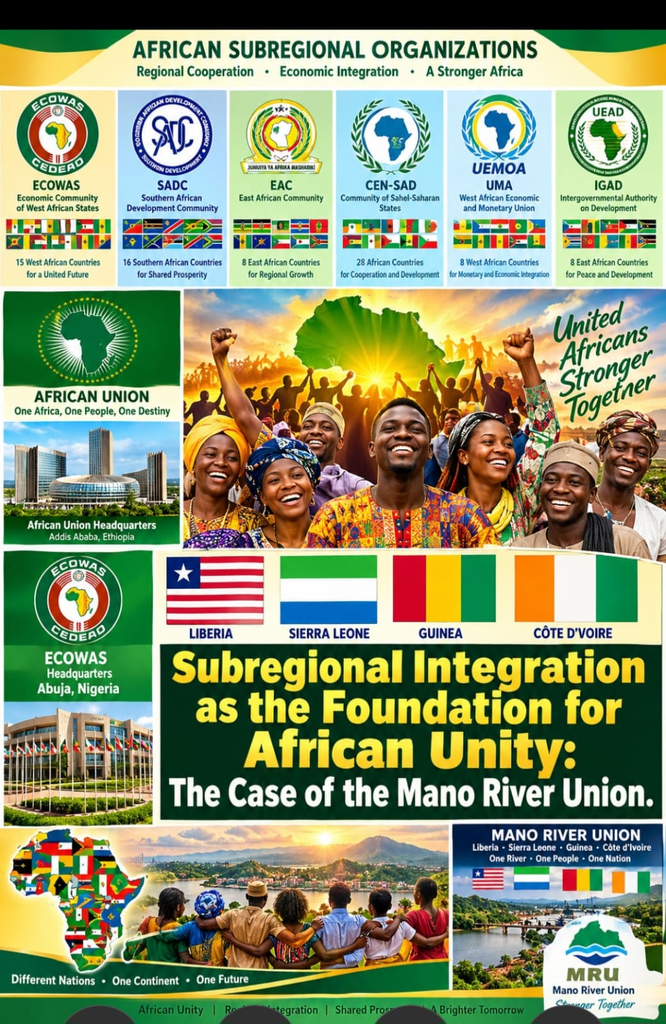
The Mano River Union: The regional foundation in practice: The founding vision of the MRU: The Mano River Union was established on 3 October 1973 through a declaration signed by Liberian President William R. Tolbert Jr. and Sierra Leonean President Siaka P. Stevens. Guinea joined in 1980, and Côte d’Ivoire acceded in 2008. Its original objectives included economic growth, cultural advancement, and cooperation within a customs union framework. These historical facts are documented by the MRU Secretariat.
By: Austin S Fallah – A True Son of the Planet Earth Soil: [email protected]
Former President Kwame Nkrumah of Ghana: “Unite we must.” Source: Former President Kwame Nkrumah, address to the founding conference of the OAU, Addis Ababa, 24 May 1963. Relevance to the MRU: Former President Nkrumah’s call supports the argument that subregional cooperation should contribute to a larger African political and economic project. In the same address, he advocated common continental institutions and the mobilization of Africa’s collective resources.
Former President Julius Nyerere of Tanzania: African federation and regional cooperation Nyerere consistently advocated African political unity, arguing that independent African states could strengthen their position through collective action.
Emperor Haile Selassie I of Ethiopia: Collective African action: In his 1963 address at the founding of the OAU, Emperor Selassie called for an examination of the relationship between national independence, African solidarity, and continental cooperation. Relevance to the MRU: The MRU provides a practical framework for investigating whether neighboring countries can build effective institutions together while retaining their individual sovereignty.
The OAU Charter, adopted on 25 May 1963: “Desirous that all African States should henceforth unite so that the welfare and well-being of their peoples can be assured.” Source: Preamble, Charter of the Organization of African Unity, 25 May 1963. Application: This passage establishes African unity as a means of improving people’s welfare. It provides a foundation for examining whether the MRU’s economic and social cooperation advances that broader objective.
OAU CHARTER, ARTICLE II: “To promote the unity and solidarity of the African States.” Source: OAU Charter, Article II(1)(a), 1963.
Application: This concise statement can serve as the normative benchmark for evaluating MRU initiatives.
OAU CHARTER, PREAMBLE:
“Resolved to reinforce the links between our states by establishing and strengthening common institutions”
ECOWAS: Cooperation as a foundation for economic integration: ECOWAS REVISED TREATY, 1993:
“To promote co-operation and integration, leading to the establishment of an economic union in West Africa”
Source: Revised Treaty of the Economic Community of West African States, Article 3(1), 24 July 1993.
Application: This passage connects the MRU to the wider West African integration project. It provides a legal basis for studying how subregional cooperation can support trade liberalization, infrastructure development, economic coordination, and improved living standards.
The dream of African unity has inspired generations of leaders, intellectuals, and ordinary citizens across the continent.
From the Pan-African ideas and from the scholarly, intellectual, critical-thinking pens of Kwame Nkrumah and W. E. B. Du Bois to the creation of the African Union, many people have recognized that Africa’s political fragmentation weakens its ability to achieve economic development, security, technological advancement, and global influence.
Yet the vision of a single African nation cannot be achieved merely through declarations at continental summits.
Africa is a vast and diverse continent containing more than fifty countries, thousands of ethnic groups, numerous languages, and distinct colonial histories.
Attempting to unite all African states immediately under one government would likely create confusion, distrust, and resistance.
A more realistic and sustainable strategy is to begin at the subregional level.
Africa can become united by first developing successful unions among neighboring countries with shared histories, economies, cultures, and geographic interests.
The Mano River Union provides an important opportunity to test this model.
The countries commonly associated with the Mano River region, Liberia, Sierra Leone, Guinea, and Côte d’Ivoire(Ivory Coast), have experienced both cooperation and conflict, but they are tied together by geography, trade routes, migration, natural resources, and social relationships.
If these nations were to move beyond limited regional cooperation and gradually form one political federation or country, they could establish a model for other African subregions.
Such a union would require careful planning, especially regarding language, rotational leadership, vice presidential representation, and the location of the capital.
Over 30 years, these arrangements could help citizens understand that leadership should be based on political platforms and national development rather than tribalism, countryism (self-crafted word), or other forms of counter-developmentalism.
In this context, countryism (a self-coined term) refers to the harmful tendency of citizens to support political interests based primarily on their original country within a union rather than on the collective needs of the larger nation.
Counter-developmentalism refers to attitudes, practices, and political strategies that undermine unity, progress, accountability, and long-term development.
The central argument is that the unity of Africa should begin with practical subregional integration.
Just as the United States did not begin as 50 states, Africa does not need to become one country all at once.
The United States began with 13-colonies that decided to form a union based on shared interests, political principles, and the desire for collective security.
Over time, it expanded, incorporated new territories, and developed into a powerful nation of 50 states.
Although Africa’s history is different and cannot simply copy the American experience, the lesson remains important: large political unions are often built gradually.
African unity must be approached as a long-term process of institution building, public education, economic cooperation, and democratic legitimacy.
The Mano River Union is an especially suitable starting point because its member countries are already interrelated.
Liberia and Sierra Leone share English as an official language and have long-standing cultural and commercial connections.
Guinea shares borders and markets with Liberia and Sierra Leone, while Côte d’Ivoire(Ivory Coast) plays a major economic role in West Africa and is connected to the region through trade, migration, and shared security concerns.
Citizens in border communities often interact more frequently with people across national boundaries than with people in their own distant capitals.
Families, traders, farmers, drivers, students, and workers cross borders daily.
This reality demonstrates that the political borders inherited from colonialism do not always reflect the true social and economic relationships of African people.
A united Mano River state could create benefits that individual countries may struggle to achieve alone.
First, it could produce a larger domestic market.
A larger market would make it easier for businesses to sell goods across the region without facing unnecessary border restrictions, multiple currencies, inconsistent regulations, or costly customs procedures.
Farmers could reach more consumers, manufacturers could expand production, and entrepreneurs could access a wider customer base.
The free movement of people, goods, services, and capital would encourage economic activity and reduce dependence on foreign markets.
Second, a Mano River federation could coordinate infrastructure development.
Many African countries suffer from weak road networks, limited railway systems, unreliable electricity, and inadequate ports.
These problems are not only national problems; they are regional problems.
A road from Liberia to Guinea, for example, can improve trade for both countries.
A coordinated electricity grid could provide more reliable power across several states.
Regional railways could connect mining areas, agricultural zones, ports, and markets.
Instead of each country designing separate projects with limited resources, a unified government could establish a common infrastructure plan based on the needs of the entire region.
Third, political union could strengthen security.
The Mano River region has suffered from civil wars, political instability, cross-border armed groups, illegal mining, drug trafficking, and disputes over natural resources.
Instability in one country often affects its neighbors.
Refugees flee across borders, weapons circulate through the region, and rebel movements may use neighboring territories for shelter or supply routes.
A united political structure would make it easier to coordinate intelligence, border security, policing, and peacebuilding.
More importantly, it could reduce the perception that neighboring countries are competitors or threats.
When people see themselves as citizens of one larger nation, conflicts based on nationality may become less likely.
However, political union cannot succeed simply because it may bring economic and security advantages.
The deepest challenge is building a shared identity among citizens.
People must believe that the union belongs to them and that it will protect their rights, dignity, culture, and opportunities.
This is why language policy would be fundamental. The Mano River countries include English-speaking and French-speaking populations, along with many indigenous languages.
A successful union should not force citizens to abandon their languages or cultural identities.
Instead, it should adopt a multilingual system that recognizes the realities of the region.
English and French could serve as co-official working languages during the early decades of the union, while major local languages could receive legal protection and support in education, media, and public life.
Government documents, school materials, and public announcements should be available in major languages wherever possible. Parliament, courts, and national institutions would need translation and interpretation services.
Over time, the union could promote bilingual education so that young people become comfortable communicating across linguistic boundaries.
Language should not be used as a weapon of exclusion. Rather, it should become a bridge that allows citizens to participate equally in national life.
The political structure of a united Mano River nation would also require safeguards against domination by any one former country or ethnic group.
One important proposal is a rotational presidency for the first thirty years.
Under this system, the presidency could rotate among the constituent regions or former member states according to a clear constitutional schedule.
This arrangement would reassure smaller populations that they will not be permanently excluded from the highest office in the land.
It would also give citizens time to adjust psychologically to the idea that the president represents the entire union, not merely one region.
A rotational presidency, however, should not become a permanent substitute for democracy.
Its main purpose should be transitional.
For the first thirty years, rotation can help establish trust and reduce fears that one group will dominate others.
After that period, the country should be prepared to rely more fully on democratic competition based on ideas, policies, competence, and public service.
Candidates should be elected because they present convincing plans for education, health care, jobs, agriculture, infrastructure, environmental protection, and anti-corruption reform.
They should not win because they belong to a particular tribe, speak a certain language, or come from a powerful former country.
The office of vice president could also play a key role in balancing representation.
During the transitional period, the president and vice president should come from different constituent regions.
For example, if the president comes from Liberia, the vice president might come from Guinea, Sierra Leone, or Côte d’Ivoire(Ivory Coast). This would symbolize national partnership and discourage the concentration of power in one community.
The constitution could further require geographic diversity in the cabinet, armed forces, judiciary, legislature, and senior civil service.
Such measures would help citizens see the government as a shared institution rather than the property of a single group.
The question of the capital is equally important.
If the capital remains in one existing city, citizens from other regions may fear that the former host country will have an unfair advantage.
A stronger option may be to establish a new federal capital in a strategically located, politically neutral area.
A new capital would symbolize a new beginning.
It would not belong emotionally to Liberia, Sierra Leone, Guinea, or Côte d’Ivoire alone(Ivory Coast); it would belong to the Mano River nation as a whole.
The creation of a federal capital could also stimulate infrastructure, housing, universities, government services, and employment.
Yet such a project must be managed carefully to avoid waste, corruption, or the displacement of local communities.
The capital should be developed gradually, transparently, and with environmental responsibility.
The 30 years of the union would be especially important because they would shape political habits.
During this period, public education should emphasize citizenship over tribalism and countrism.
Tribalism occurs when people support or oppose leaders primarily because of ethnic identity rather than public policy or national interest.
Countryism, in the context of a new union, would occur when citizens continue to treat their former national identity as more important than their new common citizenship.
A person may say, “I am Liberian first,” “I am Sierra Leonean first,” ” I am Ivorian first ” or “I am Guinean first,” and then refuse to support a qualified candidate from another part of the union.
Such attitudes would weaken the federation before it has time to mature.
Counter-developmentalism includes both tribalism and countryism, but it is broader.
It includes corruption, nepotism, violence, hate speech, political manipulation, and the misuse of public resources for personal or group interests.
It includes the practice of electing leaders who offer ethnic loyalty instead of development plans.
It also includes the refusal to support national projects merely because they are located outside one’s region.
A united Mano River country cannot succeed if its citizens view every road, school, hospital, or factory through the narrow question of which group benefits first.
Development requires the understanding that investment in one region can strengthen the whole country.
To fight these destructive tendencies, the union would need strong democratic institutions.
A constitution should protect human rights, freedom of speech, religious liberty, and equal citizenship.
Courts must be independent. Elections must be transparent and credible.
Anti-corruption agencies must have the authority to investigate powerful officials.
The media and civil society should be free to criticize the government.
Schools should teach both local history and shared regional history so that students understand how deeply connected their peoples have always been.
National service programs could also bring young people from different regions together to work on public projects, disaster response, environmental conservation, and community development.
Critics may argue that forming one Mano River nation is unrealistic because the countries have different colonial legacies, political systems, languages, and economic conditions.
These concerns are valid. Political union should not be rushed or imposed by elites without popular consent.
It should begin with practical steps: free movement of citizens, common trade rules, joint infrastructure projects, coordinated security institutions, educational exchanges, and perhaps a common currency in the future.
A federation should emerge only after citizens have been consulted through referendums and after leaders have demonstrated that regional institutions can work honestly and effectively.
Nevertheless, difficulty should not become an excuse for inaction.
Africa’s current fragmentation often limits its power in global affairs.
Individual states compete for investment, negotiate separately with powerful foreign governments and corporations, and struggle to finance major development projects.
A united Africa would have greater bargaining power, a larger market, and a stronger voice in international institutions.
But continental unity will be more believable if African regions first prove that they can build successful federations.
The Mano River Union can become one of those examples. If Liberia, Sierra Leone, Guinea, and Côte d’Ivoire(Ivory Coast)develop a union based on shared citizenship, multilingual inclusion, rotational leadership, balanced representation, and democratic institutions, they could show that African unity is not merely a slogan.
They could demonstrate that diversity does not have to produce division.
Instead, diversity can become a source of creativity, resilience, and strength.
Ultimately, the unity of Africa must begin where people already share borders, markets, histories, and everyday relationships.
A united Mano River nation would not erase the identities of its people; it would give those identities a broader political home.
Just as the United States grew from a small collection of states into a large federal nation, Africa can grow toward unity through patient, strategic, and democratic subregional integration.
The path will be difficult, but it is possible.
If Africans learn to elect leaders based on vision and performance rather than tribalism, countryism, and counter-developmentalism, then subregional unions may become the building blocks of a stronger, more peaceful, and more prosperous United Africa.
Support Independent Journalism
Your support helps FrontPage Africa continue delivering independent, credible, and impactful journalism. Every contribution strengthens our ability to investigate, inform, and hold power accountable while keeping quality journalism accessible to our readers.
Support our journalism or subscribe to receive the latest FrontPage Africa stories and updates.