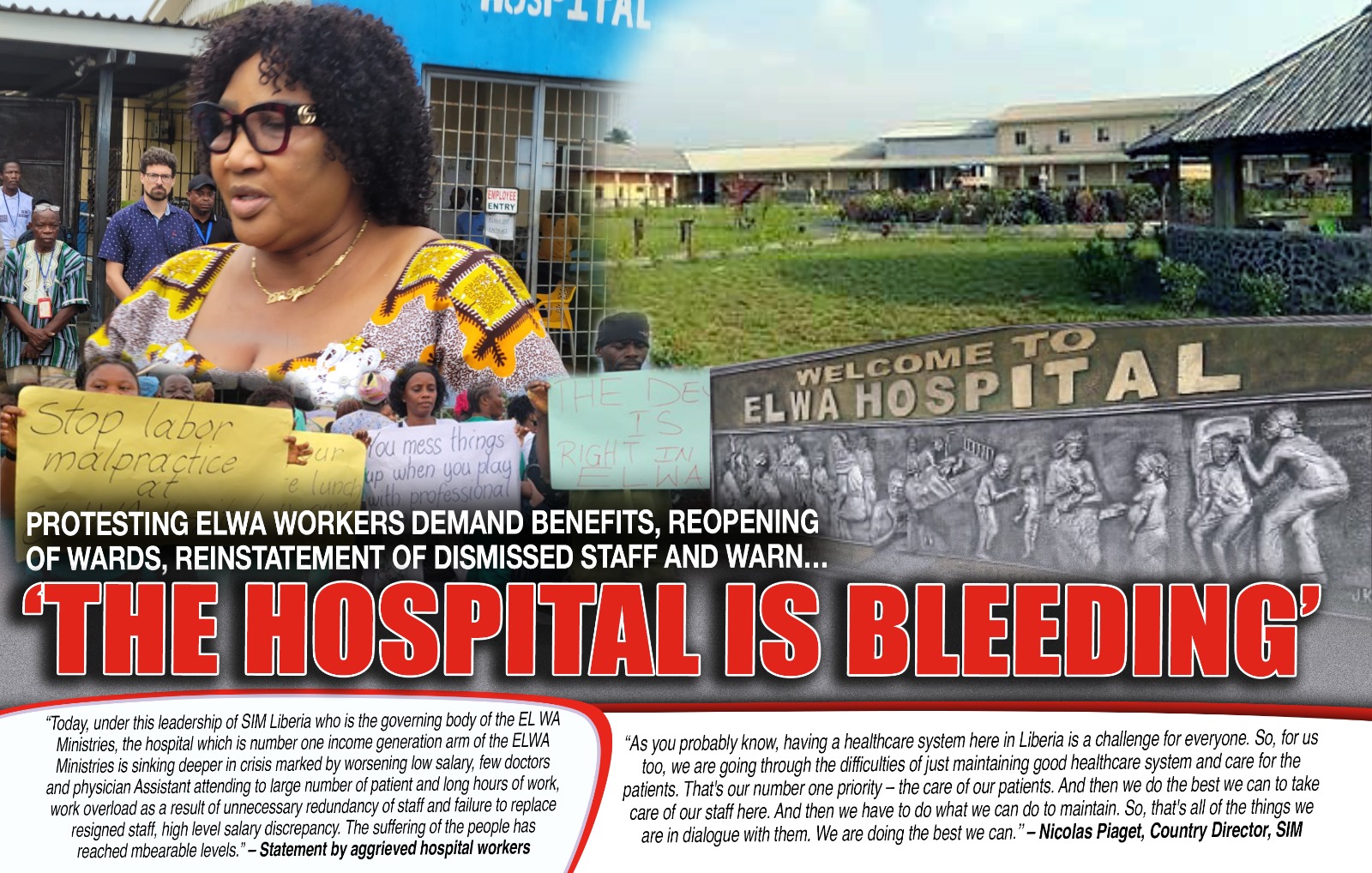
Paynesville – On a Monday morning, the usually quiet compound of ELWA Hospital in Paynesville transformed into the stage of a protest brimming with emotion and resilience. Dressed in their white uniforms, healthcare workers—nurses, lab technicians, physician assistants, janitors, and support staff—stood shoulder to shoulder, holding hand-written placards, chanting messages that pierced through the walls of the ailing institution they serve.
By Jaheim T. Tumu | [email protected]
There were no signs of aggression. There was no violence. Yet, the silence between their chants spoke of years of quiet suffering. The message was clear: “Enough is Enough — We Want a New ELWA Hospital.”
This protest wasn’t just about better pay or a demand for equipment. It was a plea for recognition, justice, and accountability. It was the cry of professionals who believe the hospital they have helped build is being allowed to wither away under poor management, unchecked financial missteps, and systemic neglect.
Standing in front of the crowd, megaphone in hand, Boima D. Dougba, Chairman of the ELWA Hospital Workers Union, addressed his colleagues with conviction—and sorrow.
“On this historic day, October 6, 2025, we, the staff of ELWA Hospital, rise as one. We stand united, not in violence, but in peaceful defiance against injustice, unnecessary staff redundancies, misuse of donor funds, high-level salary discrepancies, and the plans of SIM Liberia to reduce our 125-bed hospital to a children’s clinic,” he declared, his voice echoing beyond the hospital gates.
Dougba’s words were not simply a summary of the petition; they were the story of a crumbling health facility and the people who had kept it afloat against impossible odds. In his voice was the fatigue of years, and the urgency of now.
“Our institution, the ELWA Hospital, is broken. The future for the employees of this great institution is in jeopardy, and our patience has run out.”
Among the most pressing concerns was the closure of essential hospital departments: the female ward, the gynecology unit, and the eye clinic. These were not just routine rooms—they were lifelines for patients from across Monrovia and beyond.
“The decision to close the female ward has resulted in inadequate bed space for the hospital, jeopardizing its financial stability and adversely affecting citizens seeking care,” the workers wrote in their petition.
The closure of these wards has led to a sharp decline in patient services and revenue, turning a once-thriving facility into a shell of its former self.
The workers also called for the immediate reinstatement of eleven Liberian staff members made redundant earlier this year—reductions the union called “punitive” and damaging to already strained hospital services.
The salaries at ELWA Hospital have long been a source of frustration. For many staff, including trained nurses, the take-home pay barely covers transport, food, or rent.
“A hospital like ELWA, run by a Christian organization such as SIM, paying a professional nurse less than L$30,000 per month, is a clear abuse of labor rights,” the union declared in the petition.
The pay gap and perceived exploitation have left many workers disillusioned—questioning the values of an institution founded on faith and compassion.
One of those voices is Bridgett Peter James, a registrar and mother, who says her hope in the system has eroded.
“Every month, our social security benefits are being cut — ten thousand dollars is deducted from our account, and yet when we go to Social Security, there’s nothing there,” she said with visible frustration. “I have been to the Social Security office two times. Not even five dollars is in my account.”
Bridgett earns just L$13,000 monthly and says the biweekly payment system the hospital uses is inconsistent and unclear. She wonders how long workers are expected to survive under these conditions.
For Mary Jallah, a nurse with seven years of service, the disillusionment cuts even deeper. She remembers the harrowing days of COVID-19, when healthcare workers at ELWA risked their lives daily to save others. Today, she says, those sacrifices have gone unnoticed.
“We are tired,” she said, her voice cracking. “Our families are suffering. Sometimes we can’t even get food. Transportation to work is another problem. When you come late, they cut your hours. When you try to go to school, they say you can’t go. Everything we’re supposed to have, we are being denied.”
And the burden isn’t just physical or financial—it is emotional.
“You cannot be sufficient when you are being mistreated every day,” Mary added. “We are health workers, not slaves. We deserve better.”
Among the protest’s more alarming claims was the alleged mismanagement of US$75,000—funds reportedly donated for the purchase of a hospital ambulance over a year ago. To date, no ambulance has arrived, and no explanation has been given.
“SIM International and SIM Liberia were given about US$75,000 to purchase an ambulance for the hospital to facilitate safer patient transport. However, the ambulance remains unaccounted for,” the workers stated in their petition.
For a hospital that frequently refers critical cases or handles emergencies, the absence of a functioning ambulance isn’t just an administrative failure—it is a threat to life.
As frustration mounted, workers made a heartfelt appeal to someone they believe could intervene—President Joseph Nyumah Boakai.
“The ELWA Hospital is considered as His Excellency President Joseph Nyumah Boakai’s hospital by many Liberians because before ascending to the presidency, he was often seen taking treatment here. We are calling on him to intervene in preventing this hospital from closing,” the petition read.
The staff believe that if anyone understands the hospital’s legacy, it’s the President. And they’re hoping he listens—before it’s too late.
In response to the protest, SIM Liberia Country Director Nicolas Piaget addressed reporters with calm but visible concern. He confirmed that a meeting had taken place between the Ministry of Health, the union, and SIM representatives earlier that day.
“We had a very good meeting with the Ministry of Health and the Union of Representatives,” Piaget said.
“The discussion is that we have two weeks now, where we will come back with some propositions for the way forward in agreement with the Ministry of Health. That’s the outcome of the discussion we had this morning.”
Piaget acknowledged the ongoing financial strain faced by the organization, saying it was doing its best to meet staff needs despite tight resources.
“We do all the best we can to meet their request. That’s why we have to plan. In the next two weeks, we will give an answer that will highlight how we can address all of those issues.”
He said the union agreed to the two-week window and believed it would convince staff to return to work.
“Our hope is that they will come back so that we can treat the patients that are here. Some of them are. No, everything is under control. We have people there that are taking care of them, so no one is in danger. We have put contingency plans since last night, so everything is under control.”
He also pointed to the wider context.
“So, as you probably know, having a healthcare system here in Liberia is a challenge for everyone. So, for us too, we are going through the difficulties of just maintaining as good as we can healthcare system and care for the patients. So, that’s our number one priority, is the care of our patients.”
On the missing ambulance, Piaget said the issue was not as simple as purchasing a vehicle.
“There is one thing to have the physical ambulance, but it has costs to maintain and to make sure that we can do that. Currently, because of the financial situation, our priority is the care of the patients, and our priority is that we are able to continue to pay our salaries to our staff on a regular basis.”
“I feel very sad that we have to come to that place at the end of the year. I think we have responsibility as a leadership and management where we are. And as we engage with the staff.”
Piaget stressed that the organization had not hidden anything.
“It has been one year, according to the bargaining agreement they have always presented to you. They said close to one year, over a one year. And we have been in regular contact with them. We explain also our financial difficulties, so we are not hiding anything from anybody. We are just there and saying everything we can to improve that situation.”
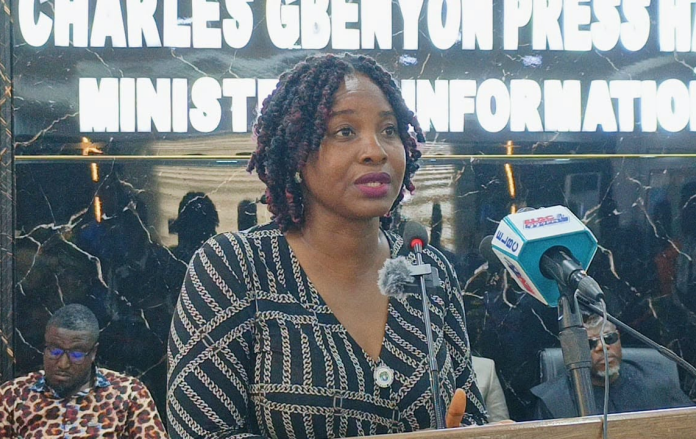
The Minister of Health, Dr. Louise Kpoto, who was present during the stakeholder meeting, offered a cautiously optimistic response.
“They will go back to work, and we are asking them within two weeks’ time for some positive answers on certain percentages of the petition that was read. I think their concerns are genuine, and it can be worked upon,” she said.
She acknowledged operational missteps on the part of hospital management and confirmed that steps were being taken to rectify them.
“It was a cordial meeting, and they recognized that they had some lapses. We are meeting them tomorrow at the Ministry of Health, but they did apologize to the workers,” she added.
The protest at ELWA Hospital may have concluded for now, but the issues that led to it remain unresolved. As the two-week deadline ticks down, all eyes will be on the hospital’s administration and the Ministry of Health.
For the staff, their protest is not just about one day of resistance—it is about reclaiming the soul of an institution they believe in, one that has served their communities and should serve them too.
Support Independent Journalism
Your support helps FrontPage Africa continue delivering independent, credible, and impactful journalism. Every contribution strengthens our ability to investigate, inform, and hold power accountable while keeping quality journalism accessible to our readers.
Support our journalism or subscribe to receive the latest FrontPage Africa stories and updates.