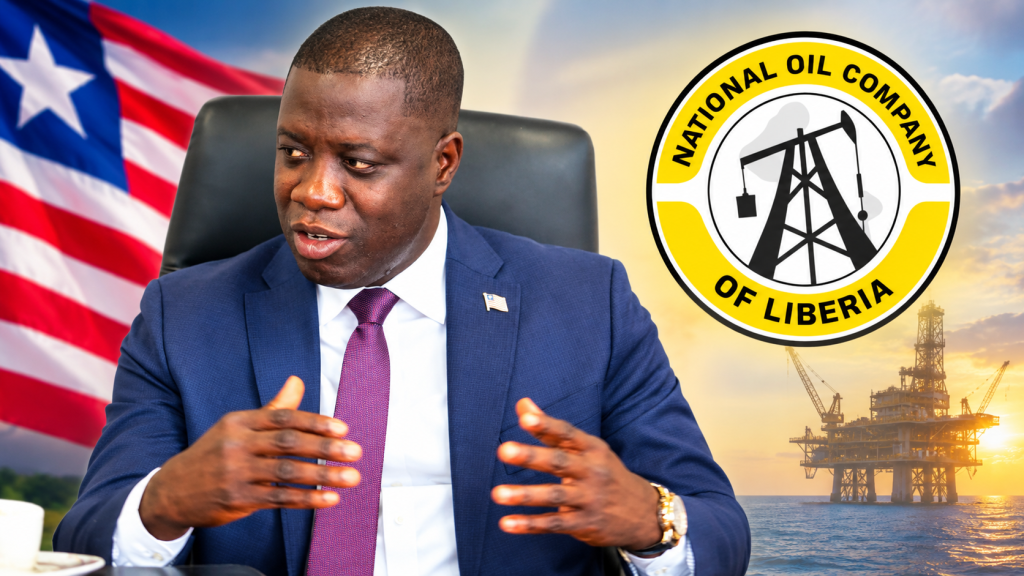
Monrovia — National Oil Company of Liberia Vice President Finance and Chief Financial Officer of NOCAL Emmanuel Azango on Wednesday, September 23, found himself at the center of a growing financial and judicial crisis after the Commercial Court held him in contempt and kept him on the court’s bench for more than two hours, as the Government of Liberia faces enforcement over a decade-old debt dispute that has reportedly ballooned into a US$764,762 court award.
By: Willie N. Tokpah
The dramatic development unfolded Wednesday, when Chief Judge Eva Mappy Morgan ordered the immediate closure and sealing of the National Oil Company of Liberia, NOCAL, and the Ministry of Finance and Development Planning, directing the Commercial Court sheriff to seal the institutions’ entrances and remove occupants.
The order grows out of an Action of Debt brought by former NOCAL officials Vida A. Mensah and Cllr. Idella Cooper-Shannon against NOCAL and its corporate officers.
The dispute, according to publicly available reporting, began with claims of approximately US$85,000 each arising from NOCAL’s controversial 2015 restructuring and severance arrangements.
After nearly a decade of litigation, accumulated interest and penalties reportedly pushed the combined court award to US$764,762.
That old dispute has now returned with renewed force, this time placing Azango, NOCAL’s financial leadership and the Ministry of Finance directly in the path of a Commercial Court enforcement action.
Azango at the Center
When confronted by FrontPage Africa about why the debt allegedly remained unpaid and what responsibility he bore as NOCAL’s Vice President for Finance and Investment, Azango pointed away from NOCAL’s current financial management and toward the Government of Liberia.
Azango said the matter was before the Government and that the Ministry of Finance and Development Planning was supposed to take charge of the payment.
He also maintained that the debt was an old obligation. But the Commercial Court’s September 23 order makes no distinction between an old debt and a new one in directing enforcement. It names NOCAL and the Ministry of Finance and orders their premises closed.
Azango further told FrontPage Africa that he was kept on the court bench for hours and that the court demanded payment of 25 percent of the obligation. He referred FrontPage Africa to the court documents, emphasizing that the debt dates back years.
The immediate question now is whether NOCAL’s financial leadership did everything required to ensure compliance with the court’s directives, or whether responsibility was allowed to move between NOCAL and the Ministry of Finance until the dispute reached the extraordinary point of a court-ordered institutional shutdown.
The US$764,762 Liability
The latest confrontation cannot be understood without looking back at the history of the underlying case. Public reporting in May 2026 said the Commercial Court had awarded nearly US$800,000 to former NOCAL executives Vida Mensah and Cllr. Idella Cooper-Shannon.
The combined figure reported was US$764,762. The claims reportedly began at approximately US$85,000 each, before years of litigation, interest and penalties substantially increased the amount.
The case traces back to the period when NOCAL was experiencing severe financial distress and undergoing re-structuring. In August 2015, Liberia’s Ministry of Foreign Affairs’ daily media summary reported that Mensah, then NOCAL’s Vice President of Administration, had resigned as the company moved toward an interim management arrangement amid a financial crisis.
According to the May 2026 reporting, Mensah and Cooper-Shannon were among the former executives who did not accept the reduced severance arrangement offered during the restructuring and instead pursued litigation.
That litigation has now produced a liability hundreds of thousands of dollars larger than the original claims.
FROM US$170,000 TO US$764,762
The evolution of the debt is one of the most consequential elements of the case. What reportedly began as approximately, Vida Mensah, US$85,000, Idella Cooper-Shannon, approximately US$85,000, has grown, according to published reporting, into US$764,762 in combined court awards after years of litigation, penalties and interest.
That means the Government of Liberia is now confronting a liability more than four times the original combined principal reported in connection with the claims. And the financial consequences are no longer confined to the two former executives and NOCAL. The dispute has reached the Government’s central financial institution.
The Commercial Court commands Acting Sheriff Emmanuel Morris, or his deputy, to have NOCAL and the Ministry of Finance “closed with immediate effect.” The sheriff is ordered to seal the entrances and remove occupants.
He is also commanded to make an official return to the court detailing the manner in which the order was served and executed. The order is signed by Randolph B. Sneh, Clerk of the Commercial Court, and bears the official seal of the court.
This means the case has moved well beyond a dispute over whether money is owed. It has become a question of judicial enforcement against the Government of Liberia and one of its most important public institutions.
Who Is Supposed To Pay?
If the debt belongs to NOCAL, why should the Ministry of Finance be expected to pay it and if the Government of Liberia is responsible for satisfying the judgment, why has the dispute been allowed to reach the point where NOCAL’s financial leadership is facing contempt and the Ministry of Finance itself is under a closure order?
Azango answers that the matter is before the Government and that the Ministry of Finance should take responsibility. But the court’s action suggests that the distinction has not resolved the issue; instead, both institutions now face enforcement.
NOCAL’s Old Financial Problems
The underlying dispute emerged during one of the most difficult periods in NOCAL’s history. By 2015, the state-owned oil company was experiencing a serious financial crisis. Government records from that period show that NOCAL was undergoing restructuring and replacing its leadership with an interim management arrangement.
Mensah resigned as Vice President of Administration during that period. The company’s historical finances have also been subjected to scrutiny by the General Auditing Commission. An earlier GAC report identifies Idella Cooper-Shannon as a former NOCAL board member.
The company’s past financial affairs have also been scrutinized in relation to executive bonuses and payments associated with the 2013 Block 13 transaction. A 2018 FrontPageAfrica report on the Special Presidential Committee investigating the Global Witness allegations reported that Cooper-Shannon was among former NOCAL board members identified in connection with proposed restitution of payments.
The report said the committee recommended restitution from officials in connection with bonuses and honoraria. Those matters are separate from the present Action of Debt and should not be conflated with the current judgment.
The 2015 Breakdown
The history is important because it explains why an apparently old employment-related dispute is now creating a new financial crisis. NOCAL was already facing financial difficulties when the restructuring took place. Mensah was among the senior executives leaving the corporation in 2015, according to the Ministry of Foreign Affairs’ contemporaneous media summary. The severance dispute subsequently became a legal battle.
According to reporting published in May 2026, the litigation continued for approximately a decade before the Commercial Court’s ruling produced the US$764,762 award.
Why Azango’s Role Matters
Azango was not a member of NOCAL’s management at the time the original severance dispute arose. That fact is important. The present NOCAL financial leadership should not automatically be blamed for creating a liability that originated under previous management.
But once a judgment exists, current officials have a responsibility to explain what actions were taken to address it. That is where Azango’s role becomes relevant. As NOCAL’s Vice President for Finance and Investment, he occupies a senior position within the corporation’s financial management structure.
His explanation that the Ministry of Finance should take responsibility raises another concern about what formal steps did NOCAL took to secure payment from the Government, and when those steps were taken.
The 25-Percent Question
Azango says the court required 25 percent of the debt to be paid. But the September 23 closure order supplied to FrontPageAfrica does not state the exact monetary amount represented by that 25 percent. Nor does the document itself establish whether the payment was made.
That leaves several questions unanswered, as to what exact amount of twenty-five per cent was actually made and if the US$764,762 award was the amount against which the 25 percent was calculated?
A US$764,762 Case Now Threatens Government Operations
An employment or severance dispute that reportedly began at approximately US$170,000 in combined claims has evolved into a court award of US$764,762 and is now threatening the physical operations of two government institutions.
The Commercial Court’s action means that a dispute originating from NOCAL’s troubled 2015 period is now confronting the Boakai administration more than a decade later. And Azango, who was not part of the NOCAL leadership involved in the original dispute, is now one of the officials being called upon to explain how the corporation responded to the judgment.
The Bigger Accountability Issue
The case exposes a recurring problem in Liberia’s public sectorororor, where old liabilities can survive changes in government, management and policy, but eventually return with financial and legal consequences.
The present controversy is therefore not simply about Azango, it is about how NOCAL and the Government of Liberia manage inherited liabilities and whether court judgments against public corporations are promptly incorporated into government financial planning.
For now, the Commercial Court has taken the strongest possible step. NOCAL have been ordered closed, Azango has been held in contempt, a 25-percent payment has reportedly been demanded and a debt dispute that began roughly a decade ago, reportedly at approximately US$85,000 for each of two former NOCAL executives, has grown into a reported US$764,762 court award.
Whether Liberia’s public financial system will resolve the liability, or whether the old NOCAL dispute will continue generating new costs, new contempt proceedings and new answers for the country’s debts, remains a concern.
Support Independent Journalism
Your support helps FrontPage Africa continue delivering independent, credible, and impactful journalism. Every contribution strengthens our ability to investigate, inform, and hold power accountable while keeping quality journalism accessible to our readers.
Support our journalism or subscribe to receive the latest FrontPage Africa stories and updates.