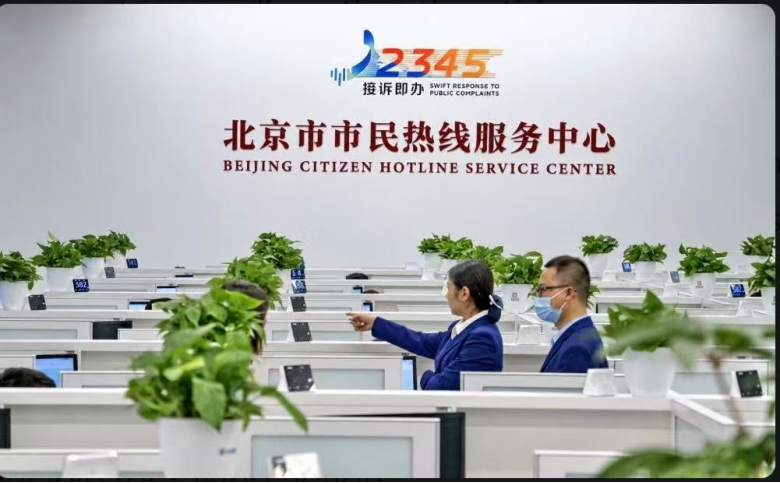
BEIJING, China — Authorities operating Beijing’s 12345 Citizens Service Hotline are encouraging African countries, including Liberia, Sierra Leone and Nigeria, to adapt China’s public service model to strengthen government accountability, improve service delivery and enhance citizen engagement.
By J.H. Webster Clayeh | [email protected]
The call was made by Feng Yingyi, Deputy Director of the Beijing Municipal Citizens Service Hotline Center, during a visit by participants of the Second Session of the China International Press Communication Center.
Feng said China is willing to share its experience with African countries and other developing nations interested in improving the way governments response to public concerns.
“In the past years we have received guests from abroad most especially from the African countries who are more interesting in our Beijing models. We are very much willing to share our success stories,” Madam Feng told journalists.
“We also hope that all countries can adapt this model to their own conditions and learn properly from these practices because we have the Chinese characteristics model. We hope that these countries can develop their own model, their own characteristics so that we can all be successful,” she stated.
A MODEL FOR AFRICAN GOVERNMENTS
The Beijing 12345 hotline provides a centralized platform through which residents can submit complaints, make inquiries and offer suggestions to government authorities.
With Beijing’s population estimated at 21.8 million, the system enables residents to communicate their concerns to relevant government departments while allowing authorities to coordinate responses and monitor cases.
For African countries such as Liberia, Sierra Leone and Mali, the model could offer lessons in establishing integrated citizen service centers that connect people to ministries, local authorities and public agencies through telephone services, digital platforms and in-person assistance.
Such systems can also help governments establish clear deadlines for resolving complaints, track cases transparently and use public feedback to identify recurring problems and improve policies.
Madam Feng called on developing countries to study Beijing’s experience while adapting the system to their respective national circumstances.
THE CHALLENGES FACING THE HOTLINE
Despite its reported achievements, Beijing’s 12345 hotline continues to face challenges associated with heavy workloads, complicated complaints, interdepartmental coordination, service quality and the long-term resolution of public problems.
According to figures cited in the center’s 2025 annual report, the hotline handled 25.802 million requests from the public and businesses in 2025, representing a 6.6 percent increase from 2024.
The report put the resolution rate at 97.3 percent and the satisfaction rate at 97.7 percent.These figures highlight the scale of the operation and the demands placed on the system as Beijing continues to address the concerns of residents and businesses.
Madam Feng said the city’s size, population and complex urban challenges require authorities to continually improve public service delivery. She acknowledged that the challenges confronting the hotline change as the city develops and public expectations increase.
“We have higher rates and higher standards for future governments. So, for the challenges, we have different stages when it comes to development. But we are trying our best to continue to overcome more challenges back to another and then we set our new higher goals for us,” Madam Feng said.
HOW THE 12345 HOTLINE OPERATES
The Beijing 12345 Citizens Service Hotline originated in 1987 as the Mayor’s Hotline. In January 2019, it was renamed the Beijing Citizen Service Hotline Center and developed into a central platform for handling public complaints and supporting urban governance reforms.
The system operates on a people-centered approach built around rapid response, efficient processing, timely feedback and proactive governance. According to information provided by the center, the hotline has handled approximately 200 million requests from residents and businesses over more than seven years.
The center’s reported resolution and satisfaction rates have remained high, reflecting its central role in Beijing’s approach to public administration. In 2025 alone, the hotline processed 25.802 million requests, averaging more than 70,000 cases daily.
To manage the workload, the center operates 750 workstations staffed by more than 1,700 operators working in shifts to provide round-the-clock services. Its mission is captured in the phrase, “When the people call, we respond,” while its service commitment is expressed through the slogan, “Let You Hear Our Smile.”
The operational framework is designed to ensure that citizens’ concerns are received, assigned to the appropriate departments, addressed and followed up. The hotline consequently serves as a link between residents’ everyday experiences and the broader machinery of municipal administration.
ARTIFICIAL INTELLIGENCE TRANSFORMS PUBLIC SERVICE
The visit also provided journalists with an opportunity to learn about the digital transformation of Beijing’s 12345 hotline and the growing role of artificial intelligence in public service delivery.
In line with the 2026 Beijing Forum on Swift Response to Public Complaints, whose annual theme is “Digital Intelligence Era and People’s City,” Beijing has upgraded its “Visit 12345” program.
The initiative includes the “12345 Hotline Digital Intelligence Innovation Lab,” which showcases developments in digital technology and artificial intelligence through interactive demonstrations and practical applications. The transformation focuses on four major areas: intelligent customer service, intelligent agent systems, intelligent workplace operations and the intelligent hub.
These innovations are intended to improve efficiency, strengthen coordination among government departments and help authorities respond more accurately to public needs.
Technology has helped transform the hotline from a traditional telephone-based complaint service into an integrated, data-driven public service and governance platform.
Through digital communication systems, big data, artificial intelligence and interconnected government information systems, the hotline can receive complaints, transfer cases to responsible departments, monitor progress, analyze recurring problems and provide feedback to citizens.
The approach supports Beijing’s Swift Response to Public Complaints reform, which emphasizes addressing citizens’ needs and resolving problems more efficiently.
TECHNOLOGY AND THE HUMAN TOUCH
Feng said the growing demands on government made technological innovation increasingly important in improving public service delivery. “Now with Science and Technological advancements, our artificial intelligence with our technological model, it is guaranteed that our services are fast running,” she said.
She added: “By the technology we can use these to analyze, to make judgment in an accurate way to identify potential risks and timely and accurate support to decision makers.”
One major area of development involves using large artificial intelligence models to improve communication between residents and the hotline.
The technology can facilitate dialogue between people and AI, automatically collect information about requests, generate work orders and direct cases to the appropriate government departments.
Through the Jingtong App, residents can access the quick-response public complaints service and use the 12345 intelligent agent. The system allows users to submit requests through an interactive process similar to a telephone conversation. It also supports text-based submissions, multilingual consultations and the uploading of photographs and videos.
These features give residents additional ways to explain their concerns, provide supporting evidence and communicate with government authorities.
MULTILINGUAL SERVICES EXPAND ACCESS
Beijing’s 12345 hotline also provides multilingual services to improve access for foreign residents and users who do not speak Chinese. According to a Beijing municipal government report published on October 11, 2026, the hotline provides services in eight foreign languages in addition to Chinese.
However, the official Beijing government website’s multilingual hotline page lists 10 languages, including Portuguese and Italian, suggesting a discrepancy between the two published sources. The multilingual arrangements reflect the importance of making public services accessible to people from different linguistic backgrounds.
For African countries considering similar systems, Beijing’s experience offers examples of how centralized complaint-handling platforms, digital technologies and multilingual communication can be incorporated into public administration.
While Feng expressed Beijing’s willingness to share its experience, she emphasized that countries should adapt the approach to their own circumstances and develop systems reflecting their national characteristics.
Support Independent Journalism
Your support helps FrontPage Africa continue delivering independent, credible, and impactful journalism. Every contribution strengthens our ability to investigate, inform, and hold power accountable while keeping quality journalism accessible to our readers.
Support our journalism or subscribe to receive the latest FrontPage Africa stories and updates.