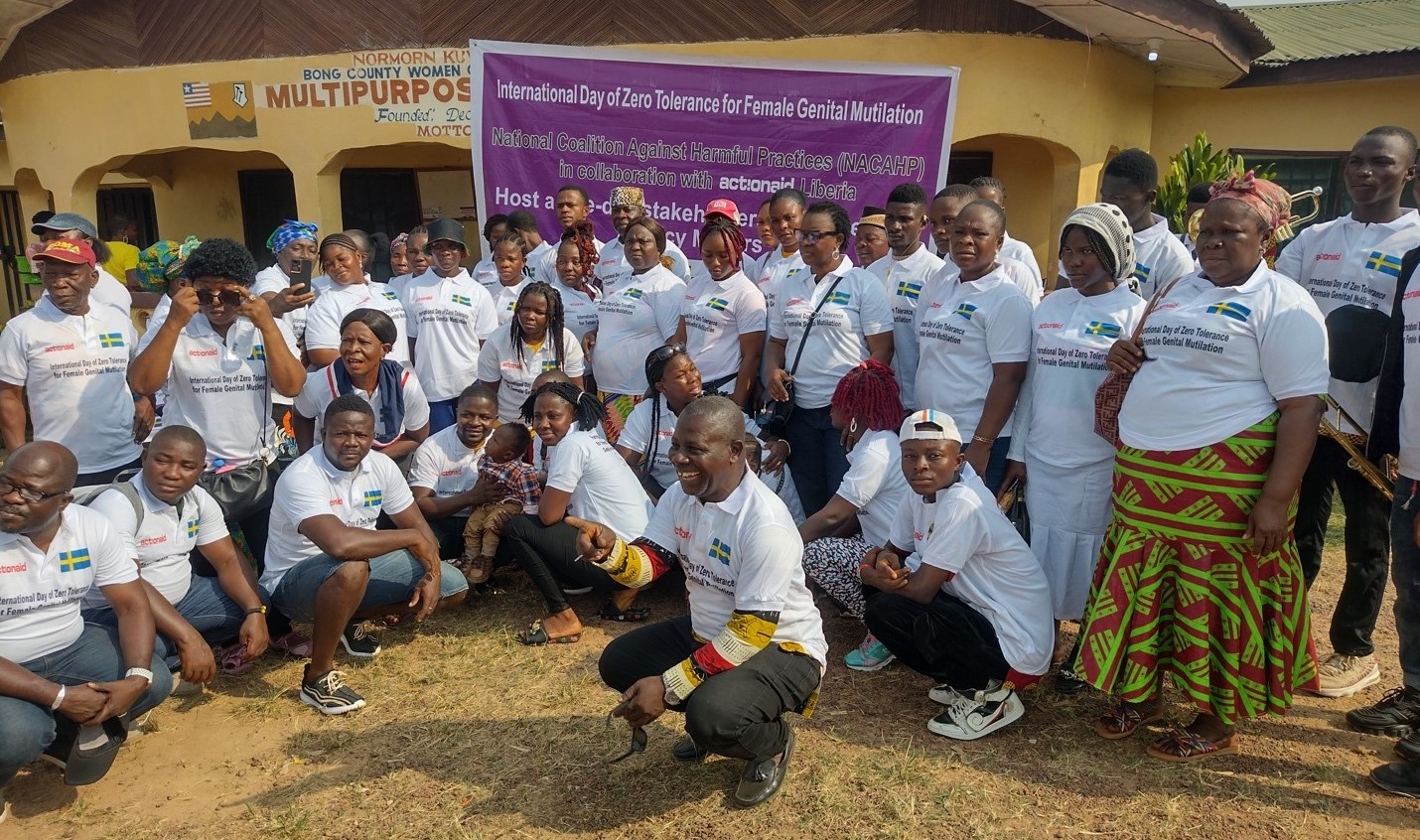
Gbarnga, Bong County – The National Coalition against Harmful Practices (NACAHP) in collaboration with Action Aid-Liberia has ended a one-day dialogue as part of efforts to end Female Genital Mutilation (FGM) in Liberia.
By Selma Lomax, [email protected]
The dialogue was held with policy makers in Gbarnga, Bong County over the weekend as part of celebrations marking International Day of Zero Tolerance for Female Genital Mutilation 2023.
According to the National Administrator of the National Coalition against Harmful Practices (NACAHP), Marian Deah, the dialogue was intended to review achievements, challenges and the way forward for the three-year moratorium placed on FGM in February last year.
Madam Deah said the dialogue also looked at how FGM can be eradicated in Liberia and how the three-year moratorium can be implemented successfully.
In the face of culture and FGM, Madam Deah said “we do not condemn the people but we condemn the practice. Even when we bring the message to them, we don’t go in battle because it deals with behaviour change communication so as to let them know that it has no health benefits”
For her part, Actionaid- Liberia Program Coordinator, Gloria Yancy, stressed the urgent need to end harmful practices especially female genital mutilation, which according her, poses threat to the future generation of Liberia.
She said the issue of FGM does not only need the efforts of local leaders, traditional leaders and international partners, but also the imports and advocacies of young people whose future and that of their children are at stake.
She said the health implications of FGM does more harm with zero percentage of data recorded so far. She said, “The health implication includes infection. The idea is that the female genital is cut. In the case of a child birth in a serious case of FGM, the whole area is tightened and the woman experiences difficulty in giving birth and then there are chances of infection, pain, ovarian cyst and in extreme cases, there’s death.”
This year’s International Day of Zero Tolerance for Female Genital Mutilation was celebrated under the theme; “Partnership with Men and Boys to transform Social and gender Norms to End FGM.”
FGM is practiced in more than 30 countries across Africa, Asia, and the Middle East, and by diaspora communities in Europe, the Americas, and Australia.
It is estimated that three million girls are at risk of undergoing the practice every year, and 200 million women and girls alive today have already been subjected to FGM.
In many communities, FGM marks the transition from girlhood to womanhood: once a girl is subjected to FGM, she is considered ready to be married and start a family. This often represents the end of her education. The impact of this on survivors’ physical and mental well-being is devastating and life-long.
Support Independent Journalism
Your support helps FrontPage Africa continue delivering independent, credible, and impactful journalism. Every contribution strengthens our ability to investigate, inform, and hold power accountable while keeping quality journalism accessible to our readers.
Support our journalism or subscribe to receive the latest FrontPage Africa stories and updates.