President Joseph Nyuma Boakai:
June 8, 2026 — Harbel, Margibi County: “Lasting progress must be anchored in strong local institutions, empowered communities, and responsive governance systems that bring decision-making closer to the people.”
By: Austin S Fallah – A True Son of the Planet Earth Soil: [email protected]
President Joseph Nyuma Boakai, at the First International Policy Roundtable on Local Governance and Rural Development: “Development must move beyond policy discussions and become visible in the lives of our people. We must move development to the people.”
Former President Ellen Johnson Sirleaf: January 5, 2012 — Salala, Bong County: “It is only through the involvement of people, through their ownership of the processes of development and decentralization, can this become an historic undertaking.”-Former President Ellen Johnson Sirleaf, at the launch of Liberia’s National Policy on Decentralization and Local Governance.
Her administration also emphasized transferring public services from Monrovia to coun ty centers and strengthening local governance institutions.
Former President George Manneh Weah: January 30, 2023 — Annual Message to the 54th National Legislature:
“No longer must our people always have to come all the way to Monrovia to get better services because most of the things done in Monrovia can now be done in the counties.”
Former President George Manneh Weah, discussing the Local Government Act of 2018. January 22, 2018, inaugural address: “The people expect better cooperation and more action from their government.”
The two US-based Liberian professionals raised the questions below after work, while driving home, which informed this article.
Hon. Edward Wesee: How many counties has each Cabinet Minister visited for official working engagements?
Hon. Edward Wesee: What specific development projects is each ministry implementing outside Montserrado County?
Hon. Alexander Torbor Kun: How much of each ministry’s budget directly benefits rural communities?
Hon. Alexander Torbor Kun: What mechanisms exist for citizens to report abandoned projects and poor service delivery?
Hon. Edward Wesee: How often do ministers report their county-level activities and implementation challenges to the President and the public?
Hon. Alexander Torbor Kun: What measurable improvements can citizens expect in healthcare, education, agriculture, roads, electricity, and employment?
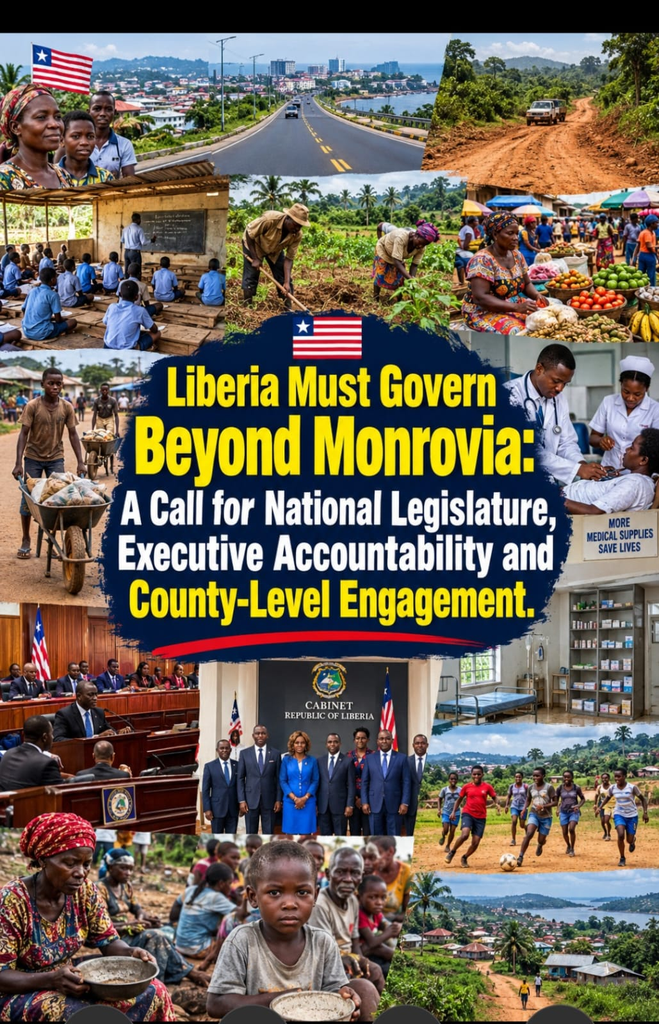
Monrovia is not Liberia.
It is Liberia’s capital city, its political center, and its largest urban community, but it is not the whole country.
Liberia is also River Gee, Grand Kru, Grand Gedeh, Gbarpolu, Sinoe, Maryland, Lofa, Nimba, Bong, Bomi, Grand Bassa, Margibi, Rural Montserrado, Grand Cape Mount, and every other district, every village, every town where citizens work, farm, raise children, struggle with poor roads, seek health care, and hope for a government that sees them.
For too long, many Liberians outside Monrovia have felt that national government exists mainly in the capital.
Some ministers, commissioners, lawmakers, and senior officials often appear visible in Monrovia while remaining distant from the very citizens whose lives are shaped by their policies.
This pattern is not only unfair; it is bad public policy.
President Joseph Boakai, Speaker Richard Nagbe Koon, and President Pro Tempore Nyonblee Karnga-Lawrence must insist that cabinet ministers, every lawmaker ,and senior government officials regularly engage citizens across all fifteen counties and produce measurable results from those engagements.
Liberia needs a government that listens beyond election season, travels beyond the capital, and delivers beyond speeches.
A leader who governs only from Monrovia cannot fully understand Liberia’s needs.
Likewise, a minister who sits in an office in the capital without visiting schools, hospitals, police stations, agricultural communities, border towns, and rural roads cannot effectively manage a national ministry.
Liberia’s development requires direct engagement between public officials and the people they serve.
The central problem is not that Monrovia should receive no attention.
As the capital, Monrovia naturally hosts the presidency, the legislature, ministries, foreign embassies, major businesses, and national institutions.
It is reasonable that many official activities happen there.
However, it becomes a problem when government attention is concentrated almost entirely in Monrovia.
At the same time, rural counties are treated as distant places remembered only during political campaigns, national celebrations, funerals, or emergencies.
Citizens in the leeward counties are Liberians too.
They vote, pay taxes in different forms, contribute to national food production, protect Liberia’s borders, and preserve the country’s cultural strength.
They deserve to see their government not merely on television, in campaign posters, or in speeches broadcast from the capital, but in person.
Government officials must engage with the people they lead face-to-face and in meaningful community settings.
Ministers and lawmakers should hold public forums in county capitals, district centers, schools, health facilities, town halls, and community meeting spaces.
These gatherings should not be staged ceremonies where officials deliver prepared remarks, shake hands, and leave.
They should be working sessions where citizens can ask questions, describe their concerns, challenge poor performance, and receive clear answers.
Community members should have an opportunity to explain why a clinic lacks medicine, why a school has too few teachers, why a road has become impassable, why police officers lack transportation, or why young people cannot find skills-training opportunities.
Public officials should listen carefully, take notes, make commitments, and report back on what has been done.
Consider the Ministry of Education.
When was the last time a Minister of Education visited River Gee County to inspect the condition of public schools, speak with teachers, meet students, and discuss educational challenges with parents?
A ministry cannot properly design national education policy without seeing the reality in the counties.
It is one thing to receive reports in Monrovia about enrollment, teacher attendance, school buildings, textbooks, and examination performance.
It is another to stand in a classroom with broken desks, travel the difficult roads teachers use to reach rural schools, or hear students explain how distance and poverty affect their ability to learn.
Direct experience creates urgency.
It also lets officials distinguish accurate reports from those that may be incomplete, delayed, orpolitically influenceds.
The same question applies to other institutions.
When was the last time the people of Grand Kru, Grand Gedeh, Gbarpolu, Sinoe, Maryland, and other counties saw the Minister of Local Government ,the Minister of Labor,the Minister of Youth and Sports, the Minister of Education, the Minister of National Defense, the Inspector General, Director or Commissioner of the Liberia National Police, and other major government officials?
These offices are not limited to Monrovia.
They are national offices, funded by the Liberian people and responsible for the welfare and security of the entire nation.
The Minister of Local Government, for example, should be deeply familiar with the realities of county administration.
Local officials often face challenges involving sanitation, local governance, land disputes, community development, markets, roads, and delivering basic services.
A minister who regularly visits counties can identify where local government structures are weak, where county authorities need support, and where citizens have lost confidence in public institutions.
Such visits can also strengthen coordination among county superintendents, district commissioners, city mayors, traditional leaders, youth organizations, and women’s groups.
The Ministry of National Defense also has responsibilities that extend beyond the capital.
Liberia’s border communities are strategically important.
Citizens living near the borders often understand security challenges better than anyone in Monrovia because they experience cross-border movement, illegal activities, community tensions, and the effects of weak infrastructure firsthand.
Defense officials should not wait for a crisis before traveling to border counties.
Regular engagement can build trust between security institutions and local communities, improve information-sharing, and help prevent conflicts before they become serious threats.
Likewise, the Liberia National Police must be visible and accountable throughout the country.
In many rural areas, citizens may have limited access to police stations, trained officers, transportation, communication systems, and legal assistance.
When police leadership visits counties, listens to residents, and examines conditions on the ground, it can better understand the challenges local officers and thecommunities theyy serve face.
People should be able to tell the police leadership about robbery, gender-based violence, drug abuse, youth crime, land conflicts, and concerns about police conduct.
Trust in law enforcement grows when citizens see that the police are not only present to enforce laws but are also willing to listen and respond.
Engagement with citizens is not charity, public relations theater, or political entertainment.
It is a core duty of democratic leadership. Public officials are not appointed or elected to enjoy the comfort of Monrovia while rural citizens carry the burden of neglect.
They are appointed to serve the nation.
A government that regularly meets its people builds legitimacy.
It shows citizens that their voices matter and that national development is not reserved for those who live near ministries and government offices.
This is especially important because Liberia has a long history of centralized political power.
Too often, development decisions have been made from the capital without adequate consultation with people in the counties.
The result has been frustration, distrust, and the feeling among many citizens that they are treated as politically useful only during elections.
Politicians travel to rural communities during campaign season, make promises, distribute small gifts, speak passionately about change, and then disappear after the votes are counted.
Such behavior weakens democracy because it turns citizens into tools for elections rather than partners in governance.
Liberians should not have to wait until election season to see national leaders.
They should not be fed empty propaganda that amounts to nothing once officials leave office or candidates are elected.
Real leadership requires consistency.
A minister who visits a county only when seeking votes is not demonstrating public service; that minister is engaging in political marketing.
The people of Liberia deserve more than slogans, T-shirts, handshakes, and promises.
They deserve functioning schools, safe communities, improved roads, reliable health services, agricultural support, and opportunities for their children.
President Boakai has an important responsibility in this regard.
As head of the executive branch, he must demand measurable results from each cabinet minister, as he has since the beginning of his administration.
Ministers should not be judged only by how often they appear in meetings in Monrovia or how well they deliver speeches.
They should be evaluated according to specific performance standards that citizens can understand.
Every ministry should have clear targets, public timelines, county-level engagement plans, and regular progress reports.
For example, the President could require every cabinet minister to visit a minimum number of counties each quarter and conduct public consultations during those visits.
These trips should be documented, but the focus should not be on photographs or media announcements.
The focus should be on outcomes.
What problems were identified?
What commitments were made? Which agencies were assigned responsibility?
How much money was allocated? What progress has been made within thirty, sixty, or ninety days?
These answers should be published in accessible language so citizens can monitor performance.
The government could also establish a national cabinet outreach calendar.
Under such a system, ministries would rotate visits across counties throughout the year.
The Ministry of Education could hold school-quality forums; the Ministry of Health could assess clinics and hospitals; the Ministry of Agriculture could meet with farmers; the Ministry of Public Works could inspect roads and bridges; the Ministry of Youth and Sports could engage young people; and the Ministry of Gender, Children and Social Protection could consult women, children, and vulnerable groups.
Rather than operating in isolation, ministries could coordinate their trips so that communities receive comprehensive attention from government.
Lawmakers must also play their part.
Senators and Representatives are expected to represent the interests of their constituents, not merely participate in legislative sessions in Monrovia.
They should hold regular town hall meetings, publish reports on their activities, and explain to citizens what they are doing in the Legislature.
Constituents have a right to know how their Representatives vote, what bills they support, what projects they advocate for, and how they advocated for the use public resources intended for county development.
Representation must be active, visible, and accountable.
Some may argue that frequent county visits are expensive and difficult because Liberia’s roads and transportation systems remain challenging.
This concern is understandable, but it is not a sufficient excuse for government absence.
In fact, poor roads are one reason ministers must travel outside Monrovia.
Officials cannot fully appreciate the urgency of infrastructure investment if they never experience the conditions citizens face.
If a minister cannot reach a community because the road is damaged, that minister has discovered a governance problem that must be addressed.
The difficulty of travel should encourage action, not justify neglect.
Others may argue that ministers can communicate through county offices, reports, radio programs, and digital platforms.
These tools are useful and should be expanded, but they cannot replace physical engagement.
Reports can be incomplete.
Radio allows communication, but it does not always allow direct follow-up.
Social media does not reach every rural resident.
Personal visits allow officials to observe, question, verify, and build trust.
They remind citizens that government is made up of human beings who are accountable to the people.
Liberia’s future depends on national unity, and national unity cannot be built from Monrovia alone.
It must be built in every county, district, town, and village.
The people of River Gee, Grand Kru, Grand Gedeh, River Cess,Gbarpolu,Sinoe, Maryland, and all other counties must feel that they belong fully to the Liberian state.
They must know that their concerns can reach the highest levels of government and that their leaders will come to them not only when they need votes, but when they need solutions.
It is time for Liberia’s public officials to become leaders of all Liberians, not only the people of Monrovia.
President Boakai should demand results, enforce accountability, and ensure that every cabinet minister understands that public service requires presence, humility, and performance.
A government that listens to its people is stronger than one that only speaks to them.
A government that visits its counties is more credible than one that governs from a distance.
And a Liberia that includes every county in its national vision will be more united, more democratic, and better prepared for sustainable development.
Support Independent Journalism
Your support helps FrontPage Africa continue delivering independent, credible, and impactful journalism. Every contribution strengthens our ability to investigate, inform, and hold power accountable while keeping quality journalism accessible to our readers.
Support our journalism or subscribe to receive the latest FrontPage Africa stories and updates.