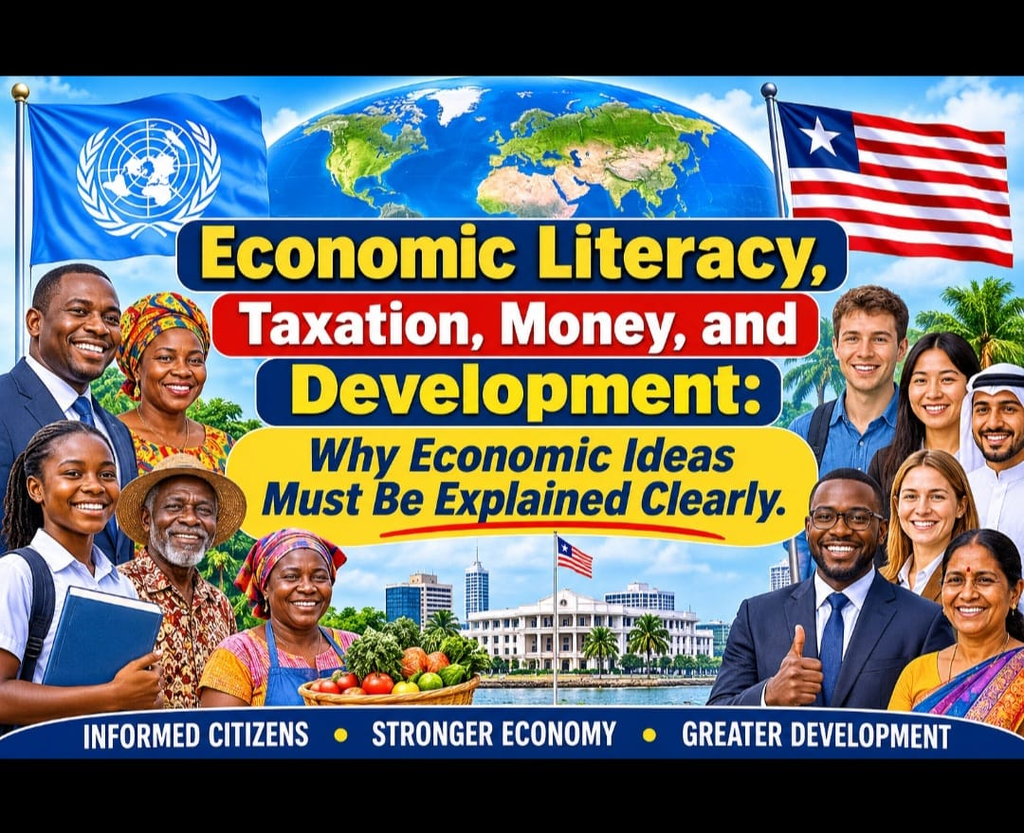
Why Must Economic Ideas Be Explained Clearly?
Why must citizens understand how the economy works?
Why do governments collect taxes, and how should tax revenue be used?
What is money, and how does monetary policy affect ordinary people?
How do public finance, investment, and development planning influence national progress?
Why should economic policies be communicated in language ordinary citizens can understand?
President Joseph Nyuma Boakai: Infrastructure and economic growth:
“Simply put, reliable electricity creates opportunities for growth and progress.”
Source: President Joseph Nyuma Boakai remarks on the dedication of the 20-megawatt solar farm, Mount Coffee, June 5, 2026.
Economic significance: Electricity is an input into production. It affects manufacturing, agriculture, commerce, employment, investment, and the cost of doing business.
By: Austin S Fallah – A True Son of the Planet Earth Soil: [email protected]
President Boakai: National economic transformation:
“Our goal is clear: to remove the obstacles to growth, improve public services, create opportunities for our citizens, and build a more prosperous and inclusive nation. “
Source: President Boakai, same presidential address, 2026.
Economic significance: Development should be measured not only by national economic growth but also by improvements in public services, employment opportunities, and living standards.
Former President Ellen Johnson Sirleaf: Public financial management:
“We have been able to do this, in a three-year program, by relentlessly pursuing public financial management under a rigorous program with the International Monetary Fund and the World Bank.”
Source: Ellen Johnson Sirleaf, The Challenges of Post-War Reconstruction – the Liberian Experience, Chatham House, London, June 13, 2011.
Economic significance: Public financial management is about how government raises, allocates, spends, accounts for, and monitors public resources.
Former President Sirleaf: Jobs and economic transformation: “This means more value-added, more labor-intensive industries, more small business, more vocational training, and a doubling of efforts to raise our educational standards.”
Source: Sirleaf, same Chatham House address, 2011.
Economic significance: Exporting raw materials alone does not capture an economy’s full potential. Processing, manufacturing, skills development, and small-business growth can create additional domestic value.
Former President George Manneh Weah: Economic empowerment: “We want to build a harmonious society, based on the goal of economic empowerment, especially for the underprivileged.”
Source: George Manneh Weah, address to the 73rd Session of the United Nations General Assembly, September 26, 2018.
Economic significance: Economic development includes people’s ability to participate in productive activity and access opportunities, not simply increases in national output.
Former President Weah: Inflation and purchasing power: In his subsequent UN General Assembly statement, President Weah discussed the economic effects of:
“Increasing inflation and currency depreciation”
He explained that these developments tend to reduce citizens’ purchasing power and burden their standard of living.
Source:President Weah, address to the 74th UN General Assembly, 2019.
Economic significance: Inflation and currency depreciation affect the real value of wages, savings, and household purchasing power.
Hon. Augustine Kpehe Ngafuan, Liberia’s Minister of Finance and Development Planning: Taxation and domestic revenue mobilization: Tax revenue and national development:
“We will take a one-government approach to unlock the potential of these sectors and support the LRA and other revenue-generating agencies in raising more revenue for the government.”
Source: Hon. Ngafuan, Senate confirmation hearing, September 5, 2024. Reported by Liberia’s Ministry of Information, September 11, 2024.
Why it matters: Government revenue is essential to financing public infrastructure, education, healthcare, and other national priorities.
Hon. Ngafuan: Taxation and economic sustainability: “We shall push all revenue-generating agencies to their full potential, but we must be careful not to milk the willing cow to death.”
Source: Ngafuan, Senate confirmation hearing, September 5, 2024.
Why it matters: Tax collection must balance revenue generation with businesses’ and citizens’ ability to remain economically productive.
Hon. Ngafuan:Public budgeting and economic literacy: Understanding economic growth:
“To unlock the economy, we must build more roads and other infrastructure, opening access to other parts of the country.”
Source: Hon.Ngafuan, Ministry of Information press conference on the FY2025 national budget, November 19, 2024.
Why it matters: Infrastructure investment connects economic theory with everyday realities, including transportation costs, agricultural markets, trade, and employment.
Hon. Ngafuan:Budget priorities:Explained that Liberia’s proposed FY2025 budget had a projected revenue envelope of US$851.8 million, with domestic revenue accounting for US$791.76 million.
Hon. Ngafuan: Economic leadership and uncertainty: “Good captains don’t tell you that there will be no turbulence, but a good captain assures you that, despite the turbulence, he or she will pilot the plane to its destination.”
Source: Hon. Ngafuan, interview with OK FM, April 7, 2026, reproduced by Analyst Liberia.
Why it matters: Economic management requires planning for uncertainty rather than assuming that economic conditions will always remain favorable.
Hon. Boima S. Kamara, former Minister of Finance and Development Planning: On taxation, domestic revenue, and national development
“The passage of the VAT Bill will help boost domestic tax revenue, enhance transparency and accountability, as well as spur development across the country.”
Relevance: This quotation demonstrates the connection between taxation, government revenue, accountability, and national development.
Source: April 8, 2024-Liberia Ministry of Finance and Development Planning, Finance Minister Wants Increased Focus on Expansion of the Country’s Economy.
Hon. Kamara: On monetary policy, fiscal policy, and economic growth
“We have to balance the monetary and fiscal policies, which will allow us to increase government spending in critical sectors.”
Relevance: This quotation illustrates why citizens need to understand money, government spending, monetary policy, and fiscal policy when discussing economic stability and development.
Source: The Japan Times, Special Economic Report on Liberia, July 26, 2017.
Hon. Samuel D. Tweah Jr., former Minister of Finance and Development Planning: Taxation and national development: “The reality is that the marginal impact of tax evasion and avoidance is largest in developing or low-income countries such as Liberia.”
Source: Hon.Samuel D. Tweah, remarks at the signing of the Convention on Mutual Administrative Assistance in Tax Matters, Paris, June 11, 2018. Published by Liberia’s Ministry of Finance and Development Planning.
Economic significance: Tax evasion reduces the resources available to government for roads, schools, hospitals, security, and other public services.
Hon.Tweah, Domestic resource mobilization: “Domestic resource mobilization is critical to Liberia’s debt sustainability.”
Source: Hon. Tweah, same address, 2018.
Economic significance: A country that can finance more of its development through reliable domestic revenue may reduce its dependence on borrowing and external assistance.
Hon. (Now Senator) Amara M. Konneh, former Minister of Finance and Development Planning: Investment and economic stability:
“I think if Liberia must be a suitable destination for foreign direct investment as well as encouraging investment in the private sector, efforts must be exerted to eradicate political risks.”
Source: Hon. (Now Senator) Amara Konneh, presentation of the proposed recast budget to legislative committees, February 10, 2016. Reported by the Ministry of Finance and Development Planning on February 12, 2016.
Economic significance: Investment decisions are influenced by political stability, policy predictability, security, infrastructure, and the legal environment.
Economic ideas often fail not because they are inherently too difficult, but because they are poorly explained, misunderstood, or discussed without the necessary foundation.
This problem is especially serious in developing countries, where public debates about taxes, government spending, inflation, money, banking, and development frequently become emotional arguments rather than informed policy discussions.
When economic explanations fail in translation, from the classroom to the public square, from technical language to everyday understanding, citizens may lose confidence in policies that are actually designed to improve their lives.
At the same time, governments may exploit public confusion to justify poor decisions.
A society cannot make sound economic choices when its people do not understand the basic reasons taxes exist, when taxes should rise or fall, who should bear the greatest tax burden, how money supply affects inflation and employment, or why access to money and credit matters for national development.
Economic education is therefore not merely an academic exercise.
It is a public necessity.
It equips citizens to hold leaders accountable, helps policymakers communicate honestly, and allows students and workers to understand how national decisions affect their households.
In Liberia, the work of economists and teachers who made economics understandable deserves special recognition.
May the soul of Professor Sumo Kupee, remembered as Liberia’s father of developmental economics at the University of Liberia, rest in peace.
His intellectual contribution represents the importance of studying economics not as abstract theory alone, but as a tool for solving real problems of poverty, unemployment, inequality, weak infrastructure, and underdevelopment.
Likewise, we owe much to Professor Tetteh, whom many regard as the father of Liberia’s modern-day monetary and banking economics at the University of Liberia.
Such educators have shaped generations of students who think more seriously about the relationship between money, institutions, banking, public policy, and national progress.
The first major economic misunderstanding concerns taxes.
Many people see taxes only as money taken away from workers, traders, businesses, and consumers.
From an individual perspective, this reaction is understandable.
No one enjoys seeing part of their income deducted.
However, taxes are not simply a punishment imposed by the government.
In a functioning society, taxes are the financial foundation of public goods and essential institutions.
Roads, schools, hospitals, courts, police services, sanitation systems, electricity infrastructure, water systems, ports, public health programs, and national defense all require funding.
Without taxation, government would lack the resources to provide services that private individuals cannot efficiently provide on their own.
The question, therefore, is not whether taxes are necessary.
The more important question is whether taxes are collected fairly, managed responsibly, and used transparently.
Citizens become resistant to taxation when they do not see results.
If roads remain impassable, hospitals lack medicine, schools lack learning materials, and public officials grow wealthier while ordinary people struggle, taxpayers will naturally ask where their money is going.
Their frustration is legitimate.
A government that demands taxes must also demonstrate accountability.
Taxation requires a social contract: citizens contribute to the state, and the state provides services, protection, opportunities, and responsible stewardship of public resources.
Taxes should not be increased carelessly.
Raising taxes at the wrong time can reduce household purchasing power, discourage business investment, and place greater pressure on families already dealing with unemployment or high prices.
For example, if food prices, transportation costs, and rent are rising rapidly, increasing consumption taxes may worsen hardship for low-income families.
Similarly, excessive taxes on small businesses can discourage entrepreneurship, reduce hiring, or push economic activity into the informal sector.
However, increasing taxes can be justified in some circumstances.
If a country needs to finance major public investments in roads, electricity, education, healthcare, agricultural systems, and digital infrastructure, it may need additional public revenue.
Taxes may also need to rise when government debt becomes unsustainable or when a country must respond to national emergencies.
Yet any increase should be guided by evidence, fairness, and a clear explanation to the public.
Leaders should tell citizens why revenue is needed, how much will be collected, who will pay, and what measurable outcomes will result.
Who should pay taxes matters just as much.
A fair tax system should not place the greatest burden on those who are least able to pay.
Low-income workers already spend most of their earnings on basic needs such as food, housing, school fees, transportation, and healthcare.
When taxes are heavily concentrated on consumption, such as taxes on basic goods and services, the poor often pay a higher share of their income than wealthier people.
This is why economists often argue for progressive taxation. Under a progressive tax system, individuals and businesses with higher income, wealth, or profit contribute a larger share than those with limited means.
Progressive taxation does not mean punishing success.
It means recognizing that a person earning a very high income can contribute more without sacrificing basic survival.
At the same time, a low-wage worker may be severely affected by even a small increase in taxes or prices.
Corporations that benefit from public roads, educated workers, legal protections, natural resources, and access to markets should also contribute their fair share.
At the same time, tax policy must be designed carefully so that it does not destroy investment incentives or encourage tax evasion.
The objective should be a balanced system: one that raises enough revenue to support development while protecting vulnerable citizens and encouraging productive enterprise.
Economic literacy is especially necessary when discussing monetary policy and the money supply.
Many people hear the phrase “money supply” and assume that a government can solve poverty simply by printing more money.
This belief is dangerous.
Money is essential to an economy because it serves as a medium of exchange, a unit of account, and a store of value.
It lets people buy and sell goods, save for the future, measure prices, and conduct business more efficiently than barter.
But money itself is not the same as wealth.
A country does not become prosperous merely because more currency is printed.
If the money supply increases faster than the production of goods and services, prices may rise.
This phenomenon is inflation.
For example, if more money is available to spend but food production, housing, transportation, and imported goods remain limited, more money may chase the same amount of goods.
Sellers may respond by increasing prices.
In severe cases, inflation reduces the purchasing power of ordinary people, especially those whose wages do not rise as quickly as prices.
Savings lose value, fixed-income households suffer, and public confidence in the national currency weakens.
At the same time, Keynesian economic theory reminds us that the economy cannot be understood only through the fear of inflation.
John Maynard Keynes emphasized that during periods of recession, unemployment, or weak demand, governments and central banks may need to take action to stimulate economic activity.
When households and businesses are spending too little, firms may reduce production and lay off workers.
This can create a vicious cycle: unemployment lowers income, lower income reduces spending, and reduced spending causes further job losses.
In such circumstances, increased government spending, investment, or money availability may help revive the economy. Governments may invest in public works, infrastructure, schools, health facilities, and employment programss.
Central banks may reduce interest rates or make credit more available so that businesses can borrow, invest, and hire.
According to Keynesian reasoning, these actions can increase aggregate demand and help move the economy away from recession.
Nevertheless, Keynesian policies should not be misunderstood as a permanent license for irresponsible spending or unlimited money creation.
The timing matters. Stimulus may be appropriate when an economy has unused labor, idle factories, weak consumer demand, and high unemployment.
But when the economy is already operating near its productive capacity, excessive spending or rapid monetary expansion can fuel inflation.
Good economic management requires judgment.
Policymakers must understand whether the country’s major problem is insufficient demand, weak production, poor infrastructure, external shocks, currency depreciation, or some combination of these factors.
For a developing economy such as Liberia’s, money and banking matter because development depends on more than natural resources and political promises.
Development requires productive investment. Farmers need credit to purchase seeds, tools, fertilizer, storage equipment, and transportation.
Small business owners need loans to expand their shops, acquire machinery, and hire workers.
Students need access to affordable financial services.
Manufacturers need capital to purchase equipment and raw materials.
Communities need banks and digital payment systems that let them save securely, transfer money, and participate in the wider economy.
When people lack access to financial institutions, they may rely on informal lenders who charge extremely high interest rates.
They may keep their savings at home, where money can be lost, stolen, or spent during emergencies.
Businesses may remain small not because their owners lack ambition, but because they cannot obtain credit.
In this sense, a sound banking system is not a luxury. It is an instrument of development.
It connects savings to investment, enables trade, supports entrepreneurship, and helps households manage financial risk.
The importance of money in developmental economics must therefore be understood broadly.
Money is not only cash in circulation.
It includes the institutions, rules, confidence, credit systems, payment mechanisms, and monetary policies that allow an economy to function.
A stable currency promotes confidence. Responsible banks encourage savings and investment.
Effective financial regulation protects consumers and depositors.
Access to credit can create jobs and expand production.
At the same time, poor monetary management can undermine national development by causing inflation, discouraging investment, weakening the banking system, and creating uncertainty.
Liberia, like many developing nations, must confront the practical challenge of making economic knowledge accessible to ordinary people.
Economic discussion should not be limited to university classrooms, government offices, or international organizations.
Market women, motorcycle riders, farmers, students, civil servants, business owners, and community leaders all have a stake in economic policy.
They deserve explanations in language they can understand.
If government raises taxes, citizens should know why.
If the central bank changes monetary policy, the public should understand the likely effects on borrowing, prices, savings, and exchange rates.
If the government announces a development plan, people should be able to ask how it will be financed and how progress will be measured.
This is why the legacy of committed economics educators is so important.
Professors such as the late Sumo Kupee and Professor Tetteh represent a tradition of intellectual service that goes beyond lectures and examinations.
Their fields, developmental economics, monetary economics, and banking, speak directly to the challenges Liberia faces.
Their teachings remind students that economics should serve society.
It should help explain why some nations remain poor, why others grow, how institutions shape opportunities, how financial systems can support or exclude citizens, and how policy choices affect the most vulnerable people.
Ultimately, a nation cannot build sustainable development on confusion.
Citizens must understand that taxes are necessary but must be fair and transparent.
They must recognize that taxes should rise only when there is a credible reason, responsible management, and a clear public benefit.
They must insist that wealthier individuals and profitable corporations contribute appropriately while low-income families are protected from excessive burdens.
They must understand that expanding the money supply can sometimes support employment and growth, particularly in a recession, but can also cause inflation if it exceeds productive capacity.
Finally, they must appreciate that money, banking, credit, and financial institutions are central to development because they make investment, trade, savings, and entrepreneurship possible.
Economic literacy is not a privilege for the few; it is a democratic responsibility for all.
A better-informed population will be less vulnerable to political manipulation, empty promises, and simplistic economic slogans.
It will demand better leadership, better institutions, and better outcomes.
For Liberia and other developing countries, strengthening economic education may be one of the most valuable investments a nation can make.
Support Independent Journalism
Your support helps FrontPage Africa continue delivering independent, credible, and impactful journalism. Every contribution strengthens our ability to investigate, inform, and hold power accountable while keeping quality journalism accessible to our readers.
Support our journalism or subscribe to receive the latest FrontPage Africa stories and updates.