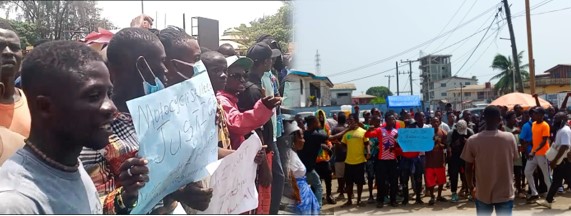
Monrovia — On Monday, hundreds of motorcyclists, many of whom rely on their bikes for their livelihood, took to the streets to protest the government’s recent decision to restrict their access to some of the capital’s main roads.
By Selma Lomax, Jahiem Tumu & Edwin Genoway
For years, commercial motorcycling has served as a vital source of income in Liberia, where formal employment opportunities are scarce. Whether transporting passengers or goods, motorcyclists — often seen as the lifeblood of urban transport — navigate the city’s streets, connecting people to work, markets, and vital services.
A protest Born of Broken Promises
The protests erupted after the government’s failure to honor promises made during the mandatory bike registration process, a scheme that required motorcyclists to pay $350 for insurance, licenses, reflective jackets, and, most importantly, access to the main streets of Monrovia.
The motorcyclists were led to believe that by paying these fees, they would gain the right to operate freely on the capital’s busiest roads.
But recent restrictions, enforced by the Liberia National Police (LNP), have blocked them from accessing these very streets, leaving many feeling cheated and betrayed.
The restrictions were enforced after a tragic incident involving a motorcyclist being struck by a truck with faulty brakes on Johnson Street, near the New Bridge.
In response, the LNP imposed a ban on motorcycles in several key areas of Monrovia, including the city’s main streets, in an attempt to reduce road accidents and improve safety.
But for many of the motorcyclists, this has created a cruel paradox: they paid fees for street access, but now, without access to those roads, they are left with limited options to earn a living.
Beyond the frustration of paying for a service they can no longer use, many motorcyclists are deeply concerned about the toll the ban is taking on their ability to survive. For them, the motorbike is not just a mode of transport but a tool of survival in a country where job opportunities are rare and the formal economy is often inaccessible.
Trokon Reginald Grimes, also known as “Yellow Machine,” a prominent spokesperson for the motorcyclists, emphasized the deep economic need at the heart of their protest.
“We don’t want to steal, we don’t want to be armed robbers. That’s why we choose to ride bikes,” he said. “We want to hustle, we don’t want to steal. Give us our money back and take your main road.”
Grimes went further, accusing the Boakai-Koung administration of dishonesty and criminal behavior. “The government collected our money and bragged that, for the first time in the history of Liberia, they raised the highest revenue,” Grimes said. “Are you telling us this government is criminal? They took our money and now they won’t provide the services we paid for?”
“I’ve not paid my ‘sue sue’ for two weeks. I lost my parents and have no one to depend on,” one rider shared. “I don’t want to steal, I am depending on my motorbike to feed my family. My children were in school, but now they are home because I can’t afford tuition. The government is trying to suppress us. What did we do to them?”
Another rider reflected on the essential role motorcyclists play in the country’s economy. “We are contributors to the economy,” he said. “Since Wednesday, we’ve been protesting to make the government listen to our concerns. We need justice for our colleagues who are currently imprisoned. They should be released. We are important contributors to the economy.”
“We want our money back,” said Frank Moses, a protest leader. “If we cannot ride on the main streets, they should give our money back.”
A call for Accountability and Justice
The protest is not just about money — it is about a demand for justice and accountability. The motorcyclists are calling for the government to not only refund the money they paid but to restore their ability to work on the main streets.
They are also demanding the resignation of Police Inspector General Gregory Coleman, whom they accuse of unfairly targeting their group and enforcing policies that damage their livelihoods.
Despite the ongoing protests, which have remained peaceful, the motorcyclists are firm in their resolve to continue demonstrating until their demands are met. “We agreed that every Monday, until this ban is lifted and we can use our bikes on the main streets again, we will continue protesting peacefully,” said Grimes, reinforcing the motorcyclists’ commitment to their cause.
“We don’t want to steal, we want to survive, and the streets are our only means of survival,” added one rider, capturing the collective sentiment of the group.
Safety or Suppression?
However, the government’s position on the ban remains unchanged. Gregory Coleman, the Inspector General of the Liberia National Police, defended the restrictions, arguing that they are necessary to maintain safety on the country’s roads.
“The country is about 43,000 square miles. We only asked for 15 miles just to have some semblance of safety. Law enforcement should never be political,” Coleman said.
He also pointed to the statistics, arguing that most of the accidents in Monrovia, including fatal ones, are caused by motorcycles and tricycles. “Most of the accidents that led to property destruction and deaths are caused by motorcycles and ‘kehkeh’ (tricycles), and they happen within this corridor [Tubman Boulevard]. We beg them to stay off this main corridor for their own safety. Until otherwise ordered, this ban remains strictly enforced.”
While the police emphasize the need to reduce accidents, the riders feel that they are being unfairly punished for a systemic issue that they did not create.
Support Independent Journalism
Your support helps FrontPage Africa continue delivering independent, credible, and impactful journalism. Every contribution strengthens our ability to investigate, inform, and hold power accountable while keeping quality journalism accessible to our readers.
Support our journalism or subscribe to receive the latest FrontPage Africa stories and updates.