Monrovia _ August 11, 2026: Fishermen in several Liberian fishing communities have reported an increase in registered fishing canoes and fish catches following the government’s reduction of annual licence fees for artisanal fishing vessels.
By Jerry Gaye/Contributing Writer
On November 24, 2025, the government of Liberia, through Vice President Jeremiah Kpan Koung, announced a nationwide decrease in annual fisheries licensing fees, which he said would take effect starting January 1, 2026. The announcement was made at the Commissioning of Liberia’s first Semi-Industrial Fiberglass Fishing Vessel – The Sea King, at the Mesurado Pier, Bushrod Island, Montserrado County.
Vice President Koung announced during the ceremony that operators of paddle-powered canoes would pay US$30 annually, while owners of motorized canoes with engines ranging from one to 15 horsepower would pay US$175. Operators of larger motorized canoes with engines ranging from 16 to 40 horsepower, according to the VP, would pay US$350 annually.
Before the reduction, paddle-powered canoes paid US$50 annually, while motorized canoes with engines of up to 15 horsepower paid US$250. The previous fee for canoes with engines ranging from 16 to 40 horsepower was listed by NaFAA as US$475.
Liberia’s fisheries sector is a major contributor to employment, food security, and economic growth, directly engaging over 40,000 fisherfolks and providing the primary source of protein for about 80% of the population. Artisanal fisheries remain central to coastal livelihoods and local food supply, while industrial fisheries are becoming increasingly important for exports and government revenue, particularly through licensing.
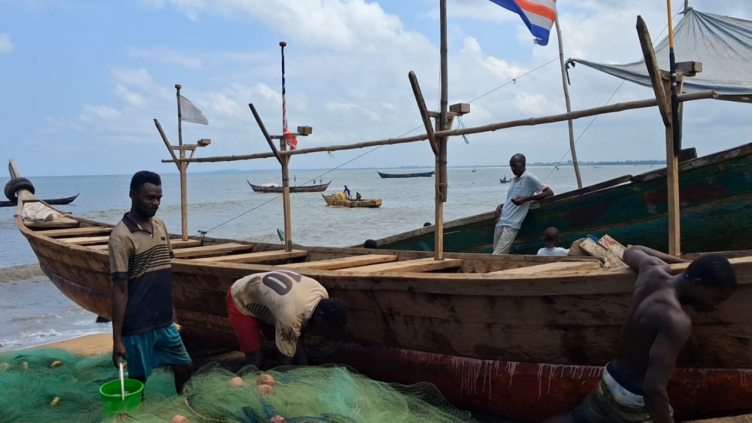
In recent days, this paper visited several fishing communities and spoke with fisherfolks about the impact of the government’s reduction in annual licence fees for artisanal fishing vessels on the industry. Speaking to our reporter in Buchanan and Robertsport cities, the fishermen said the decision by the Liberian government has increased the number of fishing canoes and catches on Liberian shores, thereby reducing the prices of fish in the community.
Ben Blamo, a 46-year-old chief fisherman in the Sekehpol fishing community in Buchanan City, applauded President Boakai for the decision, which he said has contributed to increased production and lower fish prices. “More fish coming because plenty vessels entering the water now; people paying their taxes [licenses] on time because the taxes less now”, he narrated. The 30-year-experienced fisherman explained that he now pays L$5,580.00, or US$30 for his paddle-powered canoe and US$175 for his 8 horsepower canoe as yearly license fees.
The reduction, according to him, has also inspired women to get into the fishing sector and compete with their male counterparts. He narrated that some of the women now own more than one motorized canoe and are doing well in the industry.
One of the women making strides in the Industry is Kumba Boakai-Kulu, a recipient of a World Bank-supported women empowerment grant program which is implemented by Conservation International, or CI, through NaFAA. Currently, Kumba owns three fifteen-horsepower canoes and has two paddle-powered canoes in Robertsport City, Grand Capemount County.
Benjamin Sieh, NaFAA’s Fisheries Inspector, told our reporter that several changes have taken place in Liberia’s fishing industry under the leadership of the Director-General of NaFAA, J. Cyrus Saygbe Sr. Sieh identified the reduction in artisanal fishing licence fees and the digitalization of fisheries licensing as reforms that are improving compliance and supporting domestic fish production.
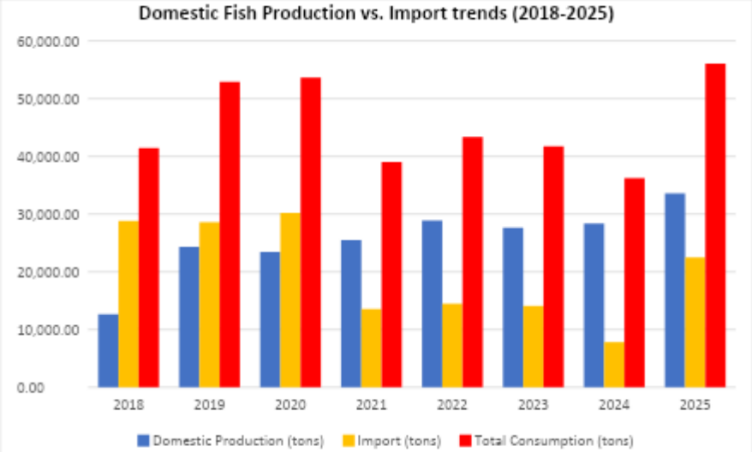
According to him, the lower fees have encouraged more canoe owners to meet their licensing obligations, while the number of new canoes operating in fishing communities continues to increase. He expressed confidence that domestic fish production could eventually surpass previously reported levels and reduce Liberia’s dependence on imported fish.Available figures show that since 2024, domestic fish production has accounted for more than half of Liberia’s estimated fish consumption. In 2025, NaFAA reported annual fish consumption at 45,549 metric tons, with domestic fish production accounting for 25,549 metric tons, representing 56% of the total annual consumption demand. This, according to Sieh, wouldn’t have been possible without the kind of reforms being carried out by Director Saygbe at the fisheries management agency.
Since Director Saygbe resumed the role as Director-General of NaFAA in 2025, the institution has reported several reforms and initiatives, focusing on digitalization, reduced costs for artisanal fishers, improved monitoring, aquaculture development, modern fishing equipment and private-sector investment.
Under his leadership, NaFAA also organized the Kpongama 2026 National Fisheries Investment Conference, which brought together government officials, development partners and private investors to discuss opportunities in Liberia’s fisheries and blue-economy sectors.
The conference highlighted an EU-supported €25 million private-sector development initiative covering artisanal fisheries and sustainable infrastructure. Additionally, in 2026, the agency secured a US$500,000 grant through Oceans5 to support the review and modernization of Liberia’s Fisheries and Aquaculture Management and Development Law of 2019.
Under his watch, NaFAA also registered 533 aquaculture farms from Bong, Nimba, and Lofa counties, respectively.
Support Independent Journalism
Your support helps FrontPage Africa continue delivering independent, credible, and impactful journalism. Every contribution strengthens our ability to investigate, inform, and hold power accountable while keeping quality journalism accessible to our readers.
Support our journalism or subscribe to receive the latest FrontPage Africa stories and updates.