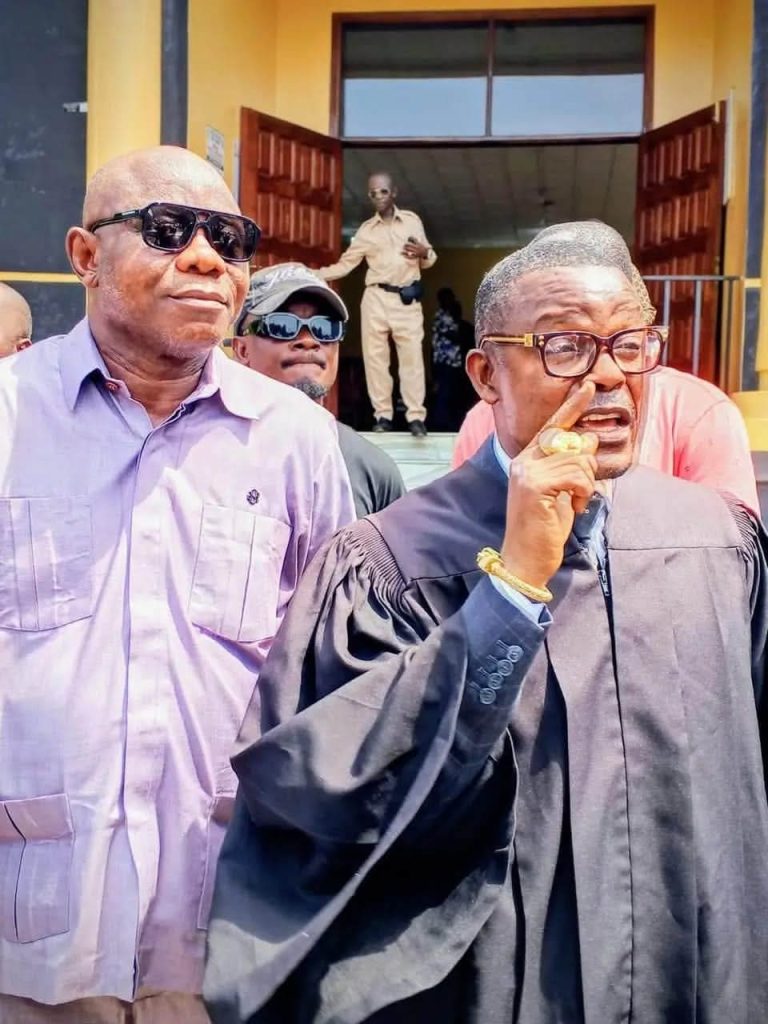
MONROVIA — The Supreme Court of Liberia has intervened in the ongoing legal controversy surrounding the corruption trial of former Finance and Development Planning Minister Samuel D. Tweah Jr. and several former government officials, ordering a temporary suspension of proceedings before Criminal Court “C” pending a hearing on a petition for a writ of prohibition.
By Selma Lomax, [email protected]
The directive from the Supreme Court places a hold on further proceedings in the challenged matter before Criminal Court “C,” where Assigned Circuit Judge Ousman F. Feika has been presiding over proceedings connected to the disputed jury verdict in the high-profile corruption case.
The intervention was communicated through an official notice dated August 3, 2026, from the Office of the Clerk of the Supreme Court. The communication summons Judge Feika to appear before Associate Justice Yussif D. Kaba, who is currently presiding in Chambers, for a conference on Wednesday, August 12, at 3:00 p.m.
Justice Kaba, pending the scheduled conference, has directed that all further proceedings and actions in the matter identified in the petition be stayed. The order effectively prevents Criminal Court “C” from taking additional action on the contested proceedings until the Supreme Court reviews the legal issues raised by the petition.
The Supreme Court’s decision introduces a new judicial dimension to an already complicated case that has attracted considerable public attention because of allegations of jury misconduct and possible interference with the deliberations of jurors. The controversy emerged following the conclusion of the corruption trial involving Tweah and four other former officials of the former government.
Those defendants included former Acting Justice Minister Cllr. Nyenati Tuan, former Financial Intelligence Agency Director Stanley S. Ford, former FIA Comptroller D. Moses P. Cooper, and former National Security Adviser Jefferson Karmoh. They faced allegations including economic sabotage, theft of public funds, money laundering and other related offenses.
The trial ended with a verdict that initially cleared the defendants of the charges. However, questions subsequently surfaced regarding the conduct of some jurors, triggering an inquiry into allegations of misconduct and possible external influence in the jury process.
The jury controversy intensified after three jurors reportedly raised concerns that led to a formal investigation into circumstances surrounding the verdict. The developments eventually prompted Judge Feika to take action against the earlier verdict, with the judge in July setting aside the not-guilty decision involving Tweah and his co-defendants following findings relating to alleged jury misconduct.
Judge Feika’s decision immediately became another major point of contention in the case. Tweah rejected the ruling, challenging the legal basis for overturning the jury’s verdict and further escalating the dispute over the manner in which the case had been handled.
The latest Supreme Court intervention now places the proceedings under the review of the country’s highest court, with the petitioners asking the Supreme Court to examine the actions of the lower court and determine whether the proceedings should be restrained.
The petition for a writ of prohibition names 11 individuals as petitioners. They are Siah J. Tandanpolie, Saah J. Bundoo, Maximum Dillon, Arbertine D. Bah, Jamesetta K. W. Higgins, Lucy T. Menyongai, Joeviria Pinky Bai, Arnold Vincent, George Dennis, Sando Mulbah and Patricia Neewborn.
Named as respondents are Judge Ousman F. Feika, Assigned Circuit Judge of Criminal Court “C,” and the Ministry of Justice.
The petition brings the actions of the lower court before the Supreme Court at a critical stage in the broader controversy. The petitioners are seeking the intervention of the Supreme Court through a writ of prohibition, an extraordinary legal remedy used in circumstances where a party contends that a lower court or judicial officer is acting beyond its lawful authority, exceeding jurisdiction or proceeding in a manner contrary to law.
The Supreme Court’s decision to stay proceedings does not, by itself, resolve the substantive issues raised in the petition. Instead, the suspension preserves the status quo while Justice Kaba considers the arguments and responses that will emerge during the scheduled conference.
Judge Feika’s appearance before Justice Kaba on August 12 is therefore expected to provide an opportunity for the Chambers Justice to hear the issues surrounding the petition and determine the appropriate next legal step.
The development comes as the jury-tampering controversy continues to generate broader questions about the integrity of Liberia’s criminal justice process, particularly regarding the protection of jury deliberations and the authority of trial courts to respond when allegations of juror misconduct arise.
For Tweah and the other former officials, the dispute has transformed what began as a major corruption prosecution into a prolonged legal battle involving not only the original criminal allegations but also the conduct of jurors and the subsequent decision to revisit the verdict.
The Supreme Court’s latest order now places the immediate future of the proceedings before Criminal Court “C” in the hands of the Chambers Justice, with all further action suspended until the petition receives judicial consideration.
The August 12 conference is expected to offer the next significant indication of how the Supreme Court intends to proceed with the prohibition case and whether the challenged actions of Criminal Court “C” will be allowed to continue.If you want, I can also produce 10–20 sharper FrontPage Africa-style headlines from this new angle.
Support Independent Journalism
Your support helps FrontPage Africa continue delivering independent, credible, and impactful journalism. Every contribution strengthens our ability to investigate, inform, and hold power accountable while keeping quality journalism accessible to our readers.
Support our journalism or subscribe to receive the latest FrontPage Africa stories and updates.