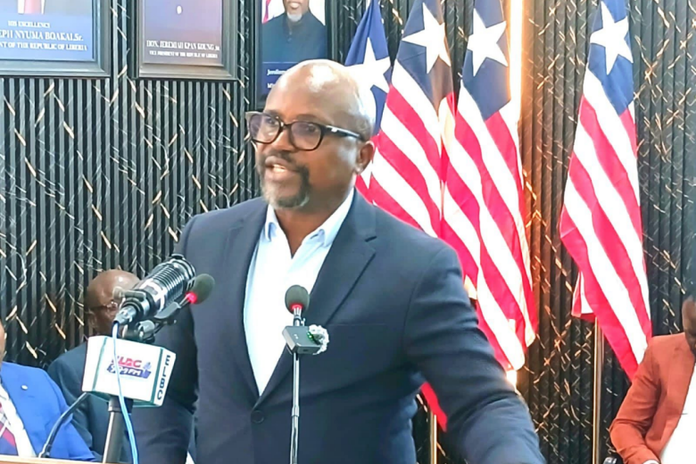
MONROVIA – APM Terminals Liberia, terminal operator at the Freeport of Monrovia, says it recognizes the pressure that current congestion of the port infrastructure and shipping delays are placing on importers, the business community and consumers.
In partnership with the National Port Authority and other port stakeholders, APM Terminals Liberia is implementing measures to increase terminal capacity instantly, improving the movement of containers and supporting a more efficient flow of cargo through Liberia’s main trade gateway.
“We acknowledge the congestion at the port and the impact it is having on our customers and businesses in Liberia. Our immediate focus is on improving the areas within our responsibility, particularly terminal capacity and the movement of containers through and out of the port.’’– Rachid Baho, Managing Director Some of the concrete measures taken from the terminal are to free up space by transferring hundreds of longstanding import containers from the full import area to another area of the Port to free up space to receive new import containers, removing buildings inside the terminal and converting the space to container stacking areas, as well as develop yard space, which is currently unpaved.
The impact of some of this work will have an effect within one week while others will deliver additional capacity in the coming months.
It is important to underline that for the long-term solutions – a collaborative reply to the issues from all stakeholders involved is needed, says Rachid Baho.
“Sustainable improvement requires coordinated action across the entire port community to solve the problem with containers not getting out of the terminal fast enough to create space for new cargo coming in,” he explains.
A GROWING PORT UNDER PRESSURE
Liberia’s container trade has grown significantly, with current volumes approaching 200,000 TEU annually – equal to about 30 per cent container volume growth within two years.
APM Terminals Liberia says that growth is positive for the economy and has to date invested USD 15 million in new container equipment, as e.g. reach stackers and other container handling equipment.
But growth needs to go hand in hand with a full ecosystem that is up to speed to handle the volumes in order not to create constraints to the supply chain.
The National Port Authority has publicly acknowledged the increasing pressure on the Freeport as the number and size of vessels serving Liberia grow.
NPA has announced plans for dredging and further expansion of the port’s capacity.
Against this backdrop, APM Terminals Liberia says improving the movement of containers out of the terminal after discharge is equally critical to restoring sustainable cargo flow.
“We have already committed to further investments than the ones already implemented this year – for instance in a third mobile harbor crane and additional terminal equipment to arrive in the new year. And we have a clear interest in always keeping the flow in the terminal fluent. However to put it simply, if you keep filling a container yard without making clear plans for how to empty is again – it is like filling a parking garage with cars and no one coming to drive away again: you will end up with no empty spaces left and new drivers coming will have to wait outside. We must solve the underlying issues together for the long-term.”
In other words, containers occupy valuable yard space until they are cleared and collected. If imports leave the terminal more slowly than new containers arrive, congestion builds and available capacity falls.
APM Terminals Liberia estimates that at least 250 import containers need to leave the terminal each day to maintain a sustainable flow.
However, only about 170 import containers are delivered on average daily, creating a huge imbalance in the terminals discharge capability vs number of containers taken by consignees daily.
The current dwell time going from 7-8 days in 2025 to 15-16 days in 2026 has effectively reduced the storage capacity in Freeport of Monrovia by almost 50%. Addressing all the touchpoints in the process of handling containers is therefore crucial for the future cargo flow – this includes vessel scheduling, terminal handling, customs and inspection, documentation, trucking and the timely collection of containers by importers.
APM Terminals Liberia therefore says it will continue working with the Government of Liberia, the National Port Authority, Liberia Revenue Authority Customs, shipping lines, Customs Brokers, Trickers Union, Consignees and other members of the port community to address the immediate situation.
BIG SURGE INTO WEST AFRICA CREATES DELAYS IN MONROVIA
To understand the full context of the issue, Liberia is currently handling, it is important to look at the journey each container takes before it reaches Freeport of Monrovia from, e.g. China.
Much of Liberia’s containerized cargo currently connects through major West African transshipment hubs that currently experience similar pressure with waiting time for vessels.
Congestion at those hubs can lead to missed connections, cargo accumulation and disruptions to vessel schedules before cargo reaches Liberia.
This distinction is important as public discussion around shipping delays continues.
Recent reports before the Legislature have referred to containers spending more than 30 days at sea before berthing in Monrovia.
Therefore, APM Terminals actively works with shipping lines to mitigate the issue of transshipment and has now confirmed a new direct service with A. P. Moller – Maersk to minimize the exposure of transshipment congested-delays.
“It will be a significant improvement for Monrovia that from January 2027, APM Terminals Liberia and Maersk has joined forces to make Monrovia the first port call for the W5A-service.’’
APM TERMINALS EXPANDING CAPACITY
Alongside efforts to improve container evacuation, APM Terminals Liberia is increasing capacity within the terminal. Measures underway include: • Creating additional container stacking capacity • Developing additional yard space • Adding a third Mobile Harbour Crane • Adding three Reach Stackers and two Empty Container Handlers; and • Adding five Terminal Trucks and two Spreaders These measures are intended to provide additional operating space and equipment capacity as Liberia’s container volumes continue to grow.
This will allow Liberia-bound cargo on the service to be discharged directly in Monrovia rather than being transshipped through Abidjan. I believe this will improve reliability and reduce the risk of delays happening elsewhere in the system,” says Rachid Baho.
BUILDING CAPACITY FOR LIBERIA’S GROWING TRADE
While the immediate priority is to improve cargo flow and ease congestion, the longer-term priority is ensuring that the Freeport has the marine infrastructure, terminal capacity, equipment and supporting processes required to accommodate Liberia’s future trade growth.
Planned direct service, additional equipment, expanded terminal capacity and the NPA’s wider port infrastructure initiatives are complementary steps toward building a more reliable and resilient gateway for Liberia.
APM Terminals Liberia remains committed to working with the Government through the National Port Authority, customers and the wider port community to address the present challenges and strengthen the Freeport of Monrovia as Liberia’s principal gateway to international trade.
Support Independent Journalism
Your support helps FrontPage Africa continue delivering independent, credible, and impactful journalism. Every contribution strengthens our ability to investigate, inform, and hold power accountable while keeping quality journalism accessible to our readers.
Support our journalism or subscribe to receive the latest FrontPage Africa stories and updates.