MONROVIA — In 2014, when Ebola swept through Liberia, the country’s health system was already struggling under the weight of years of conflict and limited resources. At the time, there were approximately 45 doctors in the public health system serving a population of nearly 4.5 million people.
By Patience M. Jones
For Dr. Maxo Luma, that reality offers one of the clearest lessons of Liberia’s health crisis: an emergency may be unpredictable, but the vulnerability that allows it to become catastrophic is not.
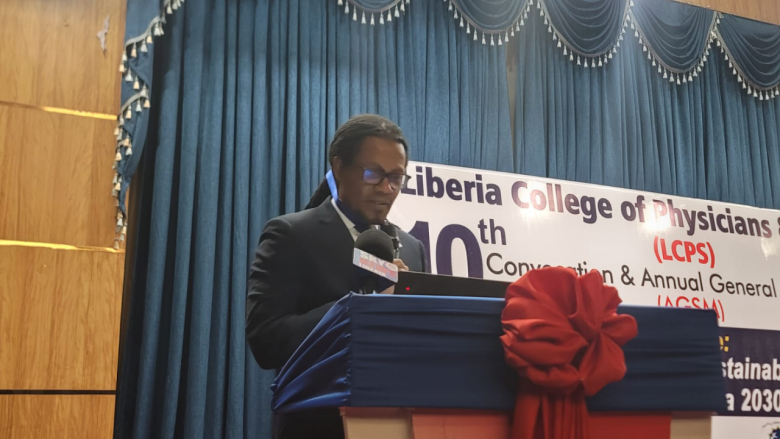
“Ebola was the spark, but a weakened and under-resourced health system served as fuel,” Dr. Luma said Thursday, as he delivered the keynote address at the 10th Annual General Scientific Meeting of the Liberia College of Physicians and Surgeons (LCPS).
Held at the Ellen Johnson Sirleaf Ministerial Complex in Congo Town, the two-day scientific meeting is being held under the theme, “Resilient, Equitable, and Sustainable Health Systems for Liberia 2030,” with discussions focusing on health systems strengthening, health financing, workforce education, digital health, emergency preparedness, climate change and One Health.
Dr. Luma, reflecting on Liberia’s experience with war, Ebola and COVID-19, said the country must move beyond repeatedly rebuilding after crises toward developing a health system capable of absorbing future shocks without starting over.
“Recovery is important. It is necessary because it does save lives,” he said. “Yet recovery alone keeps us trapped in a cycle of rebuilding what was lost.”
According to him, the real challenge is whether Liberia can build a health system that remains functional when the next crisis arrives.
“A resilient health system does not stop functioning every time a crisis emerges. It absorbs the shock. It adapts. It learns. It evolves. Most importantly, it continues serving people when they need it most,” Dr. Luma said.
From a Fragile System to Local Specialist Training
For Liberia, the journey toward resilience is also increasingly reflected in the growth of local medical training.
The Liberia College of Physicians and Surgeons, established to provide postgraduate specialist medical education in the country, has trained 166 specialist doctors across multiple disciplines since residency training began in 2013, according to the College.
The development stands in sharp contrast to the years when Liberian doctors seeking specialist training often had to leave the country.
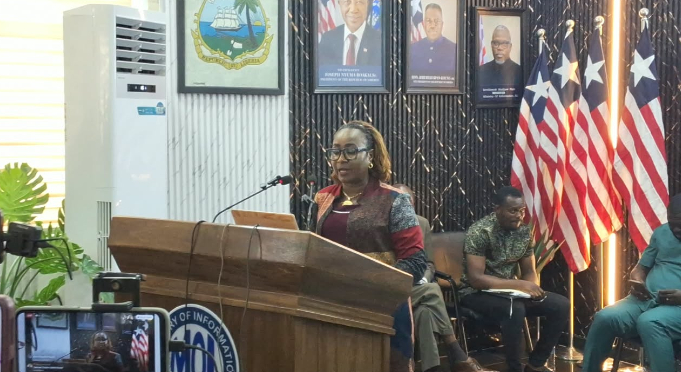
Speaking on behalf of Health Minister Dr. Louise Kpoto and Chief Medical Officer Dr. Catherine Thomas Cooper, Assistant Minister of Health for Curative Services, Dr. Teyah S. Moore, described the establishment and growth of LCPS as an important development for Liberia’s health sector.
“Years back, if you wanted to specialise in Liberia, you had to fly out of the country,” Dr. Moore told participants.
She recalled being among those who benefited from the College, noting that she is herself a product of LCPS and now serves within the Ministry of Health.
Dr. Moore urged Liberians not to underestimate institutions established locally, stressing that LCPS-trained specialists are increasingly playing key roles in the country’s health sector.
She said Liberia must continue strengthening local postgraduate training while addressing the broader challenge of retaining trained health professionals.
Eleven More Specialists Set to Join the Health Sector
The 10th Scientific Assembly and Convocation will further expand Liberia’s pool of locally trained specialists, with 11 doctors expected to graduate in four disciplines.
They include two specialists in Pediatrics, three in Internal Medicine, one in Obstetrics and Gynecology, and five in Surgery.
For a country that has historically depended heavily on foreign-trained professionals and international partners, the continued production of specialists locally represents an important part of building national capacity.
Dr. Luma, however, cautioned that training health professionals is only one part of the equation.
“Training, equitably deploying, and retaining Liberian health professionals” must be central to sustainability, he said.
“The future of Liberia’s health system must be designed, led, and sustained by Liberians,” Dr. Luma added, while noting that international partnerships should continue to support and accelerate progress.
Five-Year Accreditation for Community Health
The scientific gathering comes days after LCPS’s Faculty of Community Health received a five-year accreditation from the West African College of Physicians (WACP).
The accreditation followed a comprehensive assessment of the Community Health residency program conducted in June 2026 by a three-member WACP delegation led by Accrediting Officer Professor Hadiza Agbo.
The assessment examined the program’s faculty, training environment, clinical facilities, learning resources and practical training opportunities at Redemption Hospital and John F. Kennedy Medical Center.
WACP subsequently commended LCPS for strengthening its residency programs and expanding its institutional capacity.
The accreditation is particularly significant for Community Health, a field that supports disease prevention, health promotion, health education, disease surveillance, research and community-based healthcare.
Building Resilience from the Community Up
Dr. Luma said Liberia’s community health workforce is another example of how the country has begun shifting its approach to health-system resilience.
He pointed to the growing network of Community Health Assistants, saying thousands of trained community health workers now serve communities across Liberia.
“They identify threats early. They connect communities to care. They strengthen surveillance. They absorb pressure before small problems become gigantic ones,” he said.
According to Dr. Luma, this means Liberia’s first line of defence against health threats is increasingly found within communities rather than only at major referral hospitals.
“The first line of defence now is pretty much the community itself,” he said.
The Question of Sustainability
The keynote speaker also placed Liberia’s health future against the backdrop of changing international health financing.
He said recent reductions in international health funding have created difficulties for countries, including Liberia, but argued that the situation also presents an opportunity for the country to strengthen domestic ownership of its health system.
“Can a health system be truly resilient if it depends strongly on international funding?” Dr. Luma asked participants, leaving the question for policymakers and health-sector actors to consider.
He argued that projects may end, funding cycles may change and international partners may come and go, but the health needs of Liberians remain.
“The patient’s need doesn’t disappear when a grant expires,” he said.
Dr. Luma called for increased domestic investment, stronger primary healthcare, improved retention of health professionals and greater national ownership of health-sector systems.
Innovation, Equity and the Liberia of 2030
Using Partners In Health’s five-S framework — Staff, Stuff, Space, Systems and Social Support — Dr. Luma said resilience cannot be built through a single investment.
He stressed the importance of strong leadership, governance, health-information systems, financing, planning and accountability, alongside digital technologies such as electronic medical records, telemedicine and interoperable health-information systems.
But he cautioned that technology alone cannot define innovation.
“Innovation is not simply about technology. It is about finding better ways to solve persistent challenges and improve the health of the people we serve,” he said.
He also emphasized that resilience without equity could still leave vulnerable populations behind.
“A resilient health system for some is not a resilient health system,” Dr. Luma said.
He called for continued efforts to address disparities between urban and rural communities, improve the equitable distribution of health workers, ensure the availability of medicines and supplies, reduce financial barriers to healthcare and pay particular attention to women and girls, children, persons living with disabilities and other underserved populations.
As Liberia looks toward 2030, Dr. Luma said the country’s health system must be resilient, equitable, sustainable, digitally enabled, climate-aware, community-centered and locally led.
For the LCPS, the growing number of locally trained specialists and the latest five-year accreditation represent tangible steps in that direction.
But the message from the scientific gathering was clear: producing more doctors is only part of the journey.
Liberia must also create the systems, financing, working conditions and opportunities that enable those professionals to remain, serve communities and help build a health system capable of standing when the next crisis comes.
“The future belongs not to systems that simply react to change, but to those that anticipate it, adapt to it, and lead it,” Dr. Luma said.
“And if we commit ourselves to that vision, when the next unpredictable storm arrives, our health system will not simply recover. It will stand firm, adapt, innovate, and continue serving every Liberian.”
Support Independent Journalism
Your support helps FrontPage Africa continue delivering independent, credible, and impactful journalism. Every contribution strengthens our ability to investigate, inform, and hold power accountable while keeping quality journalism accessible to our readers.
Support our journalism or subscribe to receive the latest FrontPage Africa stories and updates.