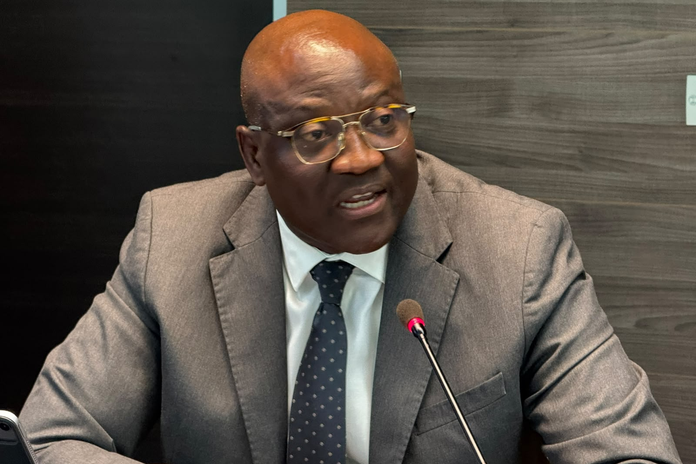
Monrovia – Finance and Development Planning Minister Augustine K. Ngafuan says the Boakai-Koung administration has restructured comprehensive, robust, and ambitious measures aimed at exceeding the previous domestic revenue generation of 2024 to maintain economic stability.
By Jaheim T. Tumu- [email protected]
In its debut year, the Boakai-Koung administration, through an improved domestic resource mobilization effort, raised nearly US$700 million in domestic revenue, arguably the highest ever in the nation’s history.
Ngafuan said, “This year, we are taking more robust measures aimed at meeting or exceeding our ambitious revenue generation targets. Our strategy quintessentially involves leveraging technology in revenue generation, plugging revenue leakages, demanding more from the government in the negotiation of concessions and other agreements, and tapping on new revenue sources.”
Delivering his keynote message at the 216th birth anniversary celebration of Liberia’s first president, Joseph Jenkins Roberts, Ngafuan said that the government is exerting more effort to prioritize education, despite challenges from recent cuts in foreign aid.
Minister Ngafuan, a beneficiary of the Joseph Jenkins Roberts Educational Foundation’s scholarship program, highlighted the crucial role of education in Liberia’s future development and prosperity. He described the former President’s legacy as a ‘visionary investment’ which continues to impact generations of Liberian students.
“I count myself truly blessed to have been the beneficiary of scholarship awards from high school straight to graduate school,” Ngafuan shared, reflecting on how his life was transformed by the support of those who believed in the power of education. “What would I have become if, at various junctures in my life, had men and women of heart, including our honored dead, Joseph Jenkins Roberts, not extended a hand of support?”
Ngafuan’s comments come amid growing concerns following recent cuts to USAID funding to Liberia, which has raised alarms over the country’s reliance on foreign aid.
In response, the government has adopted a multifaceted approach to managing aid reduction, focusing on rationalizing expenditure, stepping up domestic revenue mobilization, and forging stronger partnerships with international partners.
“We are proactively taking steps to reduce government spending on items and activities considered less critical,” Ngafuan explained. “We are prioritizing expenditure on roads and bridges and stepping up support to the health and education sectors to mitigate the impact of the USAID aid cut.”
Ngafuan also emphasized the importance of leveraging technology to plug revenue leakages and improve tax collection. “We will not retreat in the face of challenges,” he asserted. “When others retreat on us, especially with the gutting of significant aid under USAID, that’s precisely the time we must take ourselves more seriously.”
He stressed the importance of partnerships, particularly in the area of education, emphasizing that the government’s commitment to improving human capital development as a key pillar of the country’s five-year ARREST Agenda for Inclusive Development (AAID), which aims to mobilize US$2.36 billion for education and other sectors.
“The surest way to take our people from poverty is to spread the light of education,” Ngafuan said, quoting the famous Chinese philosopher Confucius: “If your plan is for one year, plant rice; if your plan is for ten years, plant trees; if your plan is for one hundred years, educate children.”
In his remarks that also resonated with the theme, “Forging Greater Partnerships for the Development and Enhancement of Quality Education for Liberian Children,” Ngafuan disclosed the government’s plans to build, renovate, and expand climate-resilient educational infrastructures across the country, with a focus on Science, Technology, Engineering, and Mathematics (STEM) education and increasing enrollment rates for children with disabilities.
Accordingly, he said in partnership with international organizations such as the Global Partnership for Education (GPE) and the World Bank, Liberia is launching the Excellence in Learning Project (EXCEL) to improve foundational learning, particularly in Early Childhood Education and Basic Education.
He, however, announced the return of the Ministry of Finance’s internship program, which will resume in 2025, with a focus on providing young Liberians, including JJ Roberts scholars, with practical experience in government. The program is expected to continue the legacy of mentorship and support that has been a hallmark of the JJ Roberts Educational Foundation.
“Through partnerships like the one we forged with the JJ Roberts Scholarship Students Association in 2011, we have seen positive results, with many of those interns growing into key roles within the Ministry of Finance,” Ngafuan said.
Ngafuan, who lauded Roberts’s empathy, foresight, and dedication to the education of future generations, called on Liberians to collectively engage in supporting young people through education.
“We cannot make everyone in the world behave like JJ Roberts, but we must ensure that his example lives on in our actions,” he concluded. “It’s our collective responsibility to ensure that no Liberian child is left behind.”
Support Independent Journalism
Your support helps FrontPage Africa continue delivering independent, credible, and impactful journalism. Every contribution strengthens our ability to investigate, inform, and hold power accountable while keeping quality journalism accessible to our readers.
Support our journalism or subscribe to receive the latest FrontPage Africa stories and updates.